
60–100 TPH Four-Unit Mobile Crushing Plant for Mining & Construction
What Is a 60–100 TPH Four-Unit Mobile Crushing Plant?
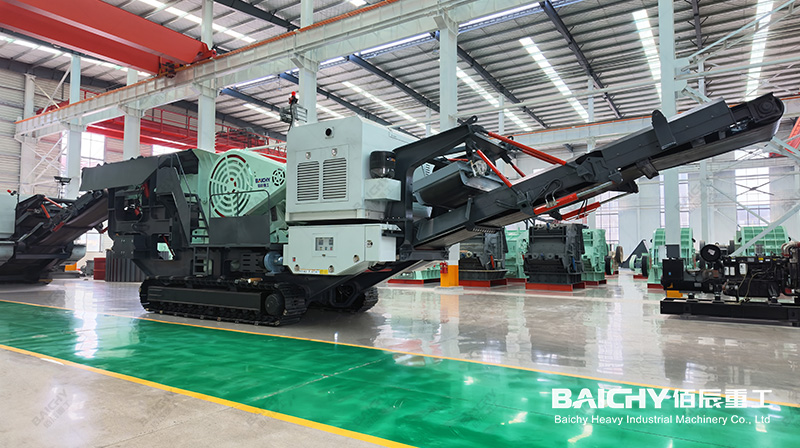
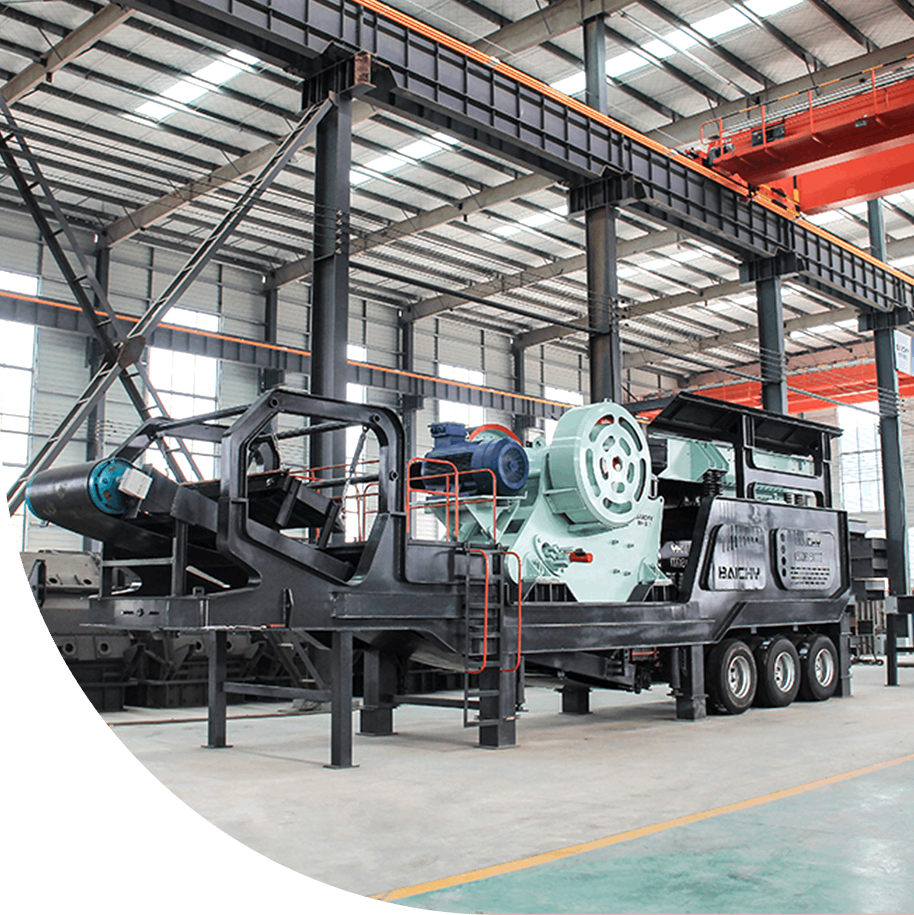
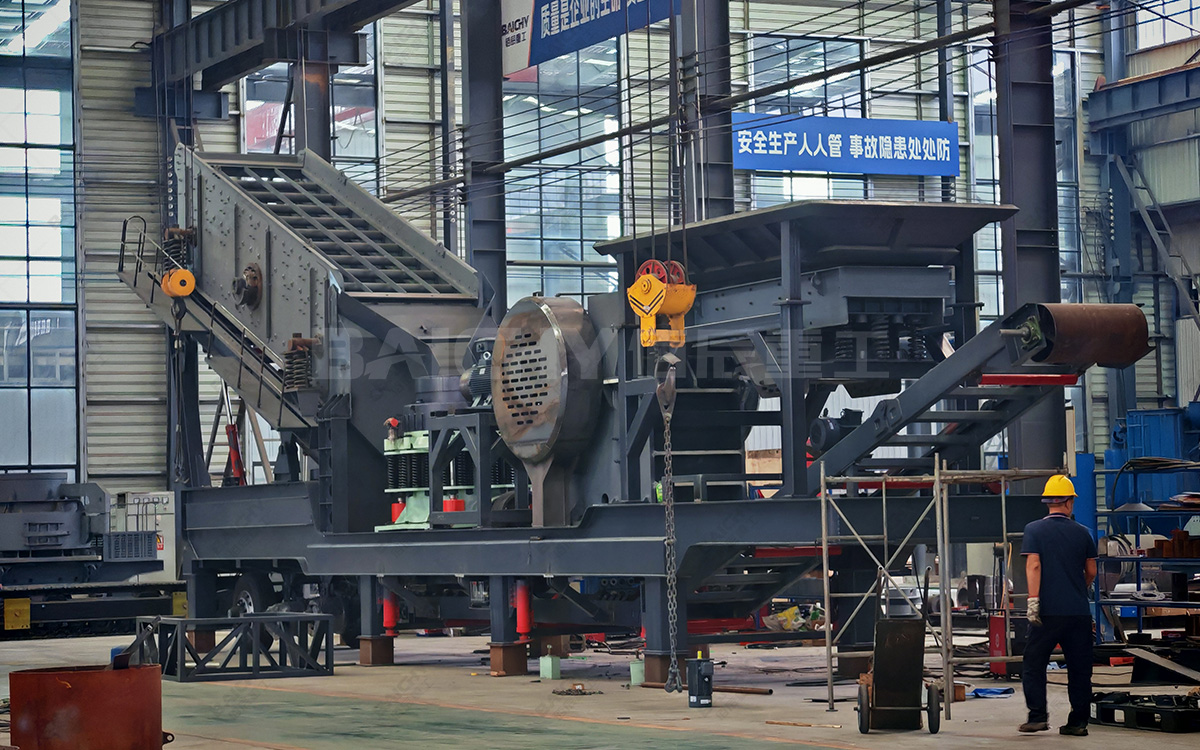
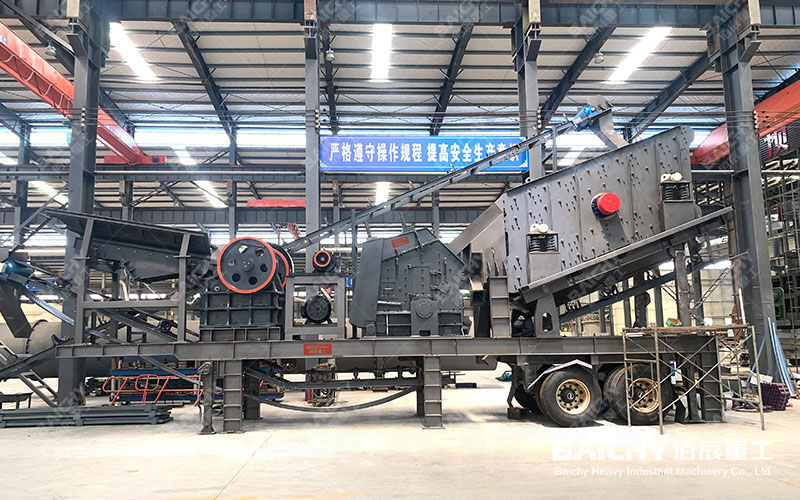
A 60–100 TPH four-unit mobile crushing plant is a complete, transportable crushing line built from four independent modules: a vibrating feeder, a primary jaw crusher, a secondary cone or impact crusher, and a screening unit. Each module rides its own chassis — tyre-type for road towing, track-type for rough pit floors — with its own motor, hydraulics and control cabinet.
Because every unit is self-contained, the whole mobile crushing plant can be hauled to a new face on standard trailers, linked by belt conveyors, and commissioned in one to two days with no concrete foundations. For contractors on 12–36 month quarry licences or urban demolition sites, that mobility is the difference between one plant serving five sites and five stationary lines sitting idle.
How Material Flows Through the Four Modules
Feeding unit — a grizzly feeder scalps out fines and soil and feeds the jaw crusher at a steady rate, which is what keeps a mobile crushing plant at rated output instead of cycling between starving and choking.
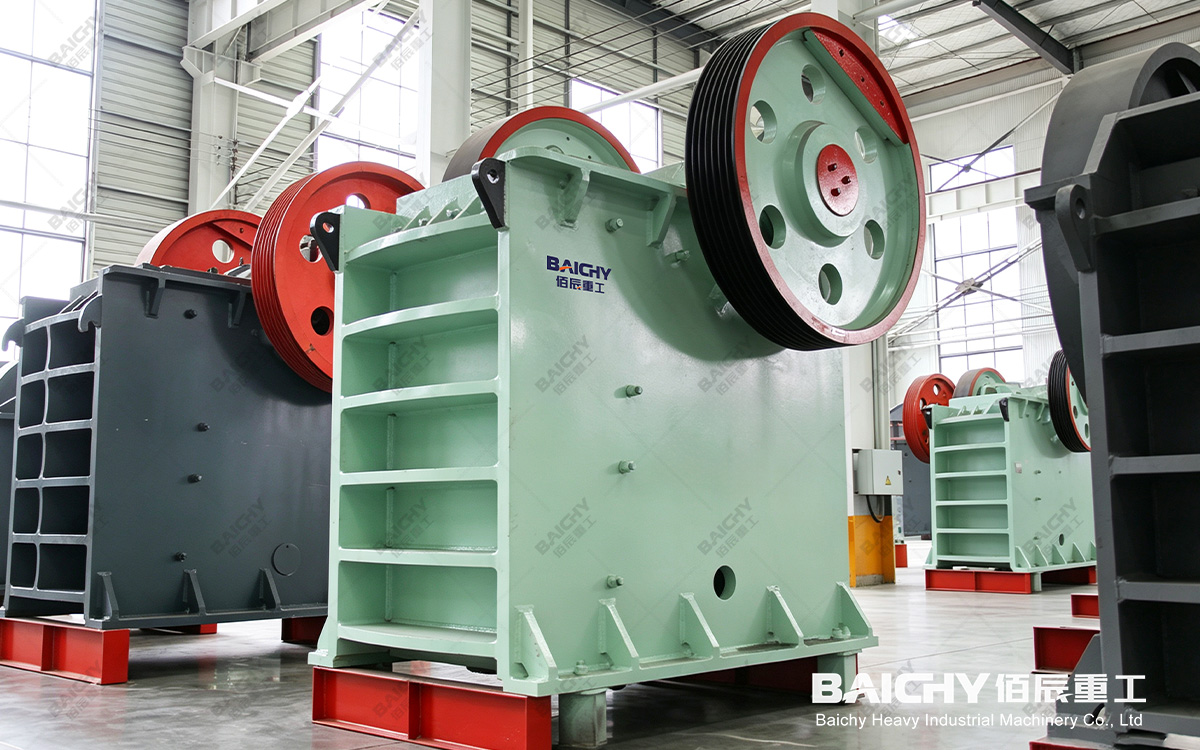
Primary unit — a PE-600×900 jaw crusher reduces 500 mm feed to 100–150 mm.
Secondary unit — an HST160 cone or PF-1214 impact crusher brings material to 0–40 mm. Cone versus impact is the biggest decision in the whole configuration.
Screening unit — a 3-deck screen separates saleable fractions; oversize returns to the secondary crusher in closed circuit. That closed circuit is why a four-unit mobile crushing plant ships in-spec, cubical aggregate rather than a random size spread.
60–100 TPH Four-Unit Mobile Crushing Plant Specifications
Capacities below are measured on medium-hard rock (120–180 MPa) at 1.6 t/m³ bulk density; limestone runs toward the top of the range.
| Module | Equipment (Baichy) | Key specification | Throughput | Power |
|---|---|---|---|---|
| 1. Feeding | APG-3895W grizzly feeder, 8 m³ hopper | Trough 3800 × 950 mm, grizzly 100 mm | 100–160 tph | 11 kW |
| 2. Primary | PE-600×900 jaw crusher | Feed 600 × 900 mm, max 500 mm, CSS 65–160 mm | 80–160 tph | 75 kW |
| 3. Secondary | HST160 cone or PF-1214 impact | Cone CSS 16–38 mm; rotor Ø1250 × 1400 mm | 70–140 tph | 132 / 110 kW |
| 4. Screening | 3YK1860 inclined screen | 3 decks, 1800 × 6000 mm, mesh 5–30 mm | 80–150 tph | 22 kW |
| Conveyors | B800 main + B650 return | 15–25 m each, 1.0–1.6 m/s | Matched | 5.5–11 kW |
| Plant total | Four-unit mobile crushing plant | Fractions 0–5 / 5–10 / 10–20 / 20–31.5 mm | 60–100 tph | ≈260–300 kW |
Each module stays within 13.5 m × 3.0 m × 4.2 m, so the line ships in 40 ft flat-rack containers without special permits in most markets.
Where This Mobile Crushing Plant Delivers the Most Value
Quarrying and Aggregate Production
For granite, basalt and river-pebble quarries feeding a ready-mix or asphalt plant, a 60–100 tph mobile crushing plant is the sweet spot: big enough to supply 1,500–2,500 m³ of aggregate per day, small enough to move when the face advances. The four-unit layout produces three or four saleable fractions at once.
Construction and Demolition Waste Recycling
Urban demolition sites rarely justify a permanent plant. A tyre-mounted combination processes reinforced concrete into 0–31.5 mm recycled sub-base on site and leaves when the job clears. An optional magnetic separator on the return conveyor removes rebar — popular with contractors in the EU and the Gulf.
Small and Mid-Scale Mining
Gold, copper, iron and manganese operations use this setup for pre-crushing ahead of a ball mill or as a standalone ore-sizing line at the pit mouth. In remote mining regions of Africa, Central Asia and South America, moving the crushing plant toward the face cuts haul-truck cycle time by 20–35%.
60-100 TPH Four-Unit Mobile Crushing Plant
Four-Unit vs. Three-Unit vs. Single-Unit Mobile Crushers
More modules means more control over gradation and particle shape — and more conveyors, horsepower and set-up time. A single mobile jaw crusher suits simple boulder reduction; a three-unit plant (feeder + jaw + screen) works when one crushing stage is enough. Choose the four-unit mobile crushing plant when you need two crushing stages plus closed-circuit screening to hit a specification such as railway ballast, highway base course or manufactured sand feed.
Configuring for Hard Rock vs. Limestone
• Hard rock (granite, basalt, river pebble): specify jaw + cone. The HST160 hydraulic cone holds a stable closed-side setting, produces the cubical shape high-grade concrete aggregate requires, and clears tramp iron hydraulically. Wear cost: about USD 0.35–0.60 per tonne.
• Medium-hard rock (limestone, dolomite): specify jaw + impact. An impact crusher gives a higher reduction ratio, lower specific energy and better sand shape at lower capital cost. Wear cost: about USD 0.20–0.35 per tonne.
• Fifth module: add a VSI downstream of the screen for 0–5 mm manufactured sand with a fineness modulus of 2.6–3.0, meeting most ASTM C33 / EN 12620 bands.
Power and Daily Operating Cost
Baichy offers full electric (grid or genset), diesel-electric hybrid, and full diesel packages; the hybrid is the most requested for mining sites without reliable grid power. Under load the plant draws 190–240 kWh per hour (about 2.0–2.8 kWh per tonne), runs on a crew of two operators plus one loader operator, and relocates in 8–16 hours. Budget 30 minutes per shift for wear and lubrication inspection.
Maintenance Checklist That Protects Uptime
Check jaw and cone liner wear each shift; rotate jaw dies at 40% wear.
Log closed-side settings daily — a drifting CSS is the earliest sign of hydraulic trouble.
Inspect belt tracking and skirt rubber weekly; most unplanned stops come from belts, not the crusher.
Grease screen bearings on a fixed hourly schedule; bearing failure is silent until it stops.
Keep spare jaw dies, a cone mantle and screen mesh on site — freight kills uptime, not part cost.
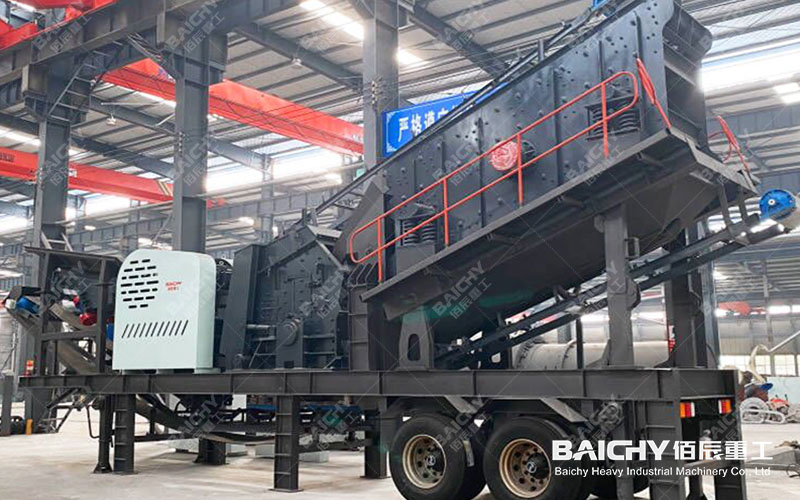
four-unit mobile crushing plant
Recommended Configurations at a Glance
| Feed material | Four-unit setup | End use | Output | Wear cost |
|---|---|---|---|---|
| Granite, basalt | Feeder + jaw + cone + screen | Base course, ballast | 60–80 tph | USD 0.35–0.60/t |
| Limestone, dolomite | Feeder + jaw + impact + screen | Manufactured sand, concrete aggregate | 80–100 tph | USD 0.20–0.35/t |
| River pebble | Feeder + jaw + short-head cone + screen | High-grade aggregate | 70–90 tph | USD 0.30–0.50/t |
| C&D waste | Feeder + jaw + impact + screen + magnet | Recycled sub-base | 70–100 tph | USD 0.15–0.30/t |
Frequently Asked Questions
1. What does "four-unit" mean in a mobile crushing plant?
The line uses four self-contained chassis — feeding, primary crushing, secondary crushing and screening — linked by belt conveyors. Unlike a single mobile crusher, a four-unit mobile crushing plant produces sized, specification-ready aggregate in one pass because oversize returns to the secondary crusher in closed circuit.
2. How much does a 60–100 TPH four-unit mobile crushing plant cost?
Indicatively USD 180,000–450,000, depending on crusher type, chassis (tracked costs more than tyre-mounted), engine package and options such as a VSI or magnetic separator. Baichy issues a firm quotation after reviewing rock type, feed size and required gradation.
3. Can the plant run without grid power?
Yes. The diesel-electric hybrid package carries an on-board genset sized for the full 260–300 kW load, so the mobile crushing plant works at remote mine sites and greenfield quarries. Grid-electric units cost about 12–18% less to buy where power is available.
4. How long do installation and relocation take?
First commissioning takes 1–2 days with a four-person crew and a crane, with no concrete foundations — modules are levelled on outriggers or steel plates. Later relocations take 8–16 hours.
5. What finished aggregate sizes can it produce?
Standard decks give 0–5, 5–10, 10–20 and 20–31.5 mm fractions. A VSI module converts the 0–5 mm fraction into specification manufactured sand, and a magnetic separator makes the line suitable for reinforced demolition waste.
Why Source Your Mobile Crushing Plant from Baichy Heavy Industry
Baichy Heavy Industry designs, manufactures and commissions complete crushing, grinding and mineral processing lines from its Henan, China facility, with plants running in more than 90 countries across Southeast Asia, Africa, the Middle East, South America and Central Asia. Every four-unit mobile crushing plant ships with wear parts, English documentation and remote commissioning support. Send us your rock type, feed size, target capacity and product specification — our engineers return a matched configuration drawing and quotation within 24 hours.
Baichy Heavy Industry
Baichy Heavy Industry is a high-tech mining equipment company integrating R&D, manufacturing, sales, and after-sales service. Focusing on crushing, grinding, and mineral processing equipment, we provide professional solutions to our customers. We are ISO9001:2015 、certified, and our products include mobile crushing palnts, crawler crushing plant, construction waste crushing plants, jaw crushers, sand making machines, cone crushers, fine crushers, grinding mills, ball mills, etc., all with reliable performance to meet diverse project needs.
Baichy Heavy Industry – Your Trusted Partner
To ensure optimal performance of your equipment, Baichy Heavy Industry offers:
- Professional on-site installation guidance
- Comprehensive operator training
- 24/7 technical support & maintenance services
Our complete after-sales service system guarantees long-term, stable operation of your machinery with minimal downtime.
Protect Your Rights – Only Use Official Channels
To avoid scams and ensure authentic support, contact us exclusively through:
• Official Website: www.baichychina.com
• WhatsApp: +8615093222637
• Email: [email protected]
Your satisfaction is our priority – expect prompt, professional service every time.
(Note: Beware of unauthorized third parties claiming to represent Baichy. Always verify through official contacts.)