
Energy-Efficient Gold Ore Ball Mills
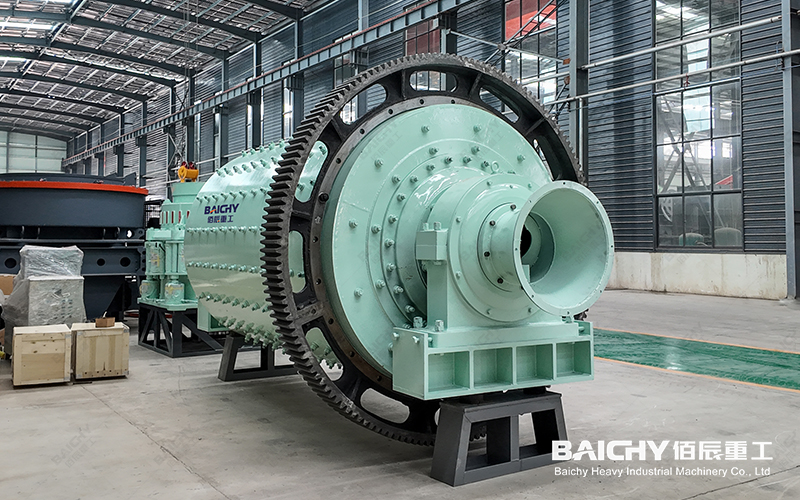
By replacing sliding bearings with rolling bearings and optimizing the liner structure, energy-saving ball mills can reduce energy consumption in gold ore grinding by 10%–30% and boost gold recovery rates by 0.5%–2%. Consequently, they serve as a pivotal piece of equipment in the development of "Green Mines."
1. Core Energy-Saving Technology: Structural Innovation Drives a Leap in Energy Efficiency
The core competitive advantage of the energy-saving ball mill lies in transforming high-friction sliding contact into low-friction rolling contact, while simultaneously optimizing grinding dynamics.
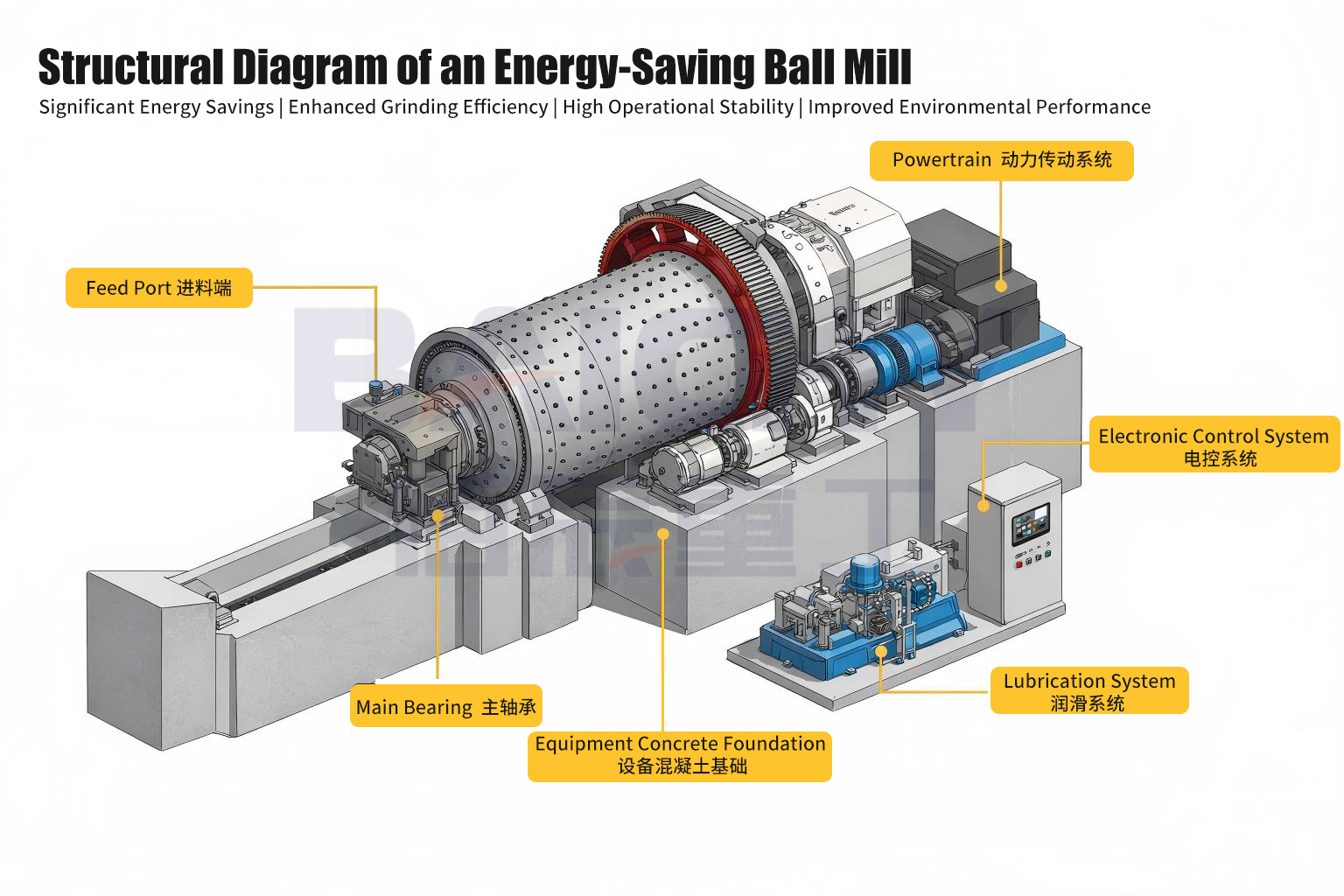
Structural-Diagram-of-an-Energy-Saving-Ball-Mill
| Structural Component | Traditional Ball Mill (Baseline) | Energy-Saving Ball Mill (Improved) | Energy-Saving Principle & Effect |
| Main Bearings | Sliding Bearings (Journal Bearings) | Double-Row Spherical Roller Bearings | Friction coefficient reduced by 90%; starting current lowered; energy consumption per unit reduced by 10%–15%. |
| Liner Design | Smooth Liners | Wavy / Grooved / Step Liners | Increases the lifting height of grinding balls; eliminates "slippage"; grinding efficiency improved by 15%. |
| Discharge System | Small Aperture, Gravity Discharge | Large-Diameter Forced Discharge | Rapid discharge of qualified fine particles; minimizes over-grinding; processing capacity increased by 15%–25%. |
| Drive Control | Fixed Frequency/Speed, Direct Start | Variable Frequency Drive (VFD) | Soft start protects the power grid; grinding speed adjusts in real-time based on ore hardness; eliminates energy waste during no-load operation. |
2. Application Scenarios: Precise Integration with Gold Ore Processing & Metallurgy
Tailored to various gold ore processing methods (CIP/CIL/Flotation), the energy-saving ball mill directly influences final recovery rates and reagent consumption through the precise control of grinding fineness.
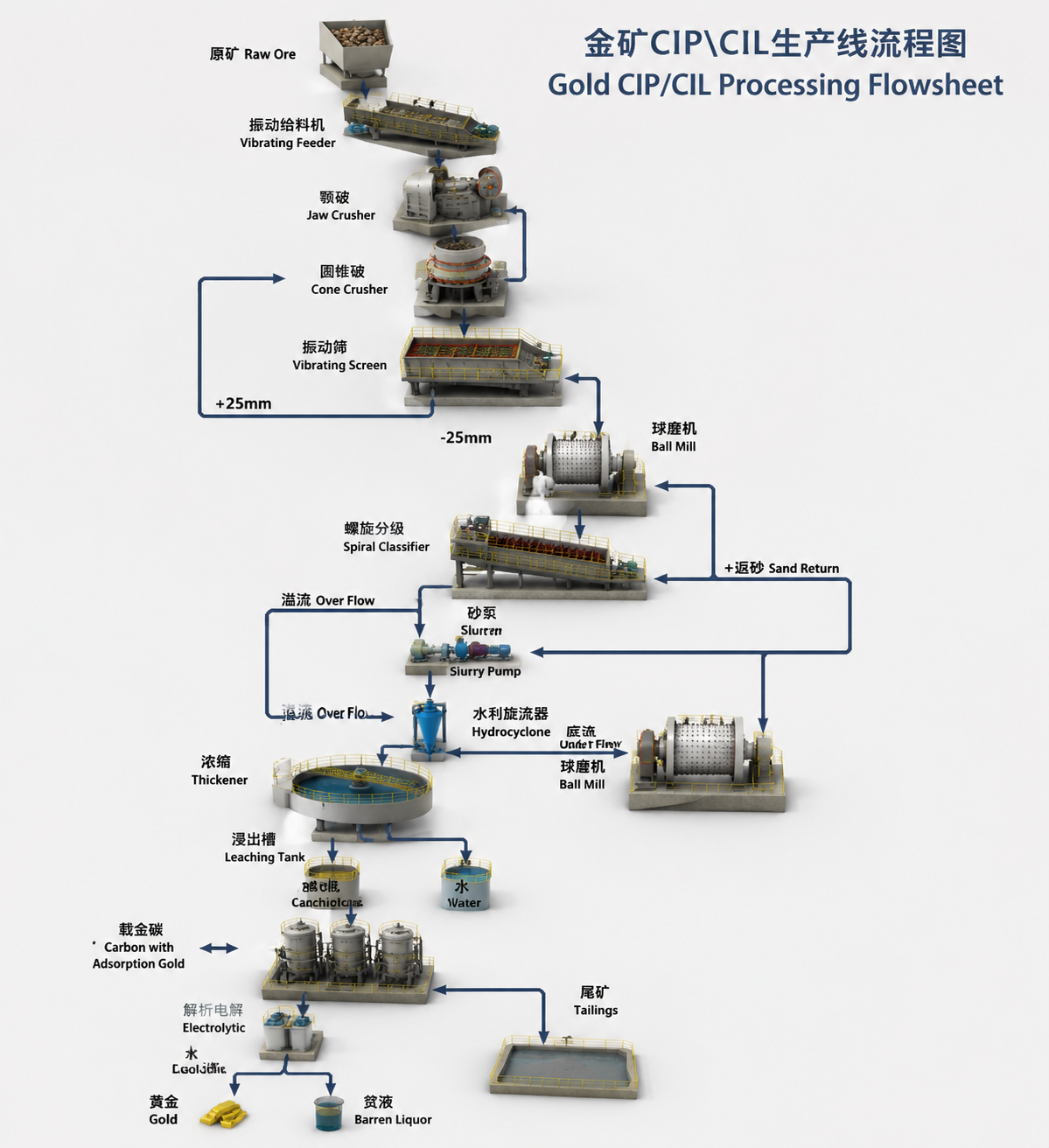
Gold CIP/CIL Processing Flowsheet
A. Primary Coarse Grinding & Secondary Fine Grinding
• Application Conclusion: Adopting a two-stage grinding configuration—combining a "Grate-type" mill with an "Overflow-type" mill—represents the lowest-energy pathway for achieving effective mineral monomer dissociation.
• Technical Details: The process aims to grind the ore to a fineness where 60%–80% passes through a -200 mesh screen. The primary grinding stage utilizes a Grate-type energy-saving ball mill, leveraging its large discharge port to maximize throughput; the secondary stage employs an Overflow-type mill for fine grinding, thereby ensuring the required degree of mineral dissociation.
B. Regrinding of Flotation Gold Concentrates
• Application Conclusion: For encapsulated gold, the regrinding stage must avoid gold losses caused by over-grinding; energy-efficient ball mills demonstrate superior performance in this regard.
• Technical Details: Flotation concentrates are finely ground to -325 mesh to thoroughly expose fine gold particles encapsulated within sulfides. Energy-efficient overflow ball mills provide a more uniform grinding force field, thereby minimizing the generation of slimes.
C. Whole-Slime Cyanidation (CIL/CIP) Pre-treatment
• Application Conclusion: Grinding fineness is the primary factor determining the cyanide leaching rate; energy-efficient ball mills ensure the uniformity of the particle size distribution.
• Technical Details: By optimizing the steel ball charge ratio and rotational speed, the process ensures the absence of excessively coarse particles (known as "coarse escape") in the slurry, thereby increasing the contact surface area between the gold and the cyanide reagents, and boosting the leaching rate.
3. Economic Benefit Analysis: The Dual Benefits of Cost Reduction and Efficiency Improvement
Conclusion: The return on investment for energy-efficient ball mills is primarily realized through two dimensions: electricity cost savings and increased metal recovery rates. Typically, the incremental investment cost for the equipment can be recouped within 1 to 2 years.
• Reduced Operating Costs: Based on the energy consumption calculation methodology outlined in *GB 30253-2013: Energy Efficiency Limits and Energy Efficiency Grades for Permanent Magnet Synchronous Motors*, energy-efficient ball mills reduce electricity consumption by 0.5 to 1.5 kWh per ton of ore processed. Assuming a daily processing capacity of 1,000 tons and an electricity price of 0.8 RMB/kWh, the annual electricity cost savings amount to approximately 260,000 to 430,000 RMB.
• Increased Recovery Rates: By minimizing over-grinding and the generation of slimes, the theoretical gold recovery rate can be improved by 0.5% to 2%. For a mine with an annual gold output of 1 ton, this translates to an additional production of 5 to 20 kilograms of gold.
• Maintenance Costs: The use of rolling bearings eliminates the need for the scraping and maintenance typically required for babbitt metal bearings. Furthermore, the cooling water system is eliminated, resulting in an 80% reduction in lubricating oil consumption.
4. Authoritative Selection Reference
Equipment selection must be strictly matched to the specific processing capacity and metallurgical process requirements. The following serves as a reference for standard configurations tailored to mainstream production capacities in gold mining operations.
| Project Scale | Recommended Model Configuration | Key Parameters | Applicable Processes |
| Small-scale Mines (100–300 t/day) | MQGg 0900 / 1200 Series | Feed size ≤ 20 mm; Ball charge: 1.5–3 t | Heap leaching, small-scale gravity separation |
| Medium-scale Mines (500–1000 t/day) | MQGg 1500 / 2100 Series | Motor power: 130–245 kW; Wet-type, Grate-discharge | Flotation, CIP |
| Large-scale Mines (2000+ t/day) | MQGg 2700 / 3600 Series and above | Dual-drive synchronous motors; Fully automatic lubrication system | Two-stage grinding, SABC circuit |
Frequently Asked Questions (FAQ)
Q1: Do energy-saving ball mills really consume less electricity than traditional ball mills? What are the specific figures?
A1: Yes, the energy-saving effect is significant. This is primarily attributed to the replacement of sliding bearings with rolling bearings; this feature alone can reduce power consumption by 10%–15%. When combined with the cumulative effects of variable frequency speed control and optimized liners, the overall energy savings for the complete machine typically range from 10% to 30%, depending on specific operating conditions.
Q2: Are rolling bearings durable under heavy loads and impact conditions? Are they prone to frequent failure?
A2: Modern energy-saving ball mills utilize double-row spherical roller bearings, which are specifically designed for heavy-load, low-speed applications. Their load-bearing capacity is far superior to that of sliding bearings of the same size, and they feature a self-aligning function that allows them to accommodate minor deformations in the mill shell. With proper lubrication, their service life can reach 8–10 years—a performance far superior to that of sliding bearings, which require frequent scraping and maintenance.
Q3: What specific considerations apply to the selection of liners for gold ores and oxidized ores containing quartz veins?
A3: For high-hardness quartz vein gold ores, we recommend using high-manganese steel corrugated liners, which offer superior wear resistance. For highly corrosive oxidized or sulfidized ores, we recommend using wear-resistant rubber liners; these are lightweight and corrosion-resistant, and can effectively reduce operating noise—though it is necessary to consider their capacity to withstand high-impact forces.
Q4: Does replacing an existing ball mill with an energy-saving model require extensive modification to the existing foundation?
A4: No, it does not require large-scale civil engineering modifications. Most energy-saving ball mills feature an integrated base frame design, wherein the main unit, motor, and reducer are pre-assembled on a single base prior to leaving the factory. On-site installation simply requires leveling the foundation and aligning the unit, which significantly reduces the downtime required for the upgrade.
Q5: How does an energy-saving ball mill work in conjunction with a classifier to improve efficiency?
A5: We recommend pairing the ball mill with a spiral classifier or hydrocyclone to establish a closed-circuit system. The energy-saving ball mill handles the grinding, while the classifier handles the screening. Coarse particles that do not meet the required fineness are returned to the ball mill for further processing, while qualified fine particles proceed to the next stage. This "closed-circuit grinding" approach maximizes the energy-saving ball mill's high-throughput capabilities and prevents inefficient over-grinding.
Q6: What are the noise and dust levels like during equipment operation?
A6: Thanks to the use of rubber or composite liners, operating noise levels can be reduced by 10–15 decibels compared to metal liners. Furthermore, when combined with fully enclosed feed and discharge systems, potential dust leakage points are drastically minimized, ensuring compliance with the *GB 16297-1996 Integrated Emission Standard of Air Pollutants*.
Q7: How much more expensive is an energy-saving ball mill compared to a standard model? What is the payback period?
A7: The initial equipment procurement cost is typically 15% to 25% higher. However, when factoring in annual savings on electricity consumption, steel ball consumption, and maintenance costs—particularly for gold mines with a daily processing capacity exceeding 500 tons—the investment payback period is typically around 12 to 18 months.
Q8: What practical benefits does variable frequency control offer regarding grinding fineness?
A8: Variable frequency control allows operators to adjust the mill's rotational speed in response to variations in ore hardness. Specifically, the speed can be increased when processing harder ores and decreased when processing softer ores. This ensures that the particle size of the ground product remains consistently within the target range (e.g., 75% passing -200 mesh), thereby preventing "under-grinding" or "over-grinding"—issues often associated with fixed-speed operation.
Q9: Is the energy-saving ball mill suitable for processing gold ores containing arsenic or high sulfur levels?
A9: It is highly suitable. When processing such refractory gold ores, a finer grinding fineness is often required (e.g., P80 < 38 μm). The energy-saving ball mill's high-efficiency grinding capability can meet these ultra-fine grinding requirements; furthermore, its rubber liners are resistant to the acidic environments generated by sulfides, thereby minimizing equipment corrosion.
Q10: What requires the most attention during routine maintenance?
A10: The most critical aspect is lubrication management. Although the energy-saving ball mill features a simplified lubrication system, it is still essential to regularly monitor bearing temperatures and the quality of the lubricating oil. We recommend utilizing an automatic spray lubrication system to ensure that a uniform oil film is consistently maintained on the meshing surfaces of the large gear, thereby preventing dry friction.