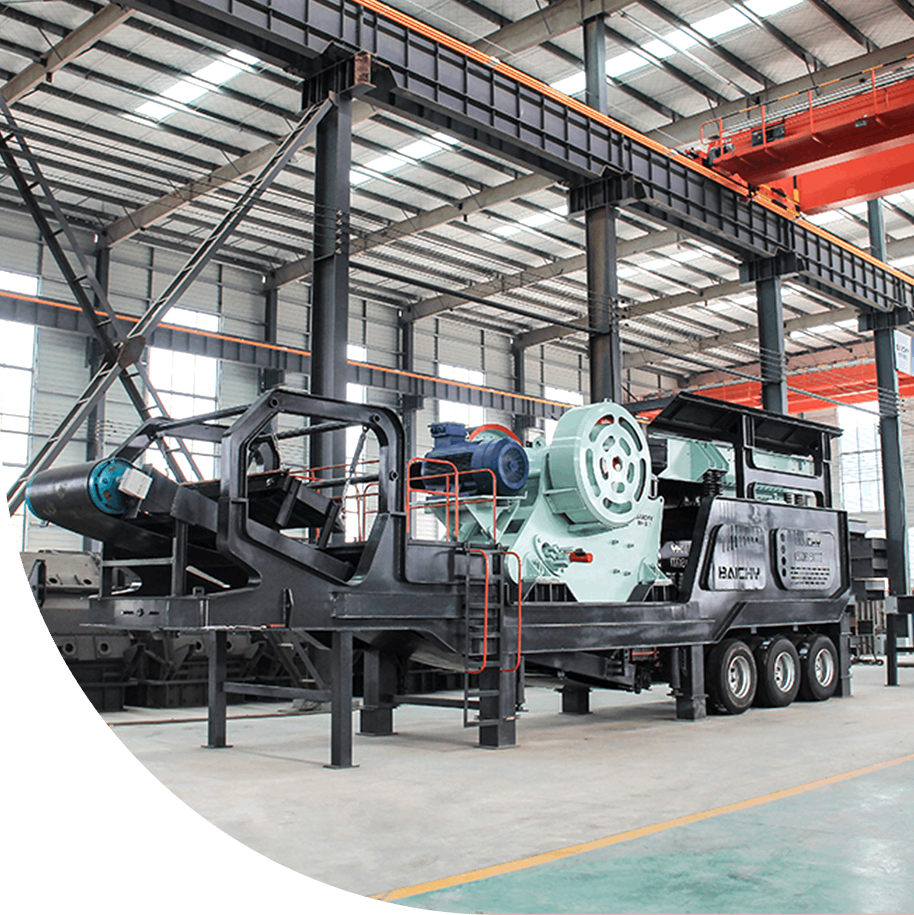

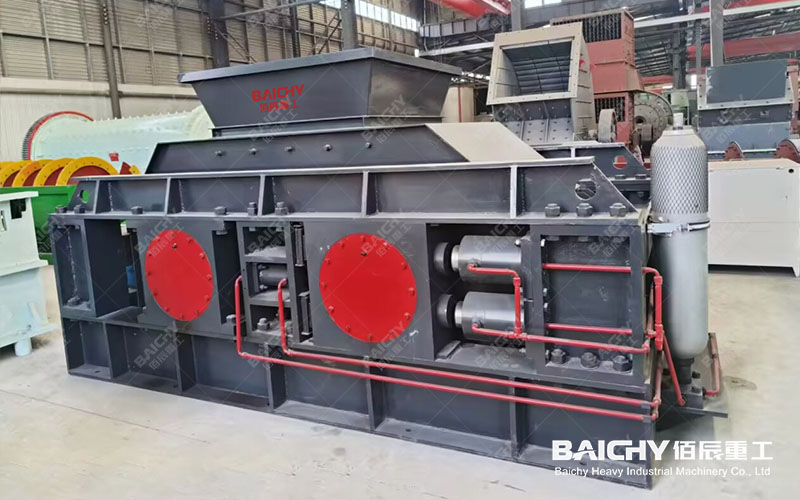
Double Roller Crusher
Have you ever encountered these frustrations in your crushing production line?
1. As you enter the medium-to-fine crushing stage, your equipment is running at "full throttle," yet the finished product is inconsistent in size—with a large volume of substandard fines (over-crushed material) directly dragging down product value and profit margins?
2. When crushing high-hardness materials, do you constantly operate on edge, fearing that stray metal foreign objects might instantly cause a catastrophic breakdown—leading to exorbitant repair costs and prolonged downtime losses?
3. Are you striving to produce higher-quality aggregates or mineral raw materials, only to be limited by equipment performance—resulting in poor particle shape that consistently fails to meet the exacting standards of high-end markets, preventing you from commanding a premium price?
If any of the above issues strike a nerve, then a Double Roll Crusher might just be the missing piece of the "efficiency and profit puzzle" your production line needs. It may not be the most "brute-force" piece of equipment, but it is very likely the "smartest"—and the one that best understands your cost-control imperatives. Let's move beyond vague generalities and cut straight to the core to see exactly how it precisely resolves these real-world challenges.
I. Overview of the Double Roll Crusher
The Double Roll Crusher—also known as a Twin Roll Crusher or Roller Crusher—features two parallel-mounted cylindrical rollers as its primary working components. During operation, the two rollers rotate toward each other; material falling between them is drawn into the crushing chamber by friction and is subsequently crushed through continuous compression and shearing forces. The particle size of the crushed product is determined by the gap between the two rollers (the discharge opening); by adjusting this roller gap, the output particle size can be conveniently controlled.
A core feature of the Double Roll Crusher lies in its principle of "selective crushing." Materials of higher hardness exert a greater reaction force, triggering the hydraulic or spring system to allow the rollers to momentarily yield. This action facilitates the discharge of uncrushable foreign objects (such as iron blocks), thereby effectively protecting the main crusher unit from damage.
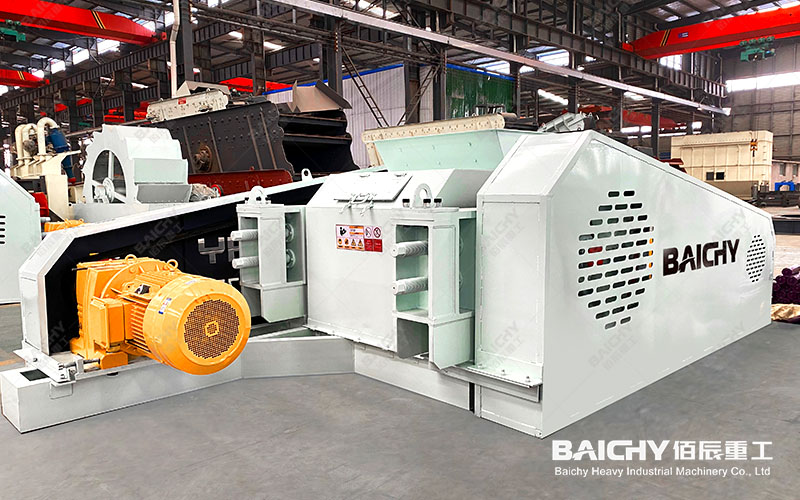
Double Roller Crusher
Examples of Key Operating Parameters
The table below presents the main technical parameters for a typical medium-sized double-roller crusher:
| Parameter Name | Value/Specification | Description |
| Roller Diameter | 750 mm | Determines processing capacity and feed size |
| Roller Width | 500 mm | Directly affects the equipment's throughput |
| Max. Feed Size | ≤ 40 mm | The maximum dimension of material entering the crushing chamber |
| Discharge Size Range | 2–10 mm | Product particle size can be controlled within this range by adjusting the roller gap |
| Processing Capacity | 20–50 t/h | Specific output is influenced by factors such as material hardness and moisture content |
| Motor Power | 2 × 30 kW | Dual-motor drive providing powerful crushing force |
II. Primary Application Scenarios
Double-roller crushers have a very wide range of applications and are particularly suitable for scenarios requiring the production of uniformly sized products:
1. Mining and Mineral Processing: Used for the medium and fine crushing of iron ore, gold ore, tungsten ore, quartz, etc., providing material of the appropriate particle size for subsequent grinding or beneficiation processes.
2. Building Materials and Refractories: Used to crush clay, shale, coal gangue, limestone, etc., for brick manufacturing or cement raw material production; also used for preparing aggregates for refractory materials.
3. Coal and Coking Industries: Crushes raw coal or coke to the required particle size for use in boiler combustion or metallurgical processes.
4. Chemical and Other Industries: Crushes chemical raw materials, caked fertilizers, quartz sand, etc., to meet the specific particle size requirements of various industrial processes.
III. Core Advantages
Compared to other types of crushers, double-roller crushers offer the following significant advantages:
• Uniform Product Size with Minimal Over-crushing: Utilizes an extrusion-based crushing principle; the resulting product is predominantly cubical in shape with low needle-and-flake content. The particle size is controllable and highly concentrated, which is particularly beneficial for downstream processing.
• Simple Structure and Easy Maintenance: The mechanical structure is relatively simple, and core components are easy to disassemble and maintain, effectively reducing long-term operating costs.
• Sensitive Overload Protection and Reliable Operation: Equipped with hydraulic or spring-based adjustment and protection mechanisms; if uncrushable foreign objects are encountered, the rollers automatically retract to discharge the object, thereby preventing damage to the equipment.
• Minimal Dust Generation, Environmentally Friendly: The crushing process relies primarily on static pressure; compared to impact-style crushers, it generates significantly less airborne dust, resulting in a superior working environment.
• Low Energy Consumption, Economical Operation: In suitable application scenarios, its energy consumption per unit of output is lower than that of many other medium-to-fine crushing devices.
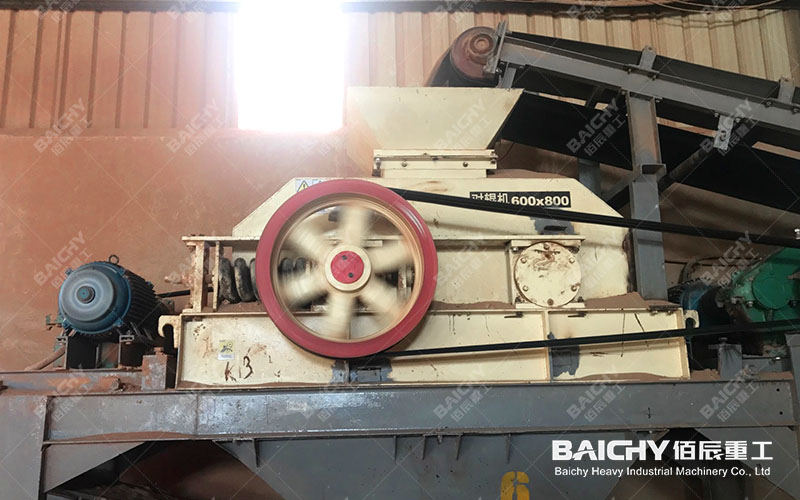
Double Roller Crusher
IV. Relevant Success Stories
Case Study: Fine Crushing Production Line at a Quartz Sand Processing Plant
• Client Requirements: To crush raw quartz stone material (sized 10–30 mm) into uniform particles (2–5 mm) for use as high-quality glass feedstock. The client required stable product particle size, minimal iron contamination, and reliable equipment operation.
• Solution: We configured a high-strength, wear-resistant double-roller crusher for the client. The roller surfaces feature a specialized tungsten carbide alloy hardfacing, which vastly improves wear resistance and extends service life. An iron remover and a fine screening unit were installed upstream of the feed inlet to establish a closed-circuit crushing loop.
• Operational Results: The equipment operates smoothly, and the discharge particle size fully meets the client's requirements (with over 90% of the output falling within the 2–5 mm range). The rate of over-crushing is low, effectively boosting both the yield and the market value of the finished product. The client highly praised the equipment for its low maintenance costs and the exceptional particle shape of the final product.
V. Recommended Equipment
Based on varying production requirements and process configurations, we typically recommend the following:
1. High-Strength Hydraulic Double-Roller Crusher: Recommended for the medium-crushing stage of high-hardness ores (e.g., granite, iron ore). Its hydraulic system offers convenient adjustment and robust overload protection, making it a preferred choice for modern mining crushing lines.
2. Dual-Motor Double-Roller Crusher: Recommended for high-capacity fine-crushing operations involving medium-hardness materials (e.g., limestone, coal gangue). It features powerful drive capabilities, high throughput, and smooth operation.
3. Toothed-Roller Crusher: If the raw material contains a significant amount of sticky or wet matter, or if a specific splitting action is required, the toothed-roller crusher is the ideal choice; it is commonly used for the coarse and medium crushing of coal and coke.
VI. Frequently Asked Questions (FAQ)
Q1: What are the differences between a double-roller crusher and a jaw crusher?
How should one choose between them for specific applications?
A1: Jaw crushers are primarily used for the first stage of coarse crushing (primary crushing) to process large-sized materials; whereas double-roll crushers are mainly utilized for medium to fine crushing (secondary or tertiary crushing) to process medium-sized materials that have already undergone coarse crushing, thereby yielding a finer and more uniform product. Typically, these two types of crushers are used in series within a production line.
Q2: How are the rollers of a double-roll crusher repaired once they become worn? How is their wear resistance?
A2: The roller shells are the primary wear parts. The roller surfaces of our double-roll crushers are manufactured using high-strength, wear-resistant alloy materials and are designed to be replaceable. Once worn, the roller shells can be replaced on-site or undergo professional wear-resistant hardfacing repair, significantly reducing both maintenance costs and downtime.
Q3: Can double-roll crushers process wet and sticky materials?
A3: For materials that are slightly wet and sticky, standard smooth-surface double-roll crushers may be prone to clogging. To address such materials, we recommend using a toothed-roll crusher; its toothed roller surface possesses superior peeling and crushing capabilities, effectively preventing clogging and making it the ideal equipment for processing sticky or wet materials such as coal and clay.
Summary
With their reliable structure, excellent product granularity, ease of maintenance, and economical operation, double-roll crushers hold a firm position across numerous industrial crushing sectors. Selecting the appropriate double-roll crusher model—and correctly applying it to the suitable materials and process stages—is the key to maximizing the overall efficiency and economic benefits of the entire production line.