Baichy Heavy Industrial Machinery Co., Ltd

Phone/Wechat/Whatsapp:+008615093222637

Email:[email protected]
24 hours online
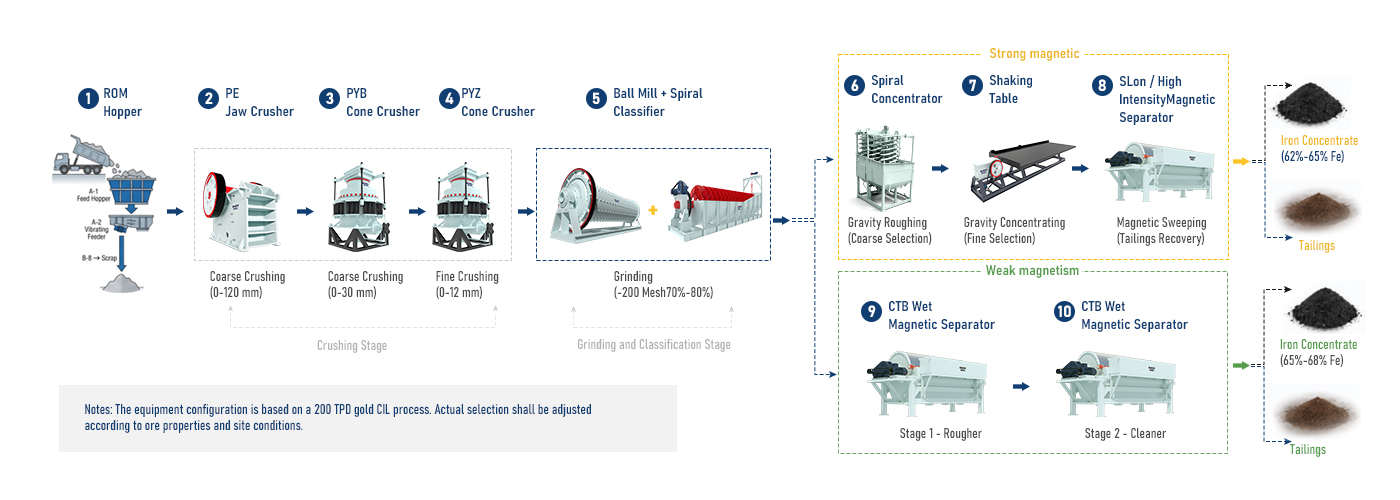
| Stage | Equipment Name | Model | Function |
| Feeding | Vibrating Feeder | ZSW380×95 | Grizzly bar pre-screening and uniform feeding; screens out <50mm fines to reduce jaw crusher load |
| Primary Crushing | Jaw Crusher | PE500×750 | Primary crushing of raw ore; feed ≤425mm → discharge 50-100mm; Mn18Cr2 jaw plates |
| Secondary Crushing | Spring Cone Crusher | PYB1200 | Standard cavity type for secondary crushing; feed ≤145mm → discharge 20-50mm |
| Fine Crushing | Spring Cone Crusher | PYZ1200 | Medium cavity type for fine crushing; closed-circuit with vibrating screen; controls mill feed size to ≤12mm |
| Screening | Circular Vibrating Screen | 2YK1860 | Double-deck screening (top 25mm / bottom 12mm); oversize material returned to fine crushing stage |
| Grinding | Overflow Ball Mill | Φ2100×3600 | Parallel fine grinding (two units); ball charge 24t/unit; power 210kW; target: 65%-80% passing -200 mesh |
| Classification | Spiral Classifier | FG-15 | Closed-circuit with ball mill; sand return ratio 150%-300%; overflow controls grinding fineness |
| Gravity Separation | Spiral Chute | | BLL-1200 | Pre-concentration of coarse heavy minerals; 6-8 units in parallel (Route B only) |
| Gravity Separation | Shaking Table | 6-S | Upgrading via cleaning; adjustable stroke 8-36mm (Route B only) |
| Magnetic Separation | Wet Drum Magnetic Separator | CTB-718 | Drum surface field: 120-180mT (low intensity, Route A) / ≥350mT (high intensity, Route B); 3-4 units in series |
| Roasting | Rotary Kiln | Φ2.5×40m | Reduction roasting at 750–850°C; hematite → magnetite (Route C only) |
| Dewatering | Thickener | NZS-9 | Concentrate thickening and settling; underflow concentration 40%–60%; throughput 15–25 tph |
| Dewatering | Disc vacuum filter | ZPG-20 | Concentrate filtration and dewatering; filter cake moisture 10%–14% |
| Conveying | Belt conveyor | B500–B650 | Material transfer across all sections; capacity 50–100 tph; length customized to site conditions |
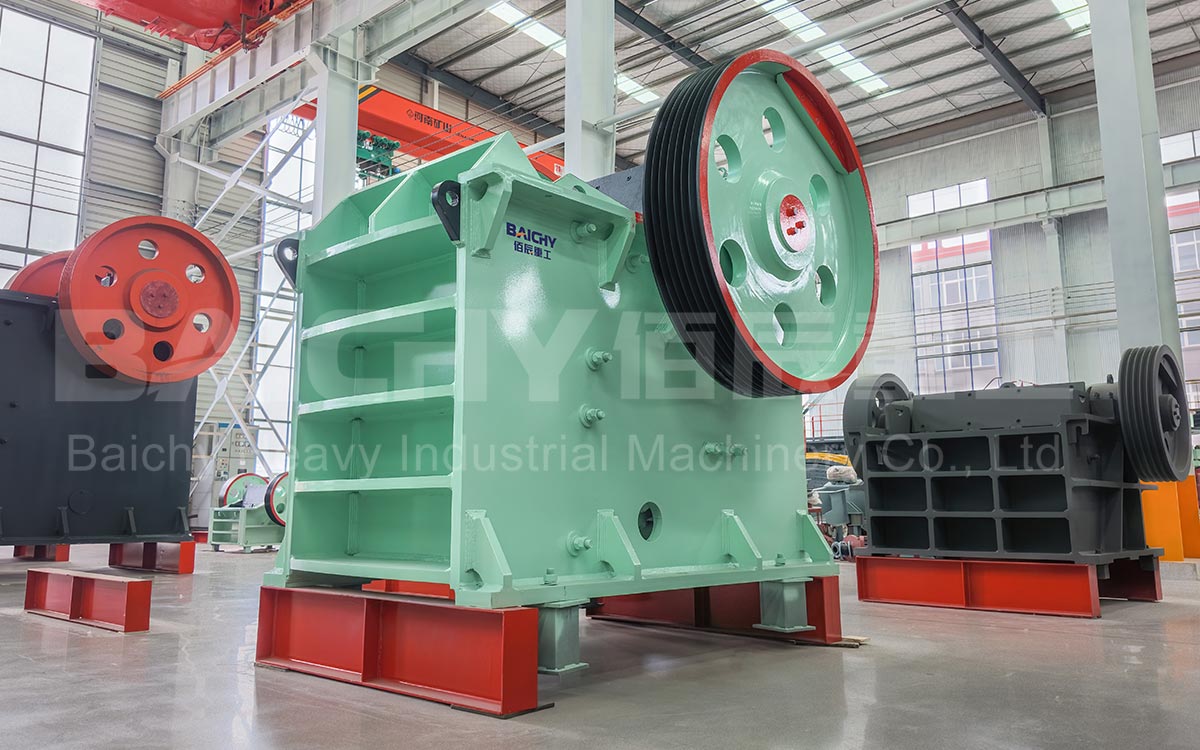
Feeder size: 500x750 mm
Max. Feed: 425 mm
Power: 45 kw
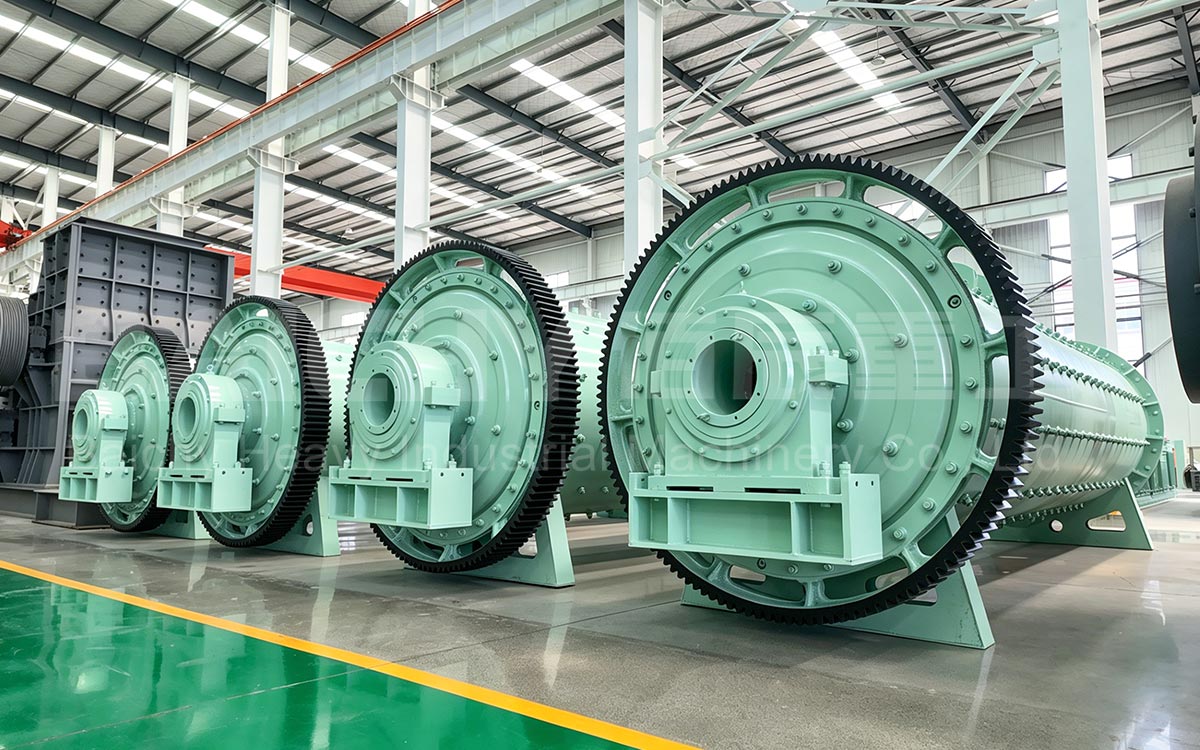
Feed Size: ≤25 mm
Discharge Size: 0.074-0.6 mm
Capacity: 1.1-91 t/h
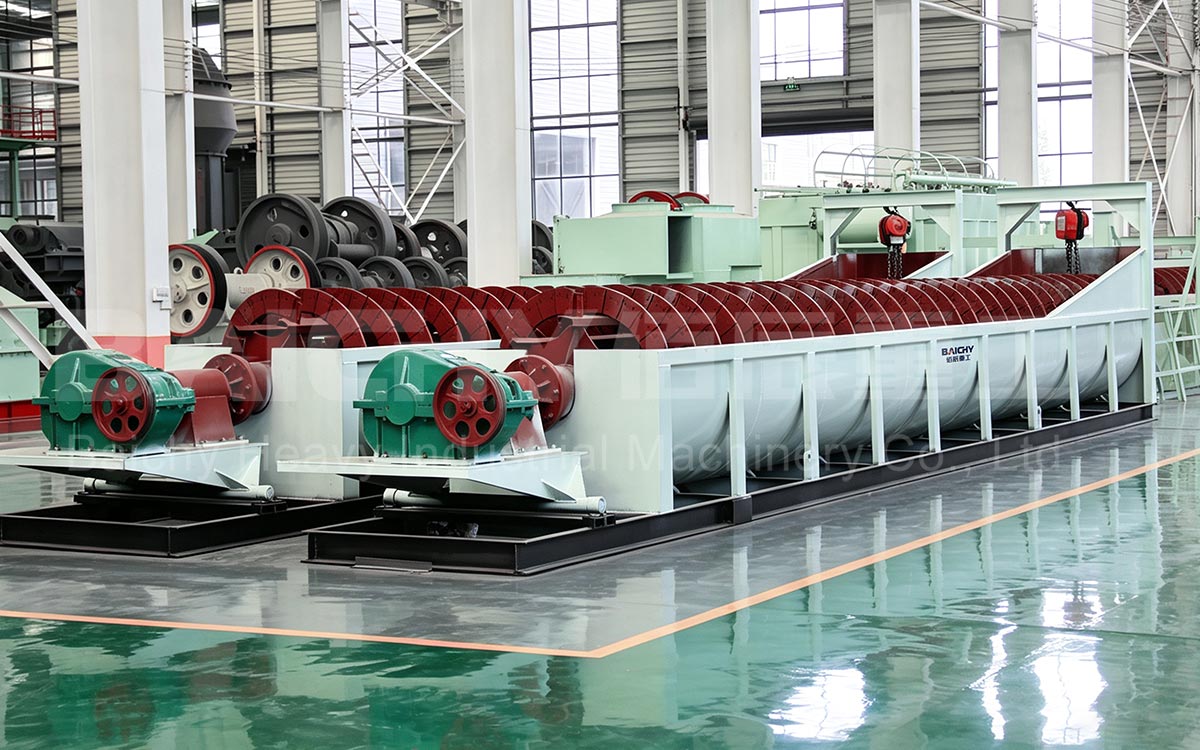
Speed of Spiral: 3.2-10 r/min
Overflow: 65-1785 t/d
Sink Length: 5500-12900 mm
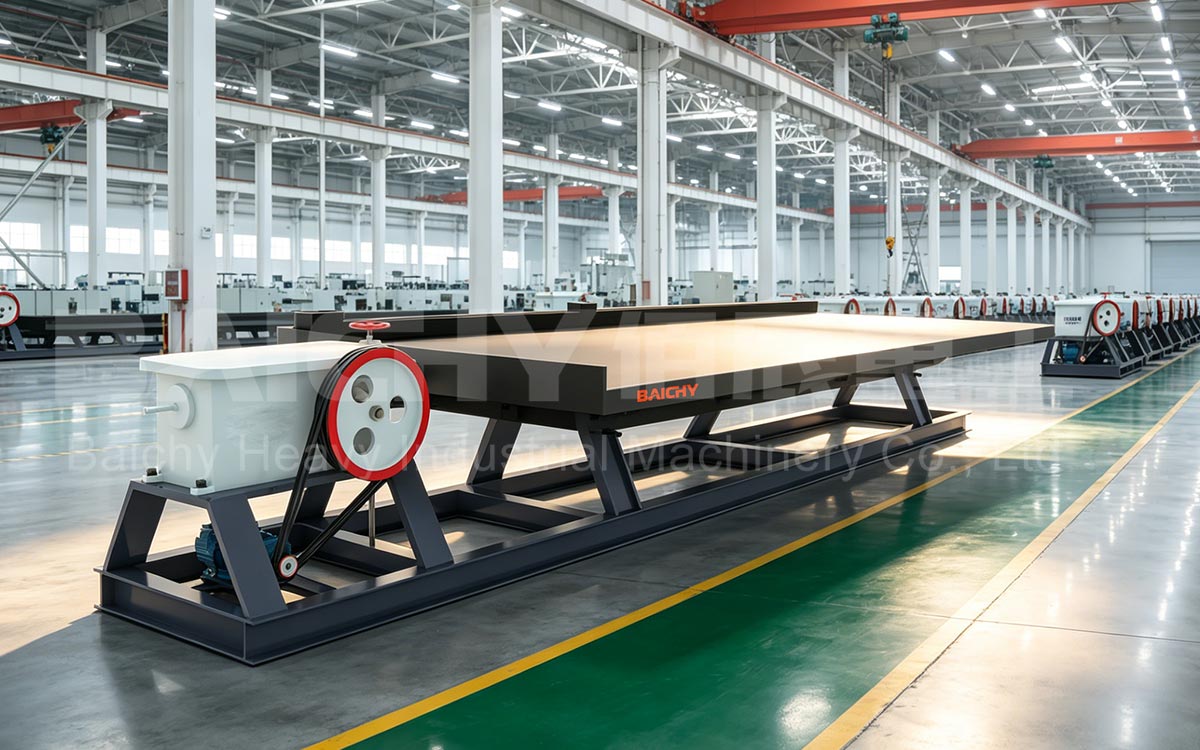
Feeder Capacity: 10-30t/d
Feeder Density: 15-30%
Power: 1.1 kw
Every iron ore deposit has a unique mineralogical fingerprint. Baichy does not force-fit your ore into a generic flowsheet — we configure the right route based on your feed characteristics.
Applicable to: Magnetite-dominant ores with strong ferromagnetic response.
Magnetite processing is the most straightforward and lowest-cost beneficiation route. After crushing and grinding to liberation size (typically 65%–80% passing 200 mesh), the ore slurry passes through 3–4 stages of low-intensity wet drum magnetic separators (CTB series, 120–180 mT surface field). The magnetic concentrate is then thickened and filtered to a final moisture content of 10%–14%.
Key advantage: No chemical reagents required. Operating cost is dominated by grinding energy alone.
Expected results: Concentrate grade 65%–68% Fe, tailings grade ≤8% Fe.
Applicable to: Hematite-dominant ores, mixed hematite-magnetite deposits.
Hematite's weak magnetic susceptibility demands a combined approach. The ground slurry first enters 6–8 spiral chutes (BLL-1200) for pre-concentration of coarse heavy minerals, discarding 30%–40% of low-density gangue upfront. The spiral concentrate then undergoes shaking table cleaning (6-S series, adjustable stroke 8–36 mm) to produce a gravity-grade concentrate, while the middling stream is routed to high-intensity wet drum magnetic separators (≥350 mT surface field) for scavenging.
This gravity-magnetic combination reduces grinding energy costs by keeping the spiral chutes at a coarser grind and only sending the middling fraction to finer regrinding.
No two quarries are the same. That's why every Baichy configuration starts with your raw material and target capacity — never a catalog template. The installations below are just a sample. Your project could be the next one on this list.

Technical Advantages of Baichy's Brazil Solutions
Project Background: Brazil has abundant iron ore resources. The goal is to efficiently develop low-grade iron ore to meet the needs of the steel industry.
Goal: Increase the grade of iron ore concentrate to more than 65%, and the comprehensive recovery rate ≥85%, to achieve a win-win situation of environmental protection and economic benefits.
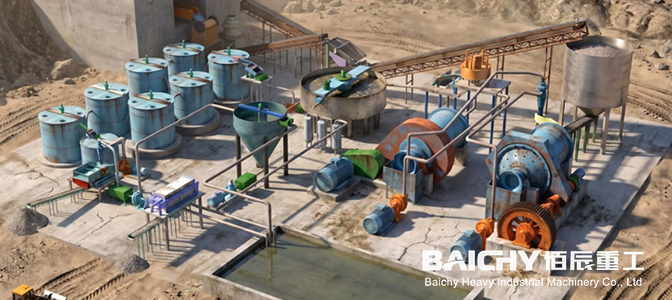
Gold Ore Flotation Extraction Plant & Equipment Solutions
1. Conventional process (applicable to high-grade gold ore)
Ore → coarse crushing (jaw crusher) → medium crushing (cone crusher) → fine crushing → ball milling → flotation/cyanidation → smelting
2. Low-grade gold ore (heap leaching)
Ore → coarse crushing → fine crushing → heap building → spray cyanidation → activated carbon adsorption → electrolytic gold extraction
Tell us your raw material and target capacity. Our engineers will design a custom line and send you a quote within 24 hours.
Get Your Custom Layout & Quote NowWe don't just sell machines. We deliver production lines that work — on time, on spec, on budget.
Certified manufacturing. 35,000 m² facility. 200+ skilled workers. All key components made in-house.
Senior engineers analyze your rock type, feed gradation, moisture content, and site elevation before proposing a single machine.
Foundation drawings, steel structure, electrical controls, dust suppression, installation supervision, and operator training — all included.
No dealer, no trader, no markup. You pay the ex-factory price. Competitive freight to your seaport.
Full warranty on main equipment. Wearing parts always in stock. Shipped within 48 hours via DHL/FedEx.
Lines operating in Indonesia, Philippines, Saudi Arabia, Nigeria, Kenya, Peru, Kazakhstan, Russia, and more.