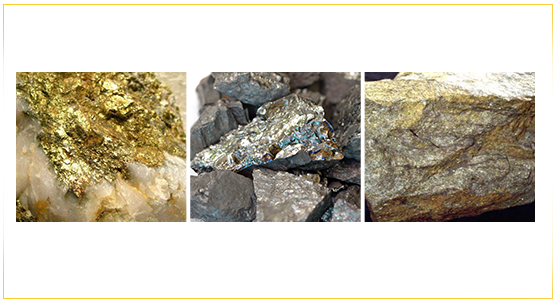
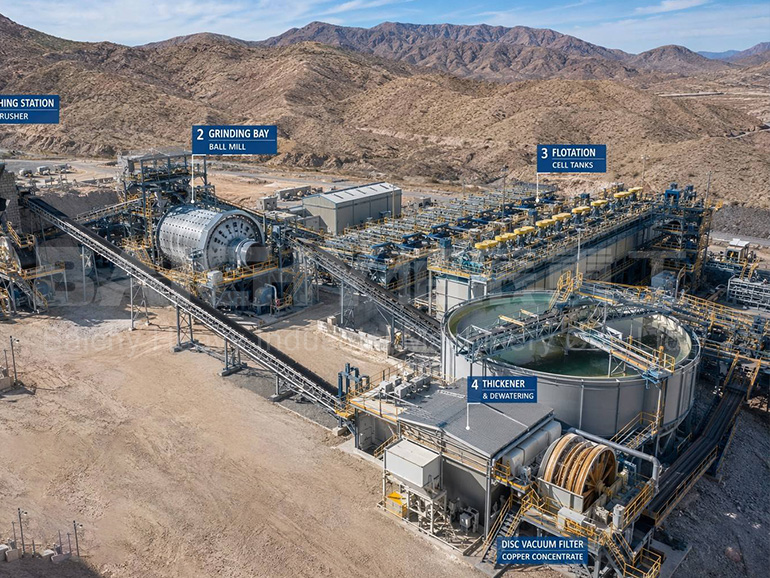
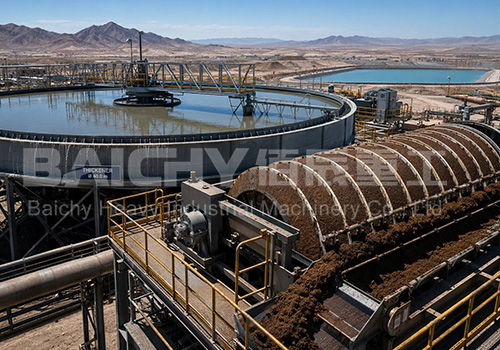
To address the specific characteristics of Mexico's copper resources—predominantly porphyry and skarn-type deposits with run-of-mine grades of 0.4%–2.0% and associated gold, silver, and molybdenum—Baichy Heavy Industry designed and delivered a complete copper flotation production line with a daily processing capacity of 200 tons. The line encompasses four key process stages: crushing, ball milling, flotation, and dewatering. It achieves a flotation recovery rate of ≥92% and produces copper concentrate with a stable grade of 18%–28%, meeting international market delivery standards. The project was executed under an EPC (Engineering, Procurement, and Construction) turnkey model, with Baichy providing a full-service package ranging from beneficiation testing
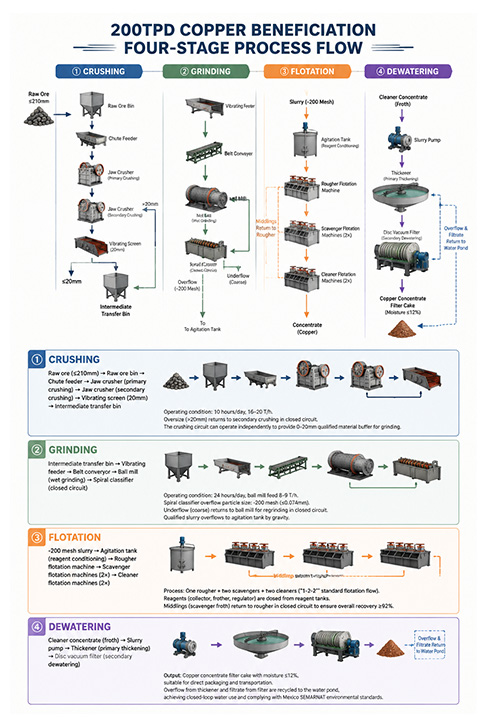
Process Flow — 200 TPD Copper Beneficiation (Four-Stage Layout)
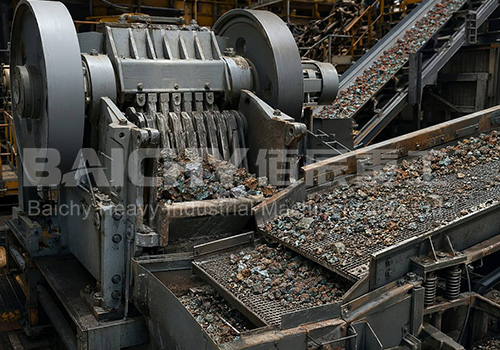
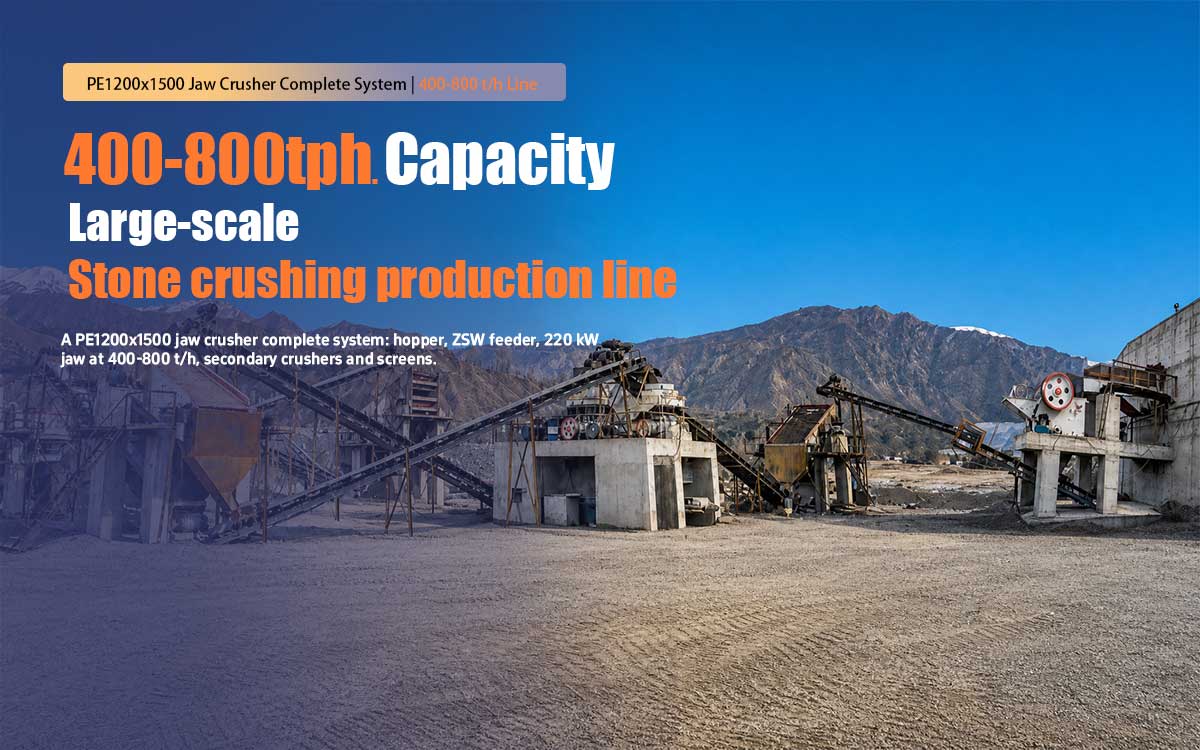
① Crushing Stage
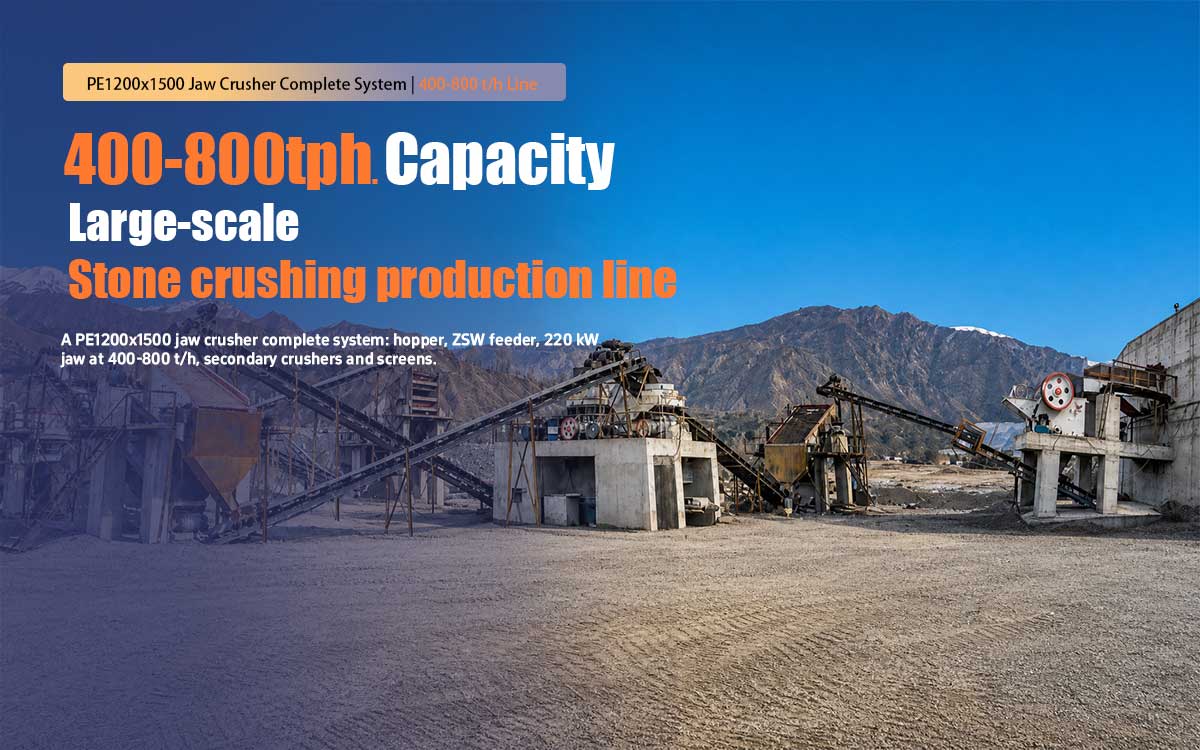
Run-of-mine ore (≤210mm) → Raw ore bin → Trough feeder → Jaw crusher (primary crushing)→ Fine-crushing jaw crusher (secondary crushing) → Vibrating screen (20mm screening) → Intermediate transfer bin
Operating conditions: 10-hour workday; throughput of 16–20 t/h. Oversize material (>20mm) is returned in a closed circuit to the fine-crushing jaw crusher. The crushing section operates independently, providing a buffer of qualified 0–20mm crushed material for the grinding section.
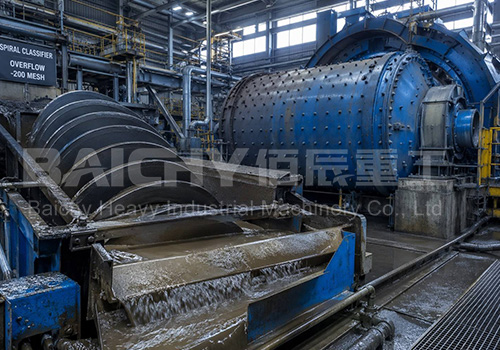
② Grinding Stage
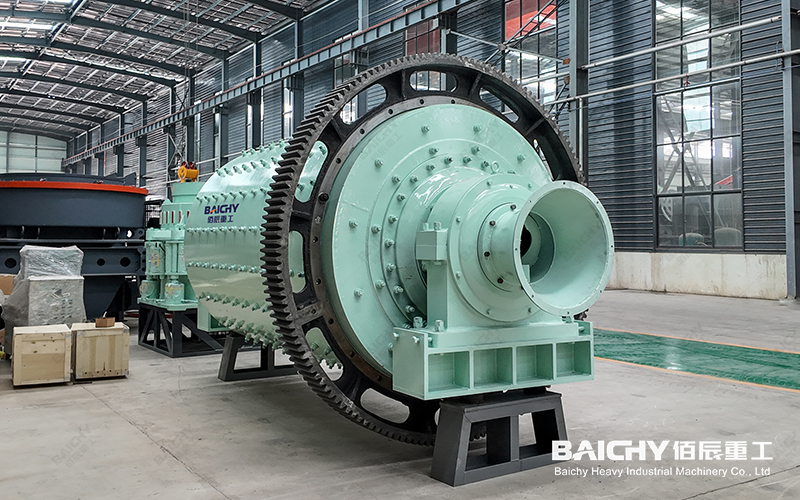
Intermediate transfer bin → Vibrating feeder → Belt conveyor → Ball mill (wet grinding) → Spiral classifier (closed-circuit classification)
Operating conditions: 24-hour workday; ball mill feed rate of 8–9 t/h. Classifier overflow particle size is -200 mesh (≤0.074mm); coarse underflow returns to the ball mill for regrinding, forming a closed-circuit loop. Qualified slurry flows by gravity into the agitation tank.
③ Flotation Stage
200 mesh slurry → Agitation tank (reagent conditioning) → Rougher flotation cell → Scavenger flotation cell → Cleaner flotation cell
Process: Employs a standard flotation circuit consisting of one roughing stage, two scavenging stages, and two cleaning stages. The number of flotation cells is dynamically configured based on raw ore grade; collectors, frothers, and modifiers are added quantitatively from reagent tanks. Middlings (scavenger froth) are returned to the roughing stage in a closed circuit to ensure an overall recovery rate of ≥92%.
④ Dewatering Stage
Cleaner copper concentrate froth → Slurry pump → Thickener (primary thickening) → Disc vacuum filter (secondary dewatering)
Output: Copper concentrate filter cake with a moisture content of ≤12%, suitable for direct packaging and transport. Thickener overflow and filter filtrate are recovered into the process water recycling tank, achieving a closed-loop process water cycle and complying with Mexico's SEMARNAT environmental discharge standards. and equipment manufacturing to installation, commissioning, and operational training.
Core Equipment Configuration — 200TPD Copper Flotation Plant
| Process section |
Equipment Name |
Model / Specification |
Quantity |
Core Features |
| Crushing |
Trough feeder |
Chute Feeder ≤210mm |
1 set |
Evenly feed material into the primary jaw crusher. |
| Jaw Crusher (Primary Crushing) |
PE Jaw Crusher — Feeder Size ≤210mm, Output Size: 30-60mm |
1 set |
Primary coarse crushing to reduce ore particle size. |
| Fine-crushing jaw crusher |
PEX Fine Jaw Crusher — Output Size ≤20mm |
1 set |
Secondary fine crushing to prepare ball mill feed. |
| Vibrating Screen |
Sigle 20mm Screen mesh - Vibrating Screen |
1 set |
Screening and classification; material >20 mm returned in closed circuit. |
| Grinding |
Vibrating Feeder |
Electromagnetic Vibrating Feeder |
1 set |
Quantitative feeding from the transfer hopper |
| Ball Mill |
Wet Ball Mill — Capacity 8-9 T/h |
1 set |
Wet grinding to -200 mesh |
| Spiral classifier |
Spiral Classifier — overflow -200 Mesh |
1 set |
Closed-circuit classification, producing overflow slurry that meets specifications. |
| Flotation |
Agitation tank |
Mixing Tank — Chemical Pulping / Chemical Slurry Preparation |
2 set |
The slurry and reagents are thoroughly mixed. |
| Flotation machine |
Flotation Machine — Rougher, scavenger, and cleaner cell banks |
1 set |
Flotation separation of copper minerals from gangue |
| Reagent tank |
Chemical Dosing Tank |
1 set |
Quantitative addition of collectors, frothers, and modifiers |
| Slurry pump |
Slurry Pump |
2 set |
Transport of slurry and concentrate froth |
| Dewatering |
Thickener |
Thickener — Center-drive type |
1 set |
Single-stage thickening of concentrate to increase slurry concentration. |
| Disc vacuum filter |
Disc Vacuum Filter |
1 set |
Secondary dewatering of concentrate; filter cake moisture content ≤12% |
Frequently Asked Questions — 200 TPD Copper Beneficiation Line
1. What is the estimated total investment for a 200 TPD copper beneficiation line?
The equipment investment for a 200-tph copper flotation line depends on the ore type, equipment specifications, and the level of automation. Taking a standard configuration for a porphyry copper mine in Mexico as an example, the FOB price range for the complete equipment set (crushing, ball milling, flotation, and dewatering) is approximately $450,000 – $680,000. The total contract value for an EPC package (including installation and commissioning, civil engineering guidance, and operational training) typically ranges from $750,000 to $1,200,000, depending on site conditions and the tailings management plan. We recommend providing raw ore samples for beneficiation testing first to accurately determine equipment models and the investment budget.
2. How long does it take from contract signing to the start of production?
Standard EPC timeline: Beneficiation testing and process design (4–6 weeks) → Equipment manufacturing (8–12 weeks) → Sea freight to the port of Manzanillo or Veracruz, Mexico (4–6 weeks) → On-site installation and commissioning (6–8 weeks) → Trial production and operational training (2–4 weeks). The total duration from contract signing to official production is approximately 4–6 months.
3. Can Baichy provide local after-sales technical support in Mexico?
Yes. Baichy has established agency channels in Mexico City and provides the following after-sales support system:
① Comprehensive pre-shipment equipment testing with video documentation;
② Dispatch of Chinese engineers to the site in Mexico to supervise installation and commissioning (typically 2–4 weeks);
③ Provision of operation manuals, maintenance manuals, and spare parts lists in Spanish;
④ Support for restocking critical wear parts (jaw plates, liners, flotation impellers) via DHL/FedEx international express, with delivery to major Mexican cities within 7–10 days.
4. What are the water consumption and environmental standards for this production line?
For the 200 TPD copper flotation line, fresh water make-up is approximately 30–50 m³/day (primarily due to losses from concentrate filter cake moisture and evaporation), and the process water recovery rate is ≥85%, significantly reducing fresh water consumption. Thickener overflow and filter filtrate are treated in a sedimentation tank and recycled in a closed loop, with tailings water meeting Mexico’s SEMARNAT NOM-001-SEMARNAT discharge standards. We can also supply a dry tailings stacking system to further reduce the land footprint required for wet tailings storage.