Baichy Heavy Industrial Machinery Co., Ltd

Phone/Wechat/Whatsapp:+008615093222637

Email:[email protected]
24 hours online
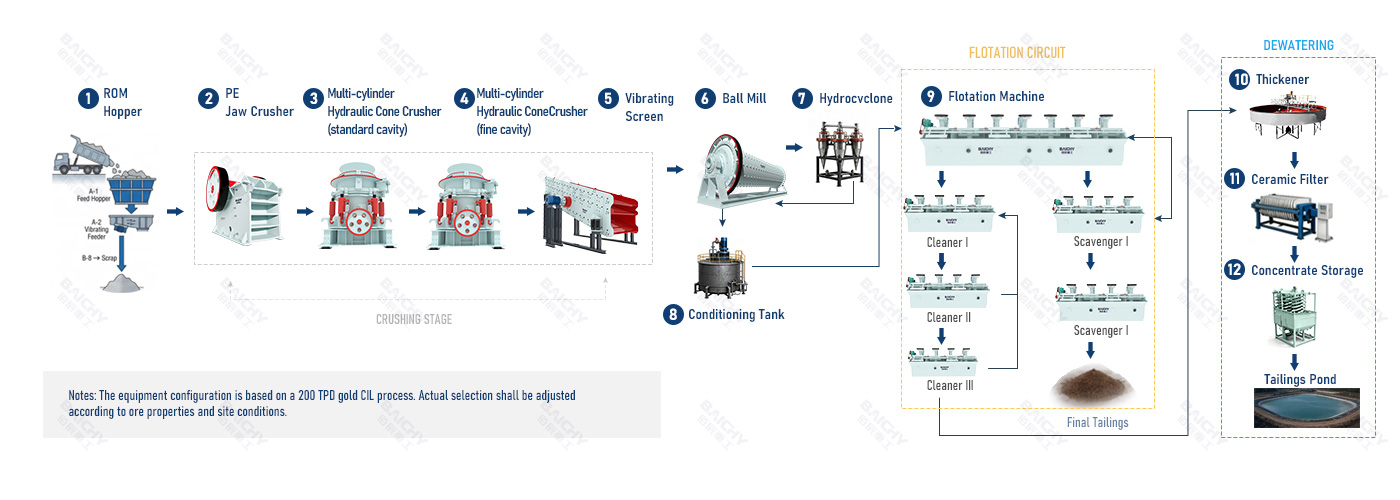
| Process Stage | Equipment | Model | Function |
| Primary Crushing | Jaw Crusher | PE 900×1200 | Coarsely crushes run-of-mine ore (≤750mm) to ≤200mm; Capacity: 220–380 t/h |
| Secondary Crushing | Multi-cylinder Hydraulic Cone Crusher | HP300 (Standard Coarse Cavity) | Hydraulic motor adjusts discharge opening; 320 t/h; automatic tramp iron release (no shutdown required for clearing) |
| Fine Crushing | Multi-cylinder Hydraulic Cone Crusher | HP300 (Fine Cavity) | Hydraulic motor adjusts discharge opening (10–25mm adjustable); reduces secondary crushing product to ≤20mm; closed-circuit loop ensures proper feed size for grinding; inter-particle (lamellar) crushing principle yields excellent particle shape with minimal flaky/elongated particles |
| Screening | Circular Vibrating Screen | 3YK2160 (2 units) | Three-deck screening to classify fine crushing product; top deck (>25mm) returns to fine crushing; middle deck (10–25mm) and bottom deck (<10mm) proceed to grinding circuit |
| First-stage Grinding | Wet Grate-discharge Ball Mill | Φ3200×4500 | Wet grinds ore (≤25mm) to 55%–60% passing 200 mesh; Capacity: 45–55 t/h; achieves suitable fineness for roughing |
| First-stage Classification | Hydrocyclone Cluster | FX-500 (6 units) | Operates in closed circuit with first-stage ball mill; overflow concentration 32%–35%, ≥55% passing 200 mesh; coarse underflow returns to ball mill for regrinding |
| Second-stage Grinding | Wet Overflow-type Ball Mill | Φ2700×3600 | Regrinds rough concentrate and middlings to >80% passing 325 mesh; ensures mineral liberation degree required for cleaning |
| Second-stage Classification | Hydrocyclone Cluster | FX-350 (4 units) | Operates in a closed circuit with the secondary grinding stage; overflow fineness: ≥80% passing -325 mesh; ensures full liberation of composite particles before entering the cleaning circuit |
| Agitation/Pulp Conditioning | High-efficiency agitation tank | Φ3000×3000 (4 units) | Pulp conditioning and reagent mixing; ensures thorough initial contact with flotation reagents (xanthate, No. 2 oil, lime milk); residence time ≥8 minutes |
| Roughing | Pneumatic flotation machine | SF-8 (10 cells) | Rapid flotation to recover the majority of liberated copper minerals; rougher concentrate grade: 8%–12%; roughing recovery: 75%–85% |
| First Cleaning | Pneumatic flotation machine | SF-4 (6 cells) | First stage of upgrading rougher concentrate; removal of gangue inclusions; concentrate grade raised to 16%–20% |
| Second Cleaning | Pneumatic flotation machine | SF-4 (4 cells) | Second stage of upgrading first-cleaner concentrate; further removal of silicate minerals; concentrate grade: 22%–26% |
| Third Cleaning | Pneumatic flotation machine | SF-2.8 (3 cells) | Final cleaning stage; ensures concentrate grade ≥26%; middlings returned to second cleaning to form a closed-loop circuit |
| First Scavenging | Pneumatic flotation machine | SF-8 (6 cells) | First scavenging pass on roughing tailings; recovery of residual copper minerals; scavenger concentrate returned to roughing feed inlet |
| Second Scavenging | Pneumatic flotation machine | SF-8 (4 cells) | Second scavenging pass on first-scavenging tailings; maximizes recovery; scavenger concentrate returned to first-scavenging feed inlet |
| Concentrate Thickening | Center-drive high-efficiency thickener | NZS-12 | Thickens flotation concentrate (solids content 18%–22%) to 45%–55%; overflow water recycled to the grinding circuit |
| Concentrate Filtration | Ceramic filter | | TT-60 | Dewaters concentrated underflow to a moisture content of ≤10%; the filter cake is suitable for direct bagging and transport; filtration area: 60 m². |
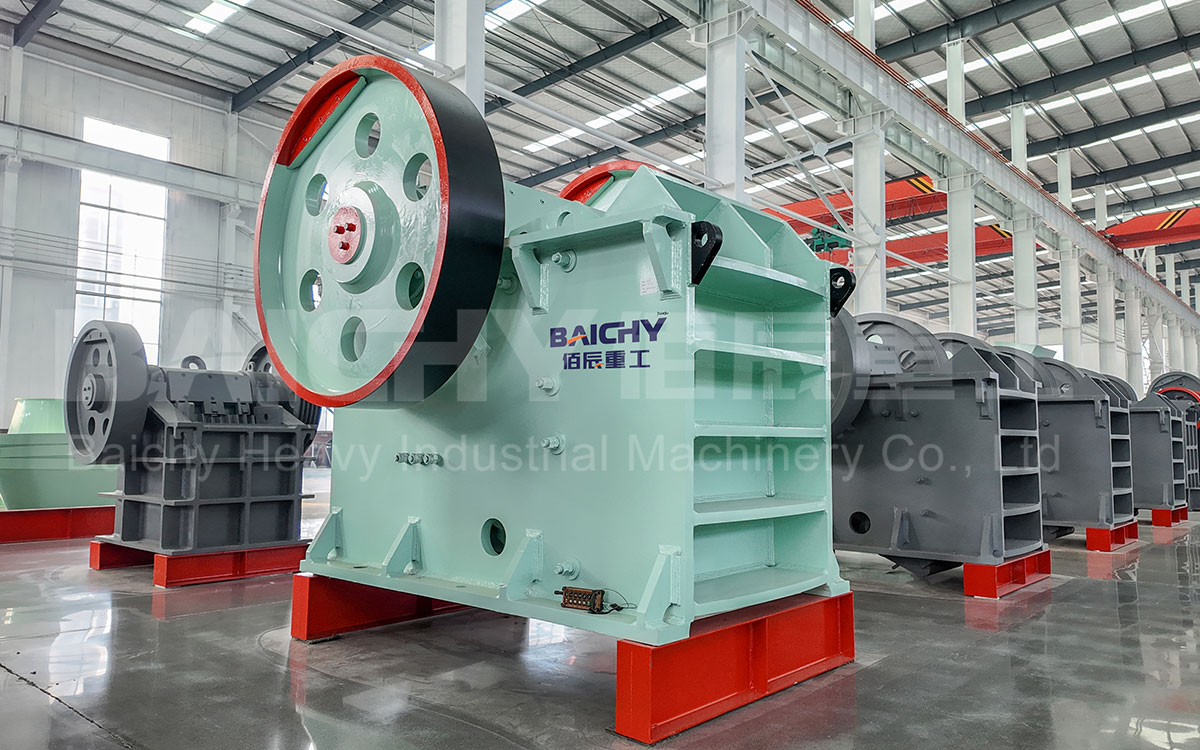
Feed opening size: 900x1200 mm
Max. Feed: 750 mm
Processing capacity: 220-550 t/h
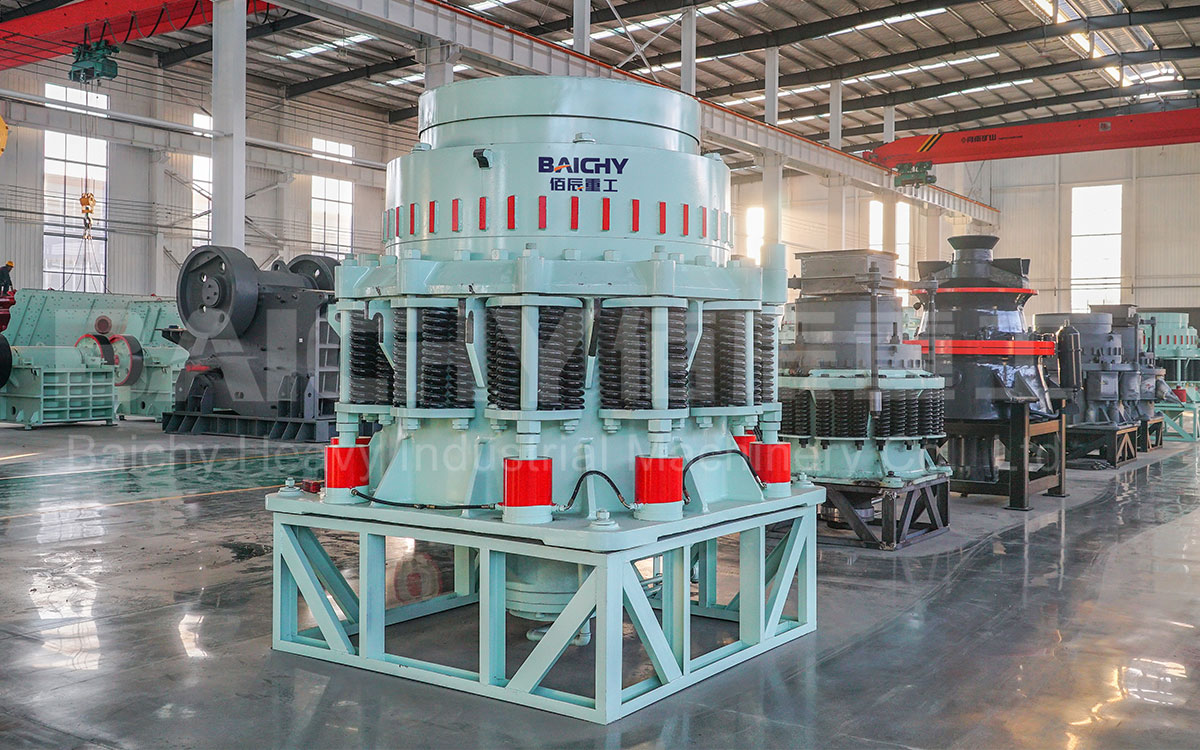
Feed Size: ≤190 mm
Discharge Size: 12-25 mm
Capacity: 110-445 t/h
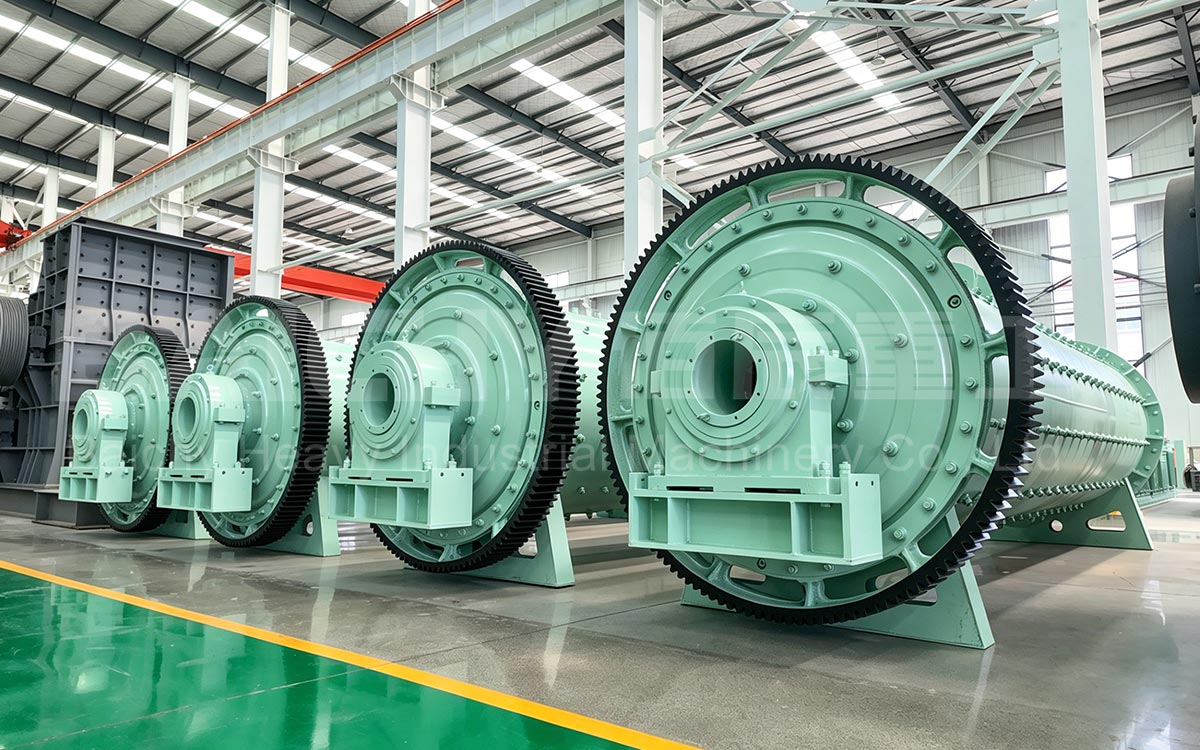
Max. Feed: <25 mm
Power: 800 kw
Processing Capacity: 25-55 t/h
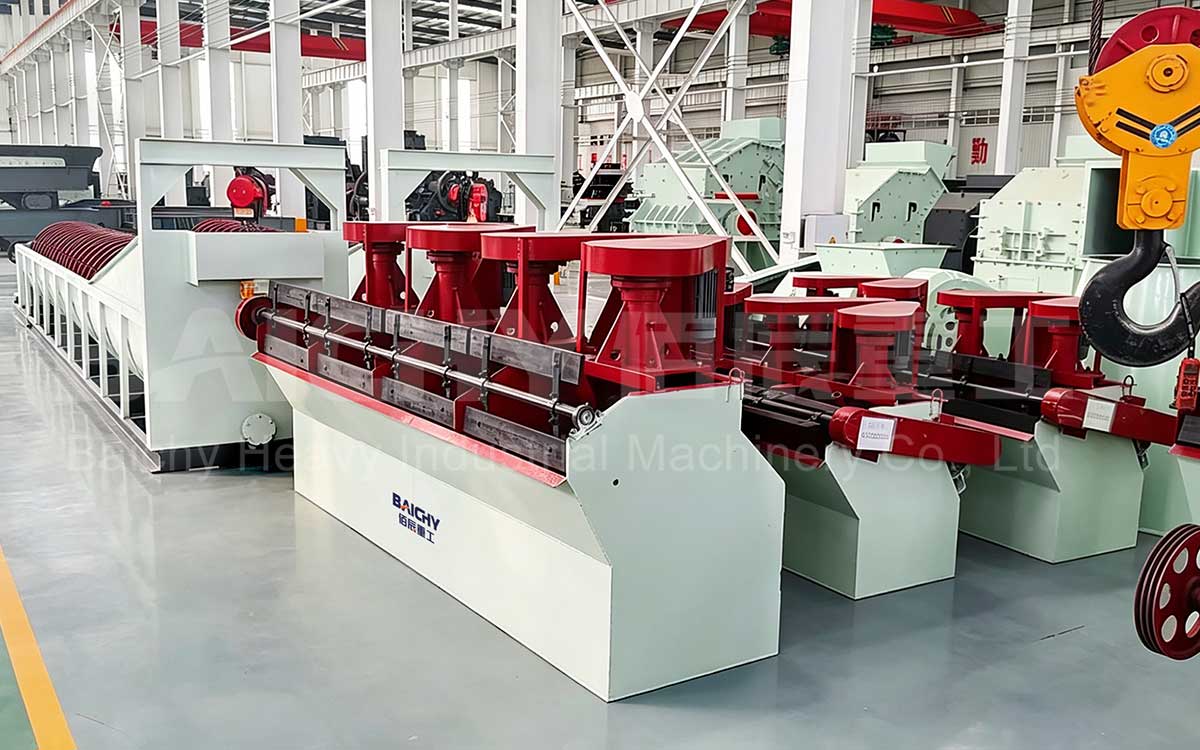
Volume: 0.37-4 m³
Impeller Dia.: 300-650 mm
Capacity: 0.24-4 m³/min
Copper flotation is currently the mainstream process for beneficiating copper sulfide and mixed copper ores. The core principle relies on differences in mineral surface hydrophobicity; by adding flotation reagents—such as collectors, frothers, and modifiers—air bubbles are generated within the slurry to float the copper minerals, thereby separating the copper concentrate from gangue minerals.
Ore Characteristics: Predominantly chalcopyrite with minor bornite; feed grade Cu 0.65%
Configuration: Single-stage grinding + one roughing, two cleaning, and two scavenging stages
Performance: Concentrate Cu 24.5%, recovery 91.2%
Commissioning Date: June 2023
Ore Characteristics: Malachite, chrysocolla, and chalcocite; feed grade Cu 2.1%
Configuration: Sulfidization pretreatment + one roughing, three cleaning, and two scavenging stages
Performance: Concentrate Cu 21%, recovery 78% (approaching the recovery ceiling for oxide ore flotation)
Commissioning Date: March 2024
Ore Characteristics: Chalcopyrite, bornite, and chalcocite; feed grade Cu 0.52%
Configuration: Two-stage grinding + one roughing, three cleaning, and three scavenging stages + middlings regrinding
Performance: Concentrate Cu 26%, recovery 93.5%
Commissioning Date: November 2024
No two quarries are the same. That's why every Baichy configuration starts with your raw material and target capacity — never a catalog template. The installations below are just a sample. Your project could be the next one on this list.
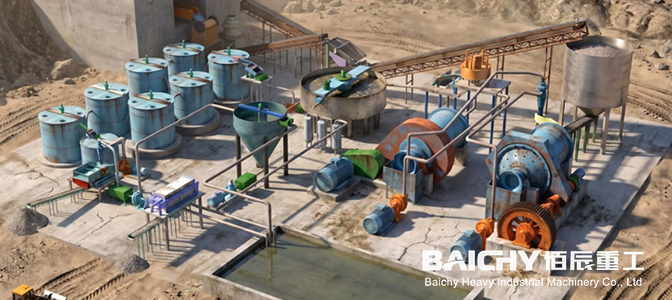
Gold Ore Flotation Extraction Plant & Equipment Solutions
1. Conventional process (applicable to high-grade gold ore)
Ore → coarse crushing (jaw crusher) → medium crushing (cone crusher) → fine crushing → ball milling → flotation/cyanidation → smelting
2. Low-grade gold ore (heap leaching)
Ore → coarse crushing → fine crushing → heap building → spray cyanidation → activated carbon adsorption → electrolytic gold extraction
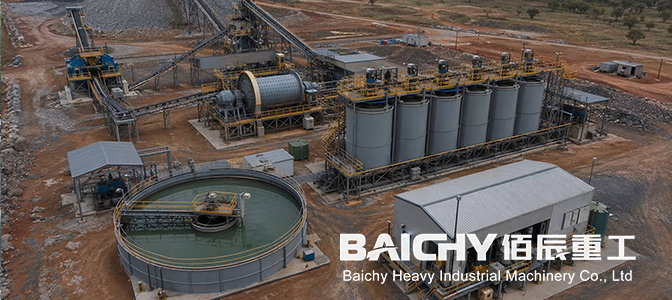
100TPD Gold Processing Plant South Africa: Complete CIL/CIP Line
Baichy Heavy Industry has launched a one-stop, full-process 100 TPD CIL/CIP equipment line for the South African market; covering the entire workflow—from crushing and grinding to leaching, adsorption, desorption/electrowinning, and smelting—it supports EPC turnkey delivery.
Tell us your raw material and target capacity. Our engineers will design a custom line and send you a quote within 24 hours.
Get Your Custom Layout & Quote NowWe don't just sell machines. We deliver production lines that work — on time, on spec, on budget.
Certified manufacturing. 35,000 m² facility. 200+ skilled workers. All key components made in-house.
Senior engineers analyze your rock type, feed gradation, moisture content, and site elevation before proposing a single machine.
Foundation drawings, steel structure, electrical controls, dust suppression, installation supervision, and operator training — all included.
No dealer, no trader, no markup. You pay the ex-factory price. Competitive freight to your seaport.
Full warranty on main equipment. Wearing parts always in stock. Shipped within 48 hours via DHL/FedEx.
Lines operating in Indonesia, Philippines, Saudi Arabia, Nigeria, Kenya, Peru, Kazakhstan, Russia, and more.



