
High-aging soil drying equipment
In the deep processing of non-metallic minerals such as kaolin, bentonite, etc., the drying process is a crucial step determining the activity, whiteness, and economic benefits of the final product. Faced with the challenging requirement of processing capacity of 1 ton/hour, reducing moisture content from 20% to 1%, selecting a well-designed and stable rotary dryer is essential.
As a professional manufacturer with 20 years of experience in mining crushing and drying equipment, we understand that a successful drying solution is far more than just a single machine. It is a customized system based on thermal calculations, fluid mechanics, and long-term practical experience. Below, we will provide an in-depth analysis based on your specific parameters.
Core Requirements Analysis and Equipment Selection Recommendations
Your 1 ton/hour refers to the processing capacity of oven-dried material. Considering a wet basis moisture content of 20%, our actual wet material processing capacity should be:
Wet Material Capacity = Oven-Dry Material Capacity / (1 - Wet Basis Moisture Content) = 1 ton / (1 - 0.2) = 1.25 tons/hour.
To achieve a depth of drying from 20% to 1%, the evaporation rate is enormous:
Theoretical evaporation rate = Wet material amount - Dry material amount = 1.25 - 1 = 0.25 tons/hour.
But this is just the beginning. In actual design, we need to consider the material's initial temperature, specific heat capacity, latent heat of vaporization, hot air temperature, system heat loss, and the burner efficiency (70%) you mentioned. The burner power of 93kW (approximately 800,000 kcal/hour) you provided is crucial data derived from complete heat balance calculations, ensuring the scientific nature of the energy configuration.
| Parameter Items | Customer-Specified Values/Calculated Values | Description |
| Final Product | Output 1 ton/hour | Oven-dried Kaolin |
| Feed | Moisture Content (Wet Basis) 20% | Deep drying, high requirements |
| Output | Moisture Content (Wet Basis) 1% | |
| Wet Material Processing Capacity | ≈1.25 tons/hour | Calculated from oven-dried output |
| Moisture Evaporation | ≈0.25 tons/hour | Core drying task |
| Required Thermal Power (Theoretical) | Approximately 650,000-750,000 kcal/hour | Considering material heating, moisture evaporation, heat loss, etc. |
| Burner Configuration Power | 93 kW (≈800,000 kcal/hour) | 70% overall thermal efficiency considered, reasonable configuration |
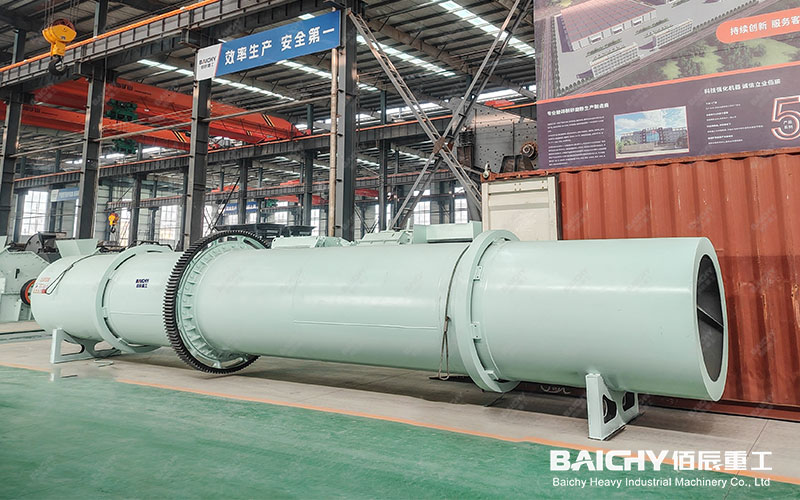
Recommended for you: Ø1.5×12 meter high-efficiency indirect heating rotary dryer
Based on the above analysis, and to protect the high activity of kaolin and avoid direct product contamination by flue gas, we strongly recommend... Ø1.5×12 meter indirect heating (steam pipe or thermal oil type) rotary dryer.
Why indirect heating?
1. Quality Assurance: The heat source (high-temperature flue gas or thermal oil) flows within the pipes, and heat is transferred to the material through the pipe walls, completely eliminating contact between the flue gas and the material, ensuring the purity and whiteness of the product.
2. High Thermal Efficiency: The outer shell of the dryer has an insulation layer, and the internal heat exchange pipes are densely arranged, resulting in minimal heat loss. Thermal efficiency is typically 10-15% higher than direct heating.
3. Environmentally Friendly and Clean: Low exhaust gas volume and light dust handling burden, better meeting environmental protection requirements.
Core Advantages of this Model:
• Design Matching: The dryer dimensions are verified using formulas based on our 20 years of experience, ensuring sufficient residence time for the material within the dryer (typically adjusted to 40-60 minutes), thereby stably achieving a final moisture content of 1%.
• Customized Design: The internal structure of the dryer is specially designed with lifting plates and cleaning devices to prevent material from sticking to the walls and forming scale, taking into account the sticky nature of kaolin.
• Intelligent Control: Equipped with a temperature control and frequency conversion speed system, it can automatically fine-tune according to fluctuations in feed moisture content, ensuring a constant outlet moisture content.
• Durable and Reliable: The main drive uses a hardened gear reducer, and the rollers and thrust rollers are made of wear-resistant heat-treated materials, ensuring trouble-free operation of a production line with an annual output of tens of thousands of tons.
Regarding Price: A Worthwhile Long-Term Investment
A complete drying system (including the main unit, combustion system/hot air furnace, air intake dust removal system, induced draft fan, electrical control system, steel structure platform, etc.) with the above configuration (Ø1.5×12m indirect heating rotary dryer) typically costs between RMB 300,000 and 500,000.
Price fluctuations mainly depend on:
• Material Requirements: Whether the interior parts in contact with the material need to be made of stainless steel.
• Heat Source Selection: Whether a gas/oil burner, a biomass pellet hot air furnace, or a steam/thermal oil boiler is used.
• Automation Level: Brand and functional complexity of the PLC control system.
• Environmental Requirements: Configuration level of the exhaust gas dust removal equipment (e.g., cyclone + bag filter).
Please understand that this is not just a quote for a single piece of equipment, but a comprehensive solution including process design, manufacturing, installation guidance, and technical support. Our 20 years of experience ensure that the system operates with minimal energy consumption and maximum stability after commissioning, allowing you to quickly recoup your costs and create long-term value.