
raymond griniding mill vs vertical roller crusher
The Raymond Mill and the Vertical Roller Mill (VRM) are the two dominant types of equipment in the field of powder processing. Simply put, the core consideration when selecting between them lies in balancing "scale" against "precision": the Raymond Mill serves as the "economical and practical choice" for small-to-medium-scale capacities, while the Vertical Roller Mill acts as the "all-around performer" for large-scale, continuous production operations.
I. Quick Reference Guide: Key Parameters
| Comparison Dimension | Raymond Mill | Vertical Roller Mill |
| Working Principle | Suspended roller crushing + Air classification (Impact + Grinding | Material bed crushing + Dynamic classification (Crushing + Shearing) |
| Applicable Scale | Small to medium scale (1–20 tons/hour) | Large-scale continuous lines (5–400+ tons/hour) |
| Product Fineness | 80–600 Mesh (Standard applications) | 80–2500 Mesh (Significant advantages for ultra-fine powders) |
| Energy Consumption | Relatively High (Approx. 25–35 kWh/t) | Low (Approx. 18–25 kWh/t; saves 20–30% energy) |
| Moisture Tolerance | Sensitive (Typically requires ≤6%) | Integrated Drying Capability (Can process wet materials up to ≤15% moisture) |
| Investment Threshold | Low (Simple structure, low maintenance costs) | High (Complex system, high initial investment) |
| Optimal Applications | Medium-to-low hardness materials (e.g., limestone, calcite, gypsum) | Slag, cement raw meal, high-hardness non-metallic minerals |
II. In-Depth Analysis of Key Differences
1. Working Principle and Efficiency
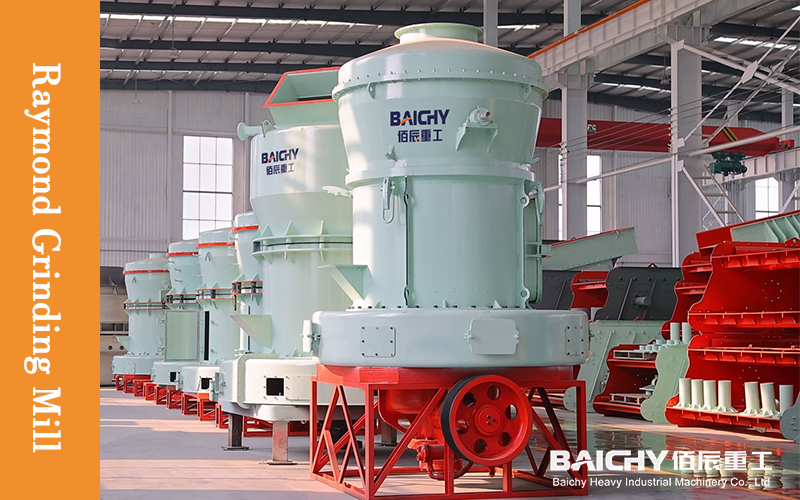
Raymond Mill
• Raymond Mill: Relies on the centrifugal rolling action of grinding rollers against a grinding ring to crush materials. While its structure is simple, it suffers from a certain degree of "idle running" loss; furthermore, fine particles are prone to "over-grinding," resulting in relatively high energy consumption.
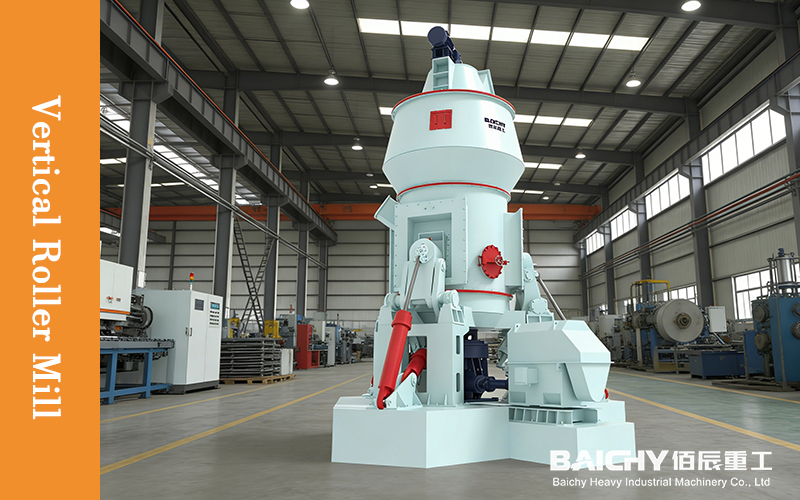
vertical roller mill
• Vertical Roller Mill: Employs a "material bed" grinding principle, wherein material is crushed by grinding rollers pressing down onto a grinding table. By integrating an efficient dynamic classifier, it achieves a unified process encompassing "grinding + classification + drying." This results in extremely high system efficiency, with the specific energy consumption per ton of product being significantly lower than that of a Raymond Mill.
2. Material Suitability
• Raymond Mill: Suitable for non-metallic minerals with a Mohs hardness of ≤7 (e.g., limestone, heavy calcium carbonate). It is extremely sensitive to moisture; wet materials can easily cause clogging, so it typically requires accompanying pre-drying equipment.
• Vertical Mill: Capable of processing high-hardness (≤9.5) and highly abrasive materials (e.g., slag, coal gangue). It features an integrated hot air system that can directly dry materials, thereby eliminating the need for a separate drying stage.
3. Product Quality and Environmental Performance
• Fineness Control: The efficiency of a Raymond mill drops significantly when processing materials finer than 400 mesh. A vertical mill, however, allows for precise control of D97 fineness by adjusting rotor speed, offering significant advantages in the production of ultra-fine powders (1250 mesh and finer).
• Environmental Performance: The vertical mill features excellent overall sealing and operates under negative pressure, resulting in minimal dust leakage. Raymond mills typically require additional, enhanced dust removal measures to meet stringent environmental standards.
III. Selection Decision Guide
1. When should you choose a Raymond Mill?
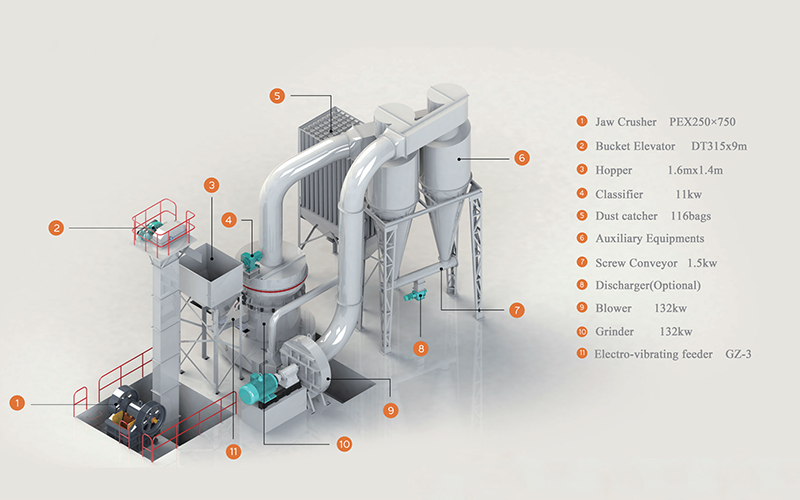
Raymond Mill Process Flow Diagram
• Limited Budget: The initial investment budget is in the range of a few hundred thousand, and you wish to avoid incurring substantial equipment loans.
• Small Scale: The required hourly output is less than 10 tons, or production is intermittent (e.g., for small-batch orders).
• Simple Materials: You are processing dry, low-hardness non-metallic minerals, and the required product fineness is only between 200 and 400 mesh (e.g., for standard coating fillers).
• Limited Maintenance Capabilities: You lack skilled electromechanical technicians and require equipment with a simple structure and easily obtainable spare parts.
2. When is a Vertical Mill the mandatory choice?
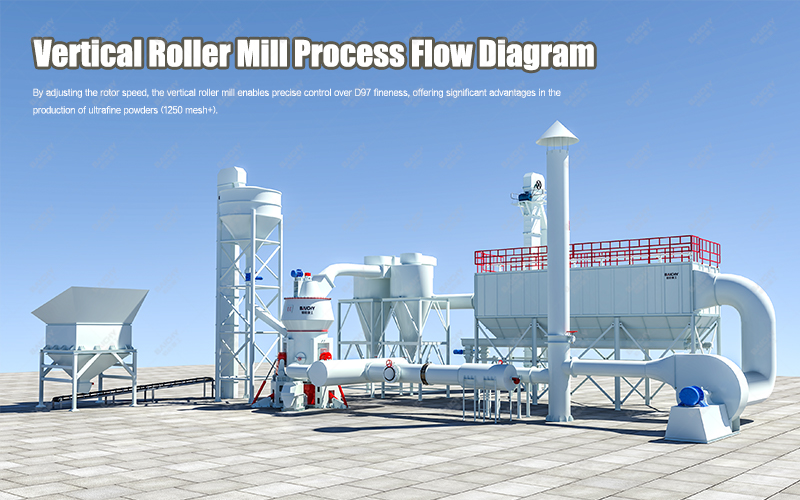
Vertical Roller Mill Process Flow Diagram
• Large-scale Continuous Production: The required hourly output is ≥20 tons, or the planned annual production capacity exceeds 100,000 tons.
• Energy Cost Sensitivity: Local electricity rates are high, and the production operation is a long-term endeavor (the electricity savings generated by a vertical mill can often offset the price difference within just a few months).
• Complex Processing Requirements: The raw materials contain significant moisture (>6%), or you need to produce high-value-added ultra-fine powders finer than 800 mesh (e.g., for high-end plastic masterbatches).
• Strict Environmental Regulations: The facility is located in an area with rigorous environmental controls, necessitating a closed-loop system with low noise levels and minimal dust emissions.
IV. Practical Recommendations
1. Consider the Total Cost, Not Just the Unit Price: Raymond mills are "cheap to buy but expensive to run" (due to high electricity costs), whereas vertical mills are "expensive to buy but economical to run." If you plan to operate for more than three years, the overall lifecycle cost of a vertical mill is typically lower.
2. Focus on Raw Materials, Not Just the Equipment: If your raw materials consist of wet slag or kaolin, you should immediately rule out the Raymond mill; the additional investment and operating costs required for a separate drying line would make it an uneconomical choice.
3. Allow for Future Capacity: If your current production demand is at the upper limit of a Raymond mill's capacity (e.g., 8 tons per hour) and you have plans to expand production in the future, we recommend making the extra investment now to acquire a small-scale vertical mill. This will prevent your equipment from becoming obsolete and requiring replacement just two years down the line.
In Summary: For small-scale operations involving dry materials and coarse grinding, choose a Raymond mill; for large-scale operations involving high-moisture materials, ultra-fine grinding, and a strong emphasis on energy efficiency, choose a vertical mill.
Frequently Asked Questions (FAQ)
1: What is the specific difference in initial investment between a Raymond mill and a vertical mill?
Answer: The investment gap is significant. A standard-configuration Raymond mill production line typically requires an investment ranging from several hundred thousand to just over one million RMB. In contrast, the vertical mill is a piece of heavy industrial machinery with a complex system; the price of the main grinding unit alone can reach several million or even tens of millions of RMB, making the total investment for the entire production line substantially higher. Crucially, the premium associated with a vertical mill is primarily allocated to energy-saving features, integrated drying capabilities, and intelligent control systems. For small and medium-sized enterprises (SMEs) with an annual processing volume of less than 50,000 tons, the Raymond mill generally offers a better cost-performance ratio.
2: I want to process kaolin with a moisture content of 12%. Which type of mill should I choose?
Answer: You *must* choose a vertical mill. A Raymond mill is virtually incapable of directly processing materials with a moisture content exceeding 6%; attempting to do so will result in blockages at the feed inlet and air ducts, causing a drastic drop in production output. A vertical mill, however, features a built-in hot air furnace that allows it to dry the material using a high-temperature airflow *simultaneously* while grinding—achieving a "grind-while-drying" capability. This is one of its core process advantages. Choosing a Raymond mill for such materials would necessitate the construction of a separate drying line beforehand, potentially driving the total project cost even higher than that of simply installing a vertical mill in the first place.
3: I've heard that operating a vertical mill is quite complex. Does it require highly skilled workers?
Answer: Yes, that is an objective fact. The operation and maintenance of traditional vertical roller mills are indeed more complex than those of Raymond mills, requiring highly specialized electromechanical engineers. However, the level of automation in modern vertical roller mills has improved significantly; by utilizing PLC/DCS central control systems, they now feature one-touch start-and-stop functionality, real-time monitoring, and automatic adjustment. Operators now primarily monitor screen parameters, resulting in a reduction in physical labor intensity. Nevertheless, advanced equipment maintenance and fault diagnosis still require the expertise of specialized technical personnel.