Ⅰ. Overview of Mobile Jaw Crushing Plant
A mobile jaw crusher plant, also known as a truck-mounted mobile jaw crusher or mobile primary crushing plant, is a complete primary crushing unit that integrates a vibrating feeder, jaw crusher, iron remover, and conveying system onto a self-propelled or towed chassis. It completely revolutionizes the traditional fixed crushing line model that requires a concrete foundation, allowing for immediate production upon arrival and relocation as the mining face advances. It is particularly suitable for projects with short mining rights periods, dispersed mining faces, or the resource utilization of urban construction waste.
Based on the different chassis, the industry generally classifies them into two main categories:
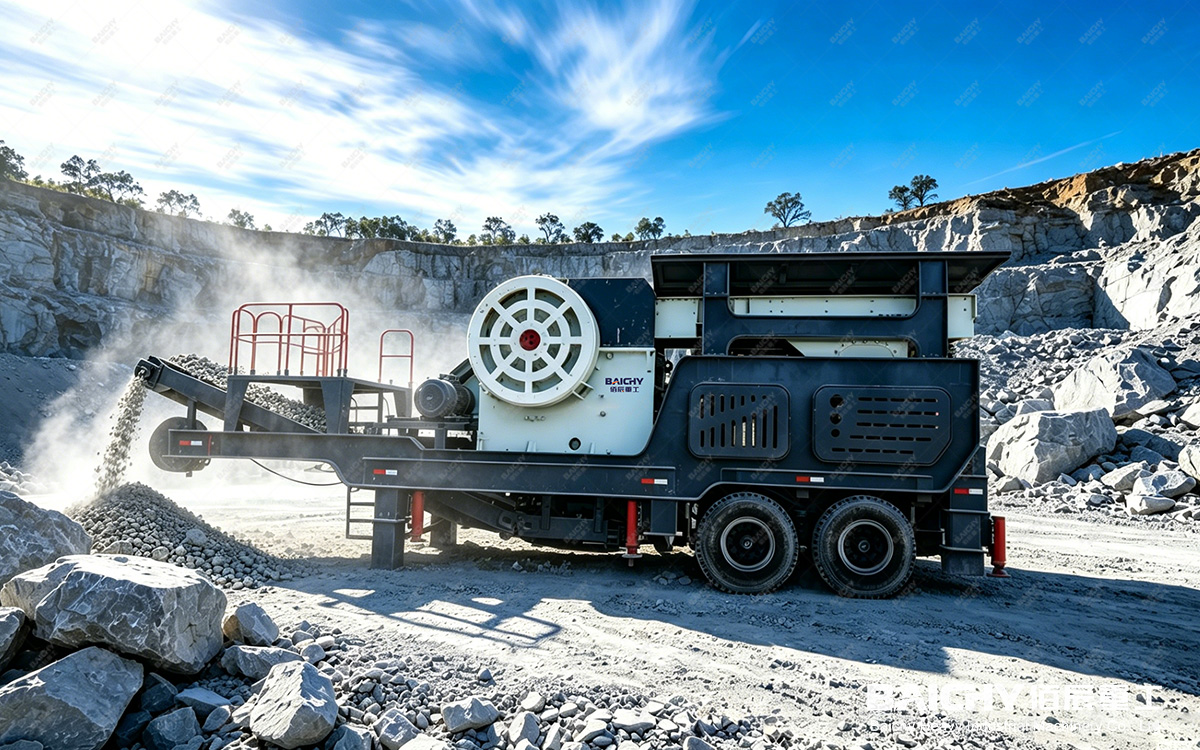
Tire-mounted mobile jaw crusher
1. Wheel-mounted Mobile Jaw Crusher Plant – Towed by a semi-trailer, often equipped with classic PE series or high-performance C/HD series European-style jaw crushers, with a capacity ranging from 40 to 400 tph (some large models can reach 500 to 650 tph).
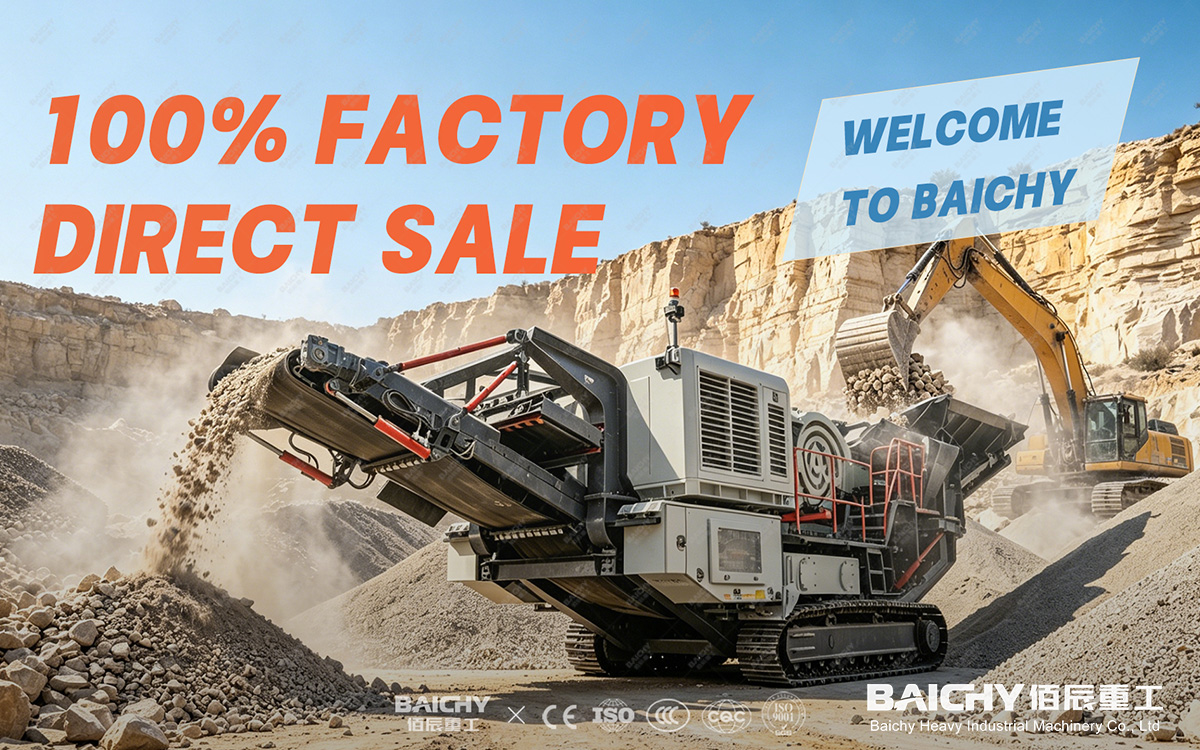
Tracked mobile jaw crusher
2. Tracked Mobile Jaw Crusher Plant – This type of plant uses a hydraulically self-propelled tracked chassis and typically features a C-series (European CJ model) jaw crusher. Capacities range from 40 to 400 tph, and it offers superior off-road capability in complex terrain.
This article will guide you in making accurate equipment selection decisions by examining structural differences, technical parameters, typical operating conditions, core advantages, and customer case studies.
II. Comparison of Core Technologies of Wheel-Mounted and Tracked Mobile Jaw Crusher Plants
2.1 Key Parameter Comparison Table
| Comparison Item | Wheel-Mounted Mobile Jaw Crusher Plant (Wheel Type) | Tracked Mobile Jaw Crusher Plant (Crawler Type) |
| Travel Method | Wheel-mounted chassis, requires semi-trailer or tractor unit for towing | Steel tracked hydraulic self-propelled, remote control operated |
| Common Jaw Crusher Main Units | PE series, HD German version jaw crusher, CJ European version jaw crusher (C series can also be equipped) | C series/CJ European version jaw crusher (deep cavity, large inclination angle) |
| Capacity Range | 40–400 tph (large models can reach 500–650 tph) | 40–400 tph (some heavy-duty large models can reach 500 tph) |
| Maximum Feed Size | ≤500–800 mm (depending on the main unit model) | ≤480–700 mm mm (depending on CJ series main unit) |
| Power Type | External industrial power grid (main motor) + optional diesel generator set | Built-in diesel engine driving hydraulic system (optional dual power) |
| Transfer Method | Can be directly towed on roads, low cost and fast for long-distance transfers | Self-propelled in mining areas; flatbed truck transport required for long-distance transfers |
| Site Adaptability | Requires flat, hardened or compacted ground, slope generally ≤8° | Suitable for soft ground, mud, gravel, and mountainous terrain, climbing slope ≤25°–30° |
| Ground Pressure | High, depends on tire pressure | Low (tracks distribute weight), not easy to sink |
| Production Preparation | Deploy hydraulic outriggers → connect to power → commissioning, approximately 0.5–2 hours | Immediate operation upon landing (some models require outrigger deployment), approximately 15–30 minutes |
| Initial Investment | Lower (usually 15%–30% cheaper for the same production capacity) | Higher (high cost of track system, hydraulic, and electrical control integration) |
| Operation and Maintenance Costs | Low (Tire replacement is inexpensive, electrical system is simple) | Medium-High (Track shoes and track rollers are wear parts, requiring regular cleaning and lubrication) |
| Recommended Scenarios | Urban construction waste, highway/railway sections, leveling quarries | Open-pit mine face operations, hydropower projects, mountain quarries |
Data compiled from mainstream industry manufacturers' technical manuals and engineering measurements.
2.2 Detailed Main Unit Configuration
1. Tire-mounted multi-configuration PE series & C/HD series jaw crushers: PE600×900, PE750×1060, PE900×1200 and other traditional deep cavity jaw crushers are economical and practical; high-end models can be upgraded to HD German version or CJ European version jaw crushers (laminated crushing chamber type, longer liner life, more uniform particle size). Suitable for projects sensitive to initial investment and with stable industrial power supply on site.
2. Tracked mobile jaw crushers: primarily the C-series (CJ type) European-style jaw crushers, such as CJ96, CJ106, and CJ120, feature large eccentricity, small meshing angle, and non-welded frames. They offer superior biting capacity and throughput for high-hardness granite, basalt, and iron ore. Combined with hydraulically adjustable discharge ports and overload protection, they are better suited for continuous heavy-duty mining operations.
III. Application Scenarios and Working Conditions
3.1 Typical Application Scenarios for Tire-Mounted Mobile Jaw Crusher
• Urban Construction Waste Recycling: Waste concrete blocks and brick-concrete structures (containing a small amount of reinforcing steel) are directly fed into demolition sites. The mobile station crushes and removes iron simultaneously, producing recycled aggregate. No fixed line is required; after completion, the material is towed to the next construction site.
• Supplying materials for multiple sections of highways/railways/water conservancy projects: Material yards along the route are scattered, and construction periods are short (3–6 months). The tire-mounted station can be quickly towed to the site along with each construction section, significantly reducing secondary aggregate transportation costs.
• Sand and gravel aggregate plants in plains or hilly areas: The site can be fixed for operation after simple leveling; electricity costs are low when connected to mains power, making it suitable for medium to large-scale continuous production.
3.2 Typical Application Scenarios of Tracked Mobile Jaw Crushers
• Open-pit metal/non-metal mine face operations: As blasting faces advance year by year, the tracked station can move autonomously to the edge of new pits for coarse crushing, reducing the haul distance for trucks. A single unit can reduce transportation costs by 20%–40%.
• Quarries in mountainous/collapsed/muddy terrain: No paved roads are available; the tracked ground pressure is low, allowing passage even in the rainy season, saving the cost of building temporary access roads.
• Remote engineering sites without power grids: Such as persion tunnel excavation for hydroelectric power stations and spoil disposal in tunnels, the self-contained diesel engine drive eliminates the limitation of power supply conditions.
IV. Core Advantages of the Equipment
4.1 Advantages of the Tire-Mounted Mobile Jaw Crusher
• Excellent Relocation Economy: Legally towed on highways, quick inter-city/inter-province relocation, single relocation time can be controlled within 1-2 hours, low equipment idle rate.
• Low Operating Costs: Primarily motor driven, power consumption per ton of crushing is lower than diesel-powered; tire wear is slow, daily checks only require tire pressure and bearing lubrication.
• Strong Modular Expandability: The same chassis can flexibly replace coarse/medium crushing modules, and can also be connected in parallel with mobile screening stations to form a "coarse crushing + screening" or "two-stage closed-circuit" mobile line.
• High Stability Platform: After deploying four hydraulic outriggers, the entire machine is fixed to the ground, with low vibration, suitable for mounting large-cavity PE series jaw crushers to obtain greater single-machine capacity.
4.2 Advantages of the Tracked Mobile Jaw Crusher
• All-Terrain Self-Propelled: Hydraulic tracks can turn on the spot and climb slopes, allowing direct access to blasting platforms or canyon working faces, truly "crushing wherever it goes."
• Rapid Deployment: Crushing can begin immediately upon unloading, requiring minimal leveling, making it ideal for projects with tight deadlines.
• Heavy-Duty Adaptability: The C-series European-style jaw crusher, paired with a heavy-duty tracked chassis, offers excellent impact resistance and wear resistance against highly abrasive hard rocks (granite, basalt, iron ore).
• Intelligent Centralized Control: Standard PLC + wireless remote control allows real-time monitoring of main unit current, oil temperature, and discharge port opening, facilitating unmanned management and fault warnings.
V. Customer Application Cases
Case 1: Construction Waste Recycling Aggregate Project in an East China City (Tire-Mounted)
• Background: Approximately 500,000 cubic meters of waste concrete were generated from urban renewal projects, requiring on-site processing and supply to surrounding roadbed filler. The project duration was estimated at 18 months, pided into 3 demolition areas.
• Solution: Configuration of 1 tire-mounted mobile jaw crusher (equipped with a PE750×1060 jaw crusher, with a production capacity of 120–180 tph per hour) + 1 tire-mounted mobile screening station.
• Results: Transfer time for each section is less than 2 hours; power consumption per ton of material is approximately 1.1 kWh when connected to the industrial power grid; the qualified rate of recycled aggregate (0–31.5 mm) is >90%, saving the customer approximately RMB 3.6 million per year in off-site disposal costs and new aggregate purchase costs.
Case Study 2: A Granite Open-Pit Mine in Southwest China - Face Crushing (Crawler Type)
• Background: Annual mining volume of 600,000 tons of granite, with the mining face advancing 150–200 meters annually. The original fixed crushing line required dismantling and hoisting each time it was relocated, resulting in high costs and prolonged downtime.
• Solution: One crawler-type mobile jaw crusher (equipped with a CJ106 European-style jaw crusher, with a production capacity of 180–220 tph per hour), diesel-powered, self-propelled following the mining face.
• Results: Direct coarse crushing within the pit reduces the average truck haul distance from 1.2 km to less than 300 m, saving approximately 28% in annual transportation costs; daily relocation time is less than 30 minutes, and the overall equipment operating rate increases to 92%.
VI. Recommended Equipment (Supply Available)
| Recommended Models | Type | Main Unit Configuration | Capacity (tph) | Applicable Scenarios |
| PYDZ-PE Series Tire-Mounted Mobile Jaw Crusher | Tire-Mounted | PE400×600 / PE600×900 / PE750×1060 / HD86–HD125 | 40–400 (Max 650) | Construction waste, highway construction, plain quarries |
| PYDZ-C Series Tracked Mobile Jaw Crusher | Tracked | CJ96 / CJ106 / CJ120 European Jaw Crusher | 50–400 | Open-pit mines, mountain quarries, construction sites without electricity |
| Matching Mobile Screening Station (Tire/Tracked) | Tire or Tracked | 2YK/3YK Vibrating Screen + Multi-layer Conveyor Belt | 80–500 | Connected in series with a mobile jaw crusher to form a closed-circuit/two-section mobile line |
VII. Frequently Asked Questions about Mobile Jaw Crusher Stations
Q1: How to choose between a tire-mounted or tracked mobile jaw crusher?
A: If your project is located in an urban area or on a flat site, requires frequent cross-city relocation, and has access to municipal power, a tire-mounted type is the first choice (lower investment, lower operating costs); if operating in a mine pit, on muddy/sloping terrain requiring advancement with the mining face, or without a stable power grid, a tracked type is the first choice (strong terrain adaptability, immediate production upon arrival). For mining rights less than 3 years and scattered locations, the tracked type has a clear advantage in following the mining face; for fixed plants with continuous production for more than 5 years, the tire-mounted type offers better cost performance.
Q2: Can a mobile jaw crusher directly process construction waste containing reinforcing steel?
A: Yes. The standard suspended magnetic separator can remove reinforcing steel in the initial stage, and the jaw crusher chamber has good throughput for concrete blocks containing a small amount of reinforcing steel; it is recommended to select a pre-screening feeder (grizzly feeder) to pre-separate fine materials, reducing the load on the main unit and increasing production capacity.
Q3: Are the fuel consumption and wear parts consumption high for tracked mobile jaw crushers? Is it not cost-effective?
A: Tracked stations have their own diesel engines. A typical 200 tph model consumes approximately 18–28 L of fuel per hour (depending on load and model), which is a necessary expense in mining areas without electricity. Track plates and track rollers are normal wear parts, generally requiring inspection and replacement every 2000–5000 hours. With proper maintenance, the total life-cycle cost is controllable. Considering the comprehensive benefits of reducing truck haul distance and saving on road construction and foundation work, most mining projects can recoup the cost difference within 1.5–2 years.
Conclusion: Mobile jaw crushers are a highly flexible solution in modern sand and gravel aggregate and primary crushing processes in mining. Wheeled models are known for their economy and speed, while tracked models excel in strong mobility and require no foundation investment—there is no absolute superiority or inferiority, only the degree of matching with the working conditions. As a professional manufacturer of mining crushing, grinding and mineral processing equipment, we can provide you with free one-on-one process selection solutions and on-site technical consultation services based on your material properties, capacity requirements, site conditions and budget.