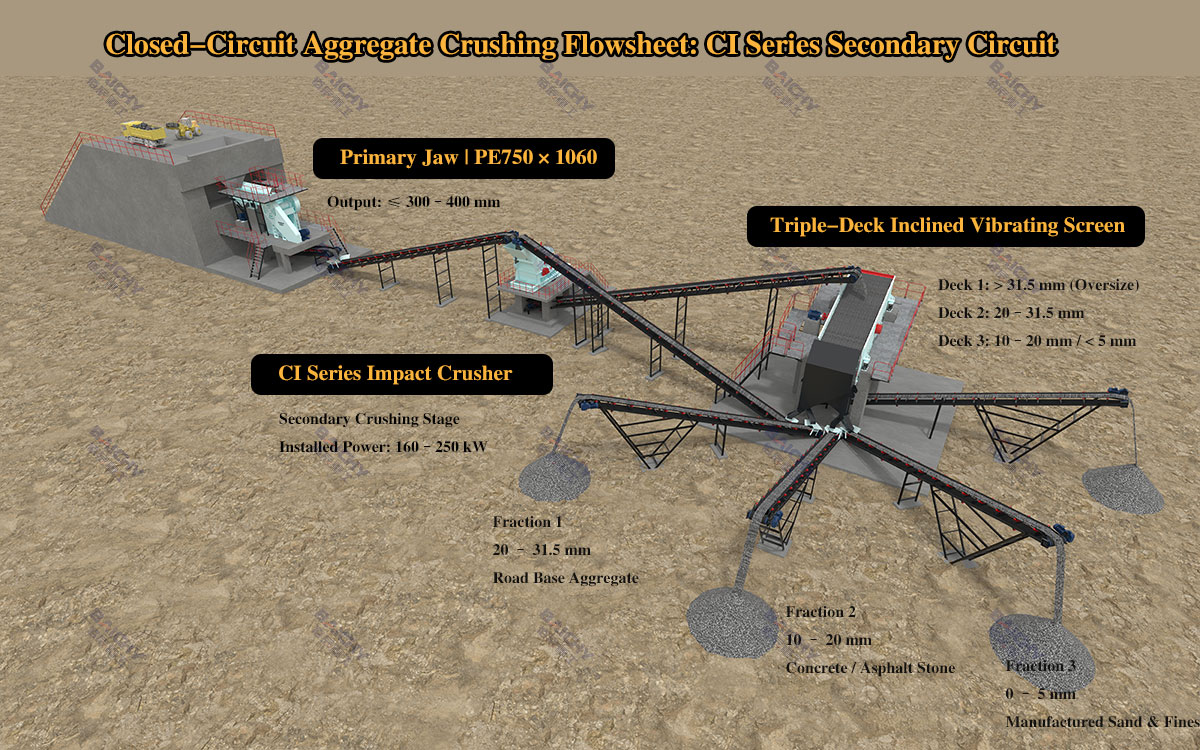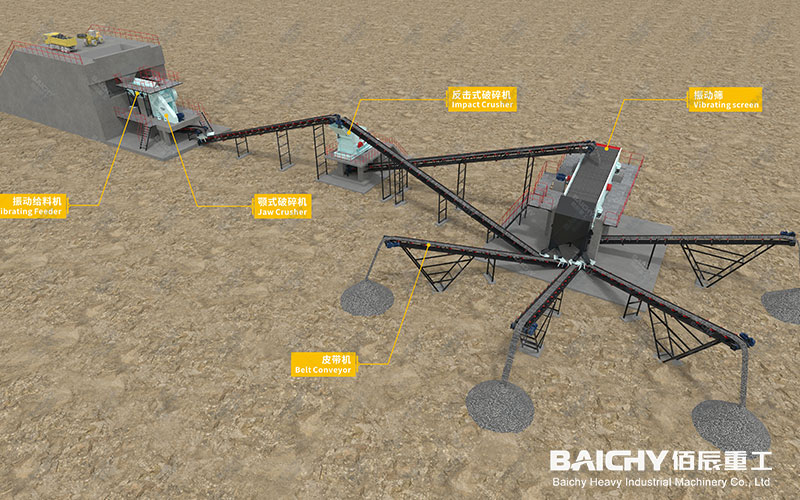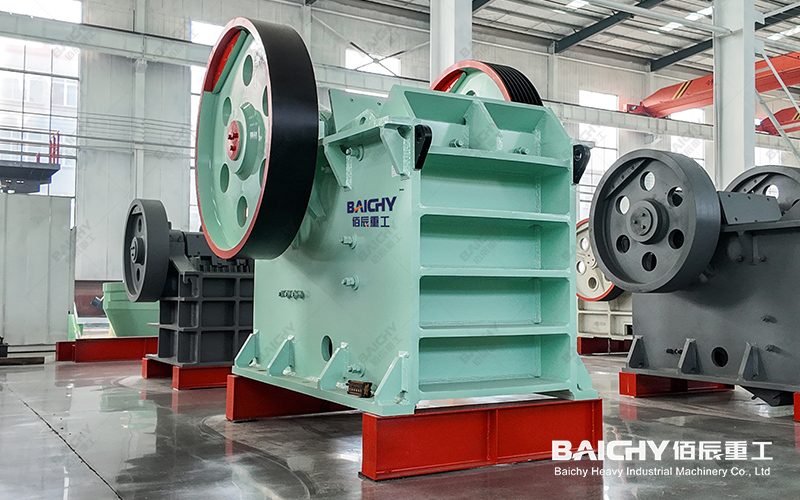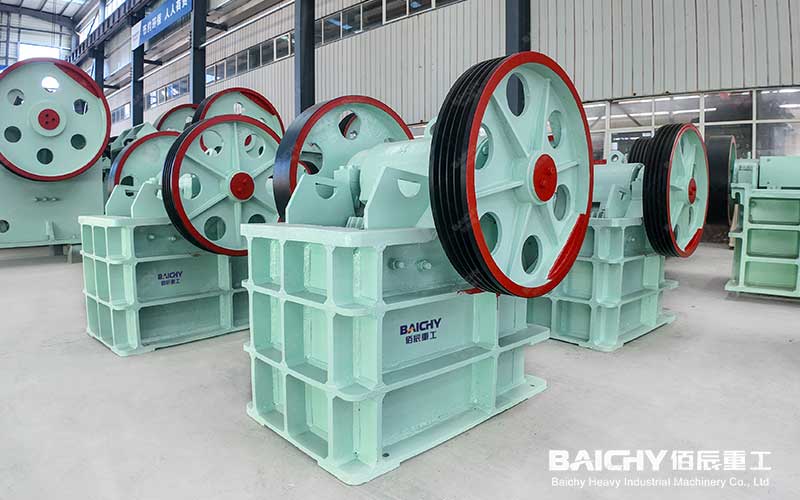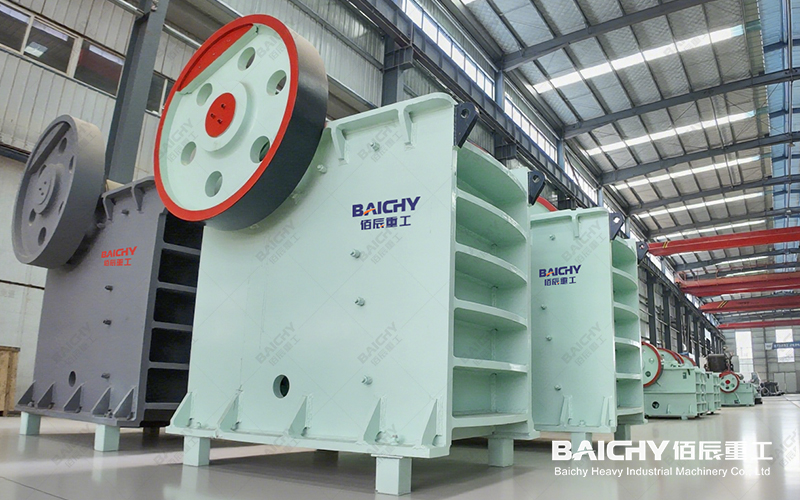
Jaw crushers are displayed in the workshop
In the field of mining crushing, the jaw crusher, as the main force in the coarse crushing stage, directly affects the efficiency and cost of the entire production line. Among the core maintenance tasks of this powerful equipment, gap adjustment is a seemingly simple yet crucial technical skill.
As a crusher manufacturer with 20 years of experience in designing, manufacturing, and servicing, we understand that a precise adjustment not only brings ideal material particle size and output but also significantly extends the service life of vulnerable parts (such as jaw plates), thereby maximizing economic benefits for our customers.
This article will provide a clear and concise analysis of all aspects of jaw crusher gap adjustment.
I. Why Adjust the Gap?
The working principle of a jaw crusher is that the moving jaw reciprocates periodically relative to the fixed jaw, thereby squeezing and crushing the material. The minimum distance between the two jaw plates is what we call the discharge gap. The size of this gap directly determines three key indicators:
1. Product Particle Size: This is the most direct impact. The smaller the gap, the finer the particle size of the crushed material; conversely, the larger the gap, the coarser the output particle size. 1. Adjusting the gap: This is the primary means of achieving different particle size requirements.
2. Processing Capacity (Output): Under the same conditions, appropriately increasing the gap allows more material to pass through smoothly, theoretically increasing output. However, it should be noted that an excessively large gap will reduce the crushing ratio, potentially increasing the load on subsequent equipment.
3. Jaw Plate Wear and Lifespan: A uniform and appropriate gap ensures that material is evenly compressed within the crushing chamber, preventing premature localized wear of the jaw plates and the formation of deep pits or grooves, thereby increasing jaw plate lifespan by 30% or more. Incorrect gaps are one of the main causes of abnormal jaw plate wear.
II. Necessary Preparations Before Adjustment: Safety and Inspection
Before starting any adjustment operation, safety procedures must be strictly followed!
• Power Off! Warning Signs! Ensure the equipment is completely stopped, the main power supply is disconnected, and a Do Not Power On warning sign is displayed.
• Clean the Crushing Chamber: All material must be thoroughly removed from the crushing chamber, ensuring no residue remains. This is a fundamental prerequisite for adjustment operations.
• Check component condition: Inspect the wear of key vulnerable parts such as the jaw plate and toggle plate. If the jaw plate is excessively worn, adjusting the clearance will be meaningless; in this case, the liner should be replaced first.
III. Detailed Explanation of Three Mainstream Clearance Adjustment Methods (with Steps)
Different types of jaw crushers use different adjustment mechanisms. The following are three of the most common methods:
1. Shim Adjustment Method (Most Traditional, Most Reliable)
This is the method used in most traditional jaw crushers. It is mainly achieved by increasing or decreasing the number of shims between the adjusting seat and the rear wall of the frame.
• Steps:
a. Use lifting equipment (such as a jack) to hold the moving jaw shaft, so that components such as the thrust plate and toggle plate are in a relaxed state.
b. Remove the clamping bolts of the adjusting seat.
c. According to the target clearance, increase (decrease) or decrease (increase) the number of steel shims by a certain amount.
d. Tighten the clamping bolts and remove the jack.
• Advantages: Reliable structure, large adjustment range.
• Disadvantages: Adjustment requires machine shutdown and is time-consuming.
2. Wedge Adjustment Method (More Efficient, More Modern)
Modern large jaw crushers commonly use wedge adjustment devices. Tightening bolts moves the wedge up and down, thus shifting the adjusting seat forward and backward.
• Steps:
a. Tighten the upper adjusting bolt to raise the wedge, pushing the adjusting seat forward and reducing the discharge port gap.
b. Tighten the lower adjusting bolt to lower the wedge, causing the adjusting seat to move backward under the action of the pull rod spring, increasing the discharge port gap.
c. After adjustment, tighten the lock nut to prevent loosening.
• Advantages: Convenient and quick adjustment; allows for fine-tuning without stopping the machine to a certain extent; safe and efficient.
3. Hydraulic Adjustment Method (Highest-End, Most Intelligent)
Some high-end jaw crushers use a fully hydraulic control system. The hydraulic cylinder directly pushes the adjusting seat or moving jaw to achieve stepless adjustment of the gap.
• Steps: Typically, the target gap value is input via a PLC touchscreen in the control room, and the system automatically completes the adjustment.
• Advantages: Extremely simple and precise operation, enabling automated control and remote monitoring, making it the preferred choice for large-scale modern mines.
• Disadvantages: High manufacturing cost, relatively complex system.
IV. Common Misconceptions and Professional Advice During Adjustment
• Misconception 1: Focusing only on the gap value, ignoring symmetry. During adjustment, it is essential to ensure that the gap on both sides of the moving jaw is consistent; otherwise, it will lead to increased wear on one side, unstable equipment operation, and abnormal vibration.
• Misconception 2: Mixing new and old jaw plates. It is absolutely forbidden to use new and old jaw plates or jaw plates from different manufacturers together. This will lead to uneven stress and serious damage to the equipment.
• Professional Advice: After adjustment, manually rotate the jaw to make it reciprocate for 2-3 cycles to check for any jamming. Run it under no-load for a few minutes to observe whether the current and sound are normal. Then, input a small amount of material for a load test and screen the output particle size, making fine adjustments if necessary.
Precise adjustment of the jaw crusher gap is an important benchmark for measuring the professionalism of an operations team. It's not an isolated operation, but a systematic project closely linked to equipment maintenance, production planning, and cost control. Mastering this skill means you can proactively control production efficiency, rather than passively dealing with equipment problems. We hope this experience sharing will provide you with practical help. If you have any questions, please feel free to contact our technical team with 20 years of practical experience; we will provide you with the most professional support.