
In the increasingly competitive sand and gravel aggregate market, efficiency and flexibility have become core determinants of project profitability. For hard and highly abrasive materials like granite, achieving efficient, economical, and environmentally friendly crushing operations is a challenge every project manager must face. When your target output is set at a medium-to-high capacity range of 100-150 tons per hour, a properly configured mobile crushing plant is no longer just an "optional piece of equipment," but your "winning trump card" in the market.
Today, we will delve into why mobile crushing plants are the ideal choice for granite crushing and how to configure a successful mobile production line for your 100-150 tons/hour granite project.
I. Why Choose a Mobile Crushing Plant to Address the Challenges of Granite?
Granite is known for its high hardness, high compressive strength, and high abrasiveness. This places extremely high demands on the wear resistance, power, and stability of crushing equipment. Mobile crushing plants, with their inherent advantages, perfectly meet the needs of granite mining:
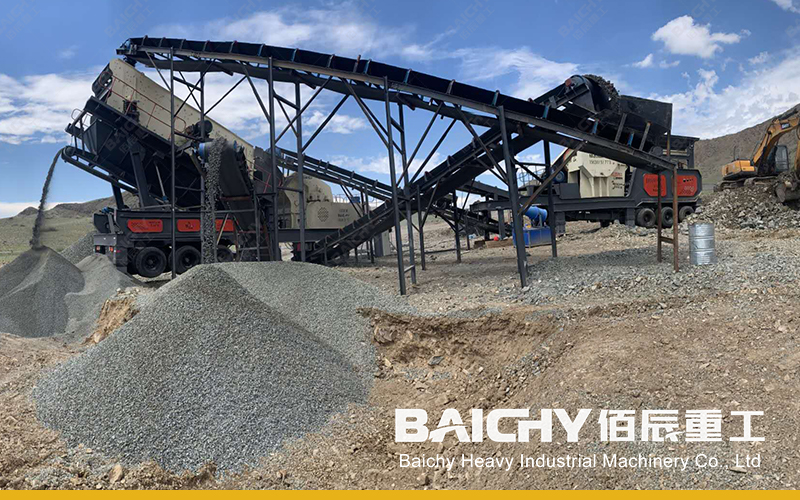
• Direct access to the mining area, reducing transportation costs: Mobile plants can be directly deployed to the mining face, converting materials "on-site," completely eliminating the huge truck transportation costs of transporting large quantities of raw stone to fixed crushing lines.
• Excellent site adaptability: For mines with complex terrain and continuously advancing mining faces, mobile plants can keep up with the pace and quickly relocate, avoiding the cumbersome process of piling and foundation construction required for fixed production lines.
• Rapid commissioning and immediate returns: Once the equipment arrives on site, almost no complex foundation construction is required; it can be put into production simply by connecting to electricity (or using its own diesel engine), greatly shortening the investment payback period.
• Environmentally friendly and flexible output: The integrated unit design provides superior dust and noise control. By changing the main unit or adjusting the unit configuration, various specifications of finished materials (such as 0-5mm, 5-10mm, 10-20mm, etc.) can be flexibly produced to meet different customer needs.
II. Core Configuration Scheme for Achieving a Capacity of 100-150 Tons/Hour
Achieving this target output cannot be easily accomplished by a single main unit; it requires a scientific and coordinated "combination punch." The following are two market-proven high-efficiency configuration schemes:
Scheme 1: Tracked Mobile Jaw Crusher + Mobile Cone Crusher Combination (Recommended First Choice)
This is the "golden combination" for processing granite, specifically designed for high-strength, highly abrasive materials.
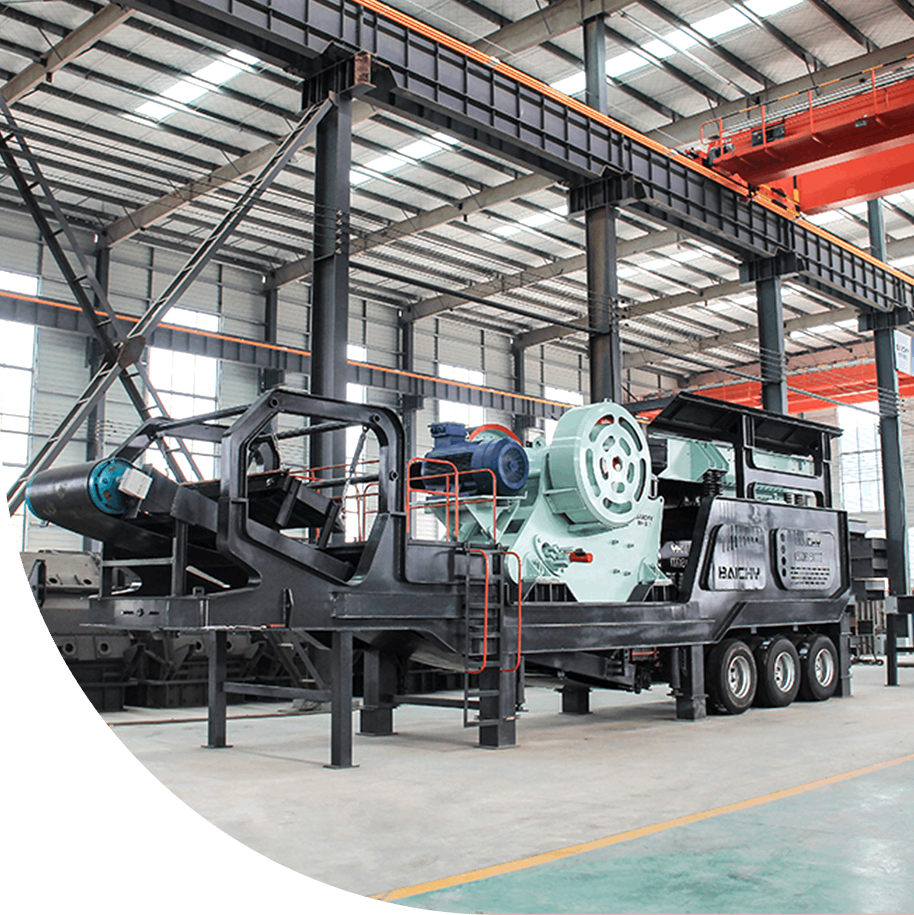
• Primary Crushing Stage: Tracked Mobile Jaw Crusher Station
◦ Role: Responsible for coarse crushing, crushing large granite ore (typically 500-750mm in side length) to a medium particle size (e.g., 150-250mm).
◦ Core Requirements: Requires powerful crushing force and a robust moving jaw assembly. A deep-cavity jaw crusher is recommended to ensure high capacity and uniform feeding.
• Medium and Fine Crushing: Tracked Mobile Cone Crusher
◦ Role: Receives material from the jaw crusher, performs medium and fine crushing, processing it into the desired final product (e.g., 0-40mm).
◦ Core Advantages: The cone crusher utilizes the principle of layered crushing, producing material with excellent particle shape (more cubic, fewer needle-like and flaky particles), particularly suitable for high-standard commercial concrete and asphalt aggregate. Its hydraulically adjustable discharge port and clearing system ensure continuous and stable high output.
The advantages of this combined solution are: smooth process, high capacity matching, excellent finished product quality, long service life of equipment wear parts, and controllable total operating costs.
Solution Two: Tracked Mobile Jaw Crusher + Mobile Impact Crusher Combination
This solution is suitable for scenarios where the granite hardness is not extremely high (or has weathered), and the requirements for finished product particle shape are very strict.
• Advantages: The impact crushing principle of the impact crusher can achieve the ultimate finished product particle shape, making it a true "stone shaping expert."
• Challenge: For hard granite, the wear rate of the impact crusher's hammer plates is significantly higher than that of the jaw crusher's jaw wall, requiring careful assessment of wear-resistant component consumption costs.
III. Beyond the Main Crusher: Auxiliary Systems Ensuring High-Efficiency Production Capacity
A powerful main crusher is fundamental, but to stably achieve a peak production capacity of 150 tons/hour, the following auxiliary systems are crucial:
1. Feeding System: A sufficiently large vibrating feeder must be configured to ensure uniform and continuous material feeding into the jaw crusher, preventing the main crusher from being overloaded or underutilized. This is the first line of defense for ensuring production capacity.
2. Pre-screening System: Before the material enters the jaw crusher, a heavy-duty screen separates already qualified fine materials and soil, effectively improving the main crusher's efficiency and reducing ineffective crushing.
3. Screening and Return System: A large, multi-layered mobile vibrating screen is configured to form a closed-loop circulation with the cone crusher. Substandard materials are returned to the cone crusher for further crushing, ensuring 100% qualified final products.
IV. Key Advice for Investors
• On-site Inspection and Material Testing: Before purchasing, be sure to provide your granite samples to the equipment supplier for crushing tests to obtain accurate data on capacity, particle shape, and wear.
• Focus on Core Components: Examine whether the main unit's motor, hydraulic system, bearings, and other core components are from leading international brands. This directly affects the long-term reliability of the equipment.
• Assess After-Sales Support Capabilities: Mobile crushing plants have complex structures. A strong after-sales team, ample spare parts inventory, and rapid response capabilities are the "insurance policy" for the continuous operation of your production line.
Investing in a 100-150 ton/hour mobile granite crushing plant is a strategic decision aimed at enhancing core competitiveness and seizing market opportunities. It represents not just a set of equipment, but an advanced, flexible, and efficient production model. Through scientific configuration and meticulous planning, you will be able to transform the hardest granite into highly sought-after wealth.