
How Much Energy is Required to Remove 20% Moisture from Raw Materials?
Rotary Drying is a crucial step in the pretreatment of raw materials in industries such as mining, building materials, and chemicals. Many customers frequently ask a core question: How much energy is needed to remove 20% moisture from my raw materials? The answer is not simple, as it involves a complex system engineering process encompassing physical principles, equipment efficiency, and process parameters. Theoretically, under normal pressure, heating 1 kg of water from room temperature and completely vaporizing it requires approximately 2600-2800 kJ (about 620-670 kcal) of energy. However, this is only a theoretical value.
In reality, the total energy required (Q) consists of the following components: energy consumption for heating moisture (Q1), latent heat of vaporization of moisture (Q2), energy consumption for heating the material (Q3), and heat loss from the entire system (Q4). Among these, the latent heat of vaporization accounts for the largest proportion, approximately 60-70% of the total energy consumption. Therefore, the theoretical minimum energy consumption for removing 20% (200 kg) of moisture from 1 ton of raw material is approximately 5.2 × 10^8 joules. However, in actual industrial production, due to factors such as thermal efficiency, inlet air temperature, and raw material characteristics, actual energy consumption is usually 20%-50% higher than the theoretical value.
| Key Words | In-Depth Analysis of Dryer Energy Consumption |
|---|---|
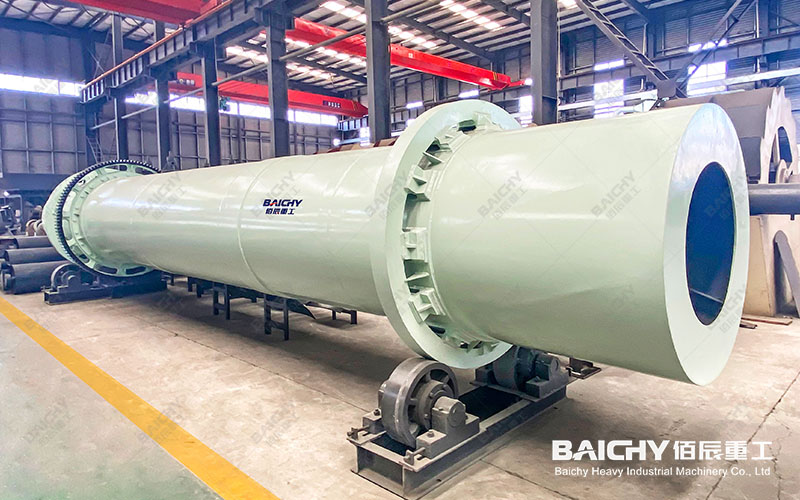
| Product Model | Single Cylinder Dryer |
| Feed Size | ≤10mm |
| Motor Power | 3-110kw |
| Capacity | 1-75t/h |
| Heat source | A direct heating system using natural gas as a heat source, or an indirect/direct heating system utilizing surplus steam/waste heat. |
| Brand | Baichy Heavy Industry |
| Packing | Standard containers,Nude Packing,Wooden boxes, etc |
| Installation | Engineer Guide |
| Factory visit | Welcomed Warmly |
| Export Countries | Southeast Asia, Central Asia, South America, North America, Africa |
| Payment | T/T,L/C payment,Paypal...etc |
| Please note: The above table data is for reference only. For specific information, please contact us. | |
Key Factors Affecting Drying Energy Consumption
• Raw Material Characteristics: Particle size, initial moisture content, viscosity, and specific heat capacity of the material all affect heat transfer efficiency.
• Hot Air System: Inlet air temperature, velocity, volume, and the contact method with the material (co-current or counter-current) are crucial.
• Equipment Insulation and Sealing: Good insulation can significantly reduce system heat loss (Q4).
• Automated Control: Precise temperature and humidity monitoring can prevent over-drying and avoid energy waste.
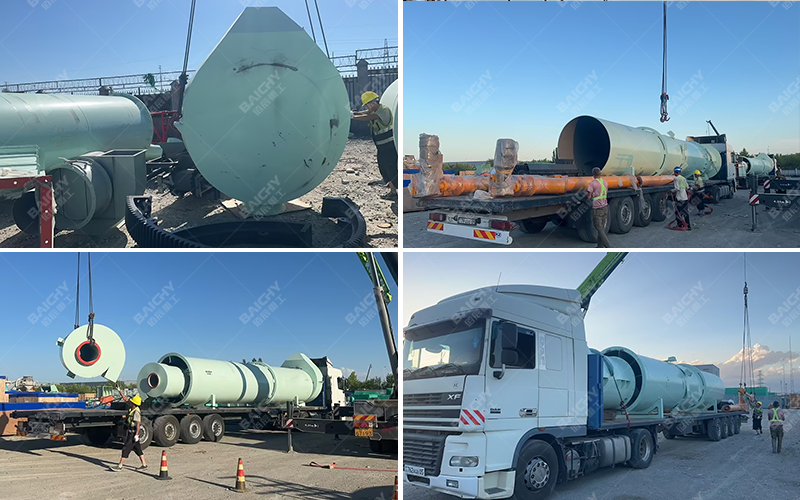
Single-drum dryer shipped
High Efficiency and Energy Saving: The Core Advantage of Modern Industrial Dryers
As a manufacturer with 20 years of experience, we understand that reducing the cost of removing that 20% moisture hinges on improving the energy efficiency of the entire dryer system. Our equipment design always revolves around the principle of maximizing energy utilization.
1. Three-stage waste heat recovery system: A unique tail-end exhaust gas-intake air heat exchange design recovers 15-25% of the waste heat from the exhaust gas for preheating the intake air, directly reducing primary energy consumption.
2. Intelligent temperature control and frequency conversion technology: Based on real-time feedback of material moisture content, the system automatically adjusts the power of the hot air furnace and the frequency of the induced draft fan to achieve on-demand heating and avoid waste energy consumption.
3. Customized internal structure: The lifting plate structure designed for different materials ensures that the material is evenly dispersed in the cylinder and fully contacts the hot air, shortening the drying time and improving heat exchange efficiency.
4. High-quality insulation materials: Multi-layer composite insulation materials are used to ensure that heat loss from the cylinder surface is minimized.
Solving high-energy-consumption drying problems for customers
Case background: A large cement plant needs to dry slag, requiring a reduction in moisture content from 25% to 5%, i.e., removing 20% of the moisture, with a processing capacity of 50 tons per hour.
Challenge: The existing old dryer had extremely high energy consumption and a thermal efficiency of less than 60%, resulting in high production costs.
Our Solution: We customized a large-scale, high-efficiency, energy-saving rotary drum dryer (Φ3.2×25 meters), equipped with an automated heating system and a high-efficiency cyclone dust collector + waste heat recovery device.
Results: After the upgrade, the system's overall thermal efficiency increased to over 75%. Calculations showed that removing 20% moisture from each ton of raw material reduced actual energy consumption by approximately 30%, and the equipment investment cost is expected to be recovered within 1.5 years through energy savings. The client is very satisfied with the stability of the output moisture content and the reduction in energy consumption.
How to Choose the Right High-Efficiency Drying Equipment for You?
Choosing a dryer should not only focus on price, but also on its long-term overall energy efficiency. We suggest you consider the following:
• Clearly define material parameters: Accurately provide the initial/final moisture content, viscosity, temperature resistance, etc. of the material.
• Focus on core energy efficiency indicators: Inquire about the equipment's energy consumption per unit water evaporation (kg water/standard cubic meter of gas or kW·h of electricity) and conduct a comparative analysis.
• Assess process adaptability: Communicate thoroughly with technical personnel to determine the most suitable drying process (e.g., direct heating or indirect heating) for your material characteristics.
• Emphasize after-sales service and intelligent upgrades: Choose a supplier that can provide continuous optimization suggestions and automation upgrade services.
Frequently Asked Questions (FAQ) about drying energy consumption
1: Why is there such a large difference between theoretical and actual energy consumption?
Theoretical calculations only consider the minimum energy required for the change of water's state itself, representing an ideal state. In actual production, heat loss from the equipment, heat carried away by exhaust gases, material temperature rise, and imperfect heat exchange efficiency all increase additional energy consumption. The value of an excellent dryer lies in its optimized design to approach this theoretical minimum value as closely as possible.
2: Besides the equipment itself, what other methods can reduce drying energy consumption?
• Pre-treatment: Reduce initial moisture content as much as possible through mechanical dewatering (such as filter press). Mechanical dewatering consumes significantly less energy than thermal dewatering.
• Waste heat utilization: If there is waste heat from other processes in the plant, it can be considered as a heat source for drying, which can greatly reduce fuel costs.
• Refined operation management: Maintain continuous and stable operation of the equipment at rated capacity, avoiding frequent start-ups and shutdowns and low-load operation.
3: How long is the payback period for investing in a high-efficiency energy-saving dryer?
The payback period depends on your processing volume, energy prices (natural gas, coal, electricity), and the obsolescence of your existing equipment. Based on numerous customer case studies, under continuous production conditions, the cost savings from energy conservation typically result in a payback period of 1.5 to 3 years. Thereafter, the energy savings will directly translate into business profits.
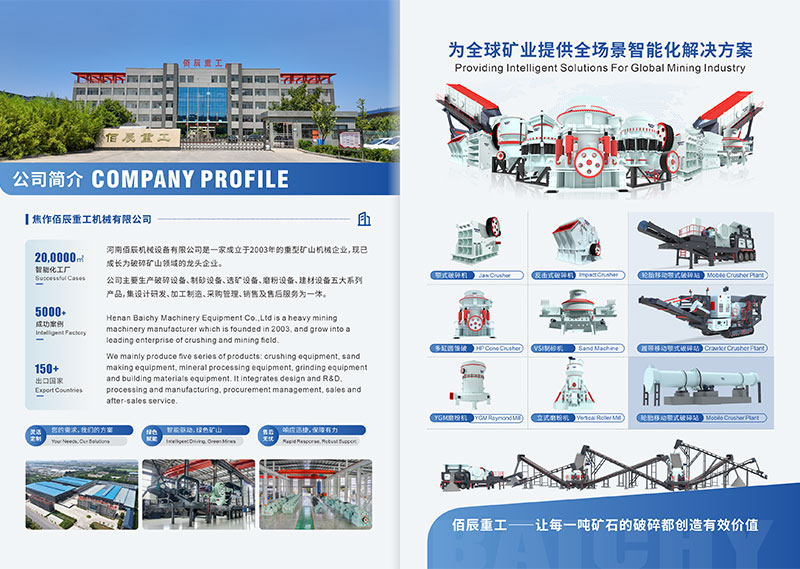
About of Baichy Heavy Industry
Baichy Heavy Industry is a high-tech mining equipment company integrating R&D, manufacturing, sales, and after-sales service. Focusing on crushing, grinding, and mineral processing equipment, we provide professional solutions to our customers. We are ISO9001:2015 、certified, and our products include mobile crushing palnts, crawler crushing plant, construction waste crushing plants, jaw crushers, sand making machines, cone crushers, fine crushers, grinding mills, ball mills, etc., all with reliable performance to meet diverse project needs.
Our advantages:
• Professional pre-sales support: Free project design and comprehensive solutions to help you accurately select the right equipment;
• Comprehensive on-site service: Providing installation guidance and worker training to ensure smooth equipment commissioning;
• Reliable after-sales guarantee: A complete after-sales system, timely response to technical inquiries and equipment maintenance, ensuring long-term stable operation.
To protect your rights, please contact us through the following official channels for professional service:
Official Website Customer Service
WhatsApp: 0086-15093222637
Email: [email protected]
We are committed to providing high-quality equipment and full-cycle services to deliver comprehensive intelligent solutions for the global mining industry!