
PE400x600 Jaw Crusher
I. PE400×600 Jaw Crusher: Overview
The PE400×600 jaw crusher is a flagship primary crushing machine developed by Baichen Heavy Industry for small-to-medium-sized mines, quarries, and mineral processing plants worldwide. It is also one of the most market-proven jaw crusher models in the 16–65 tph (tonnes per hour) capacity range.
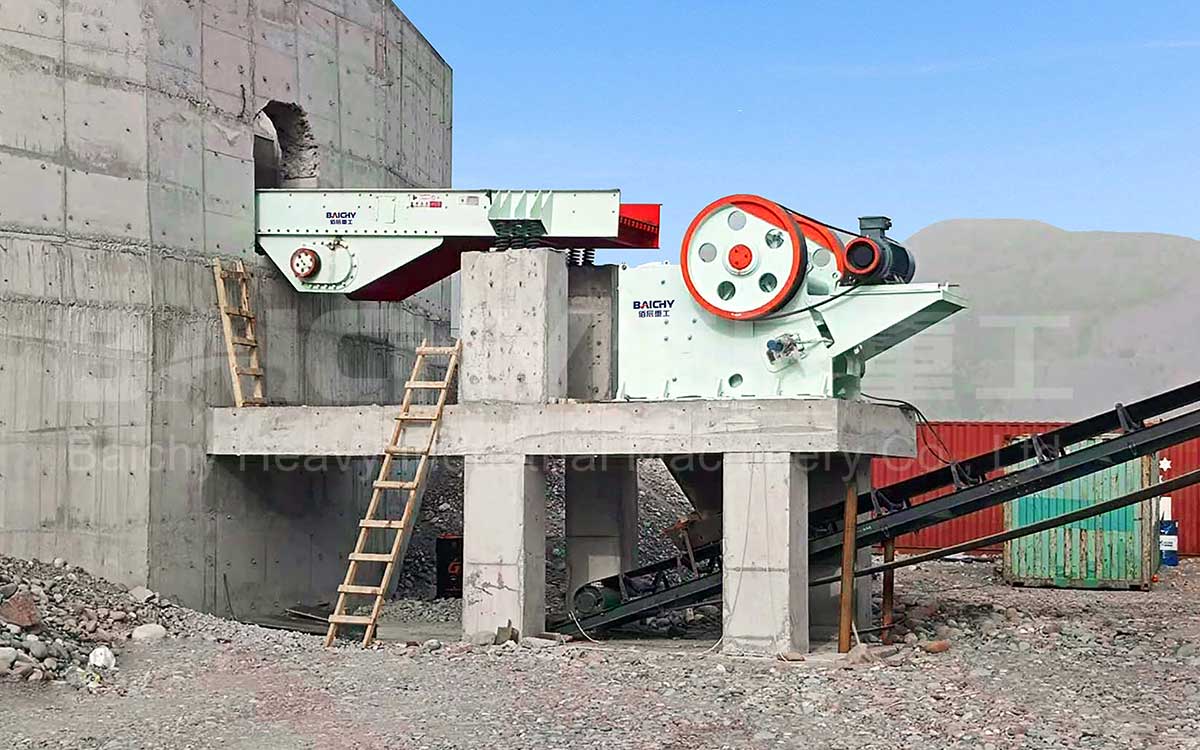
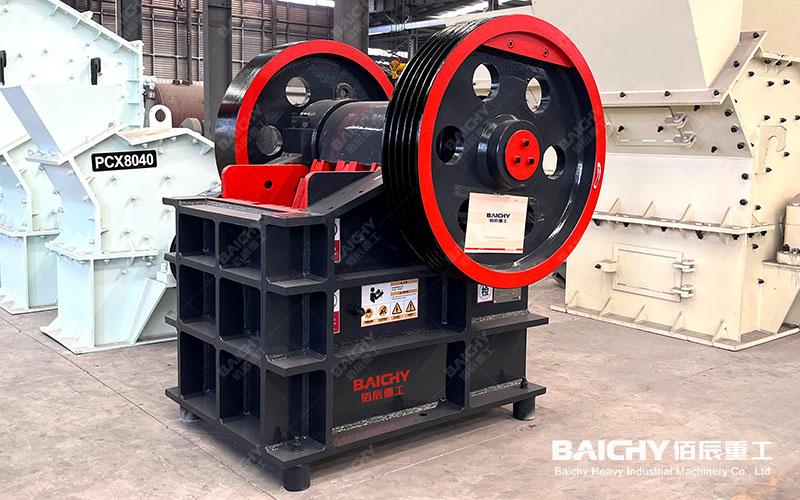
It employs the classic "simple-swing" (or double-toggle) compression crushing principle: a fixed jaw plate and a movable jaw plate form a V-shaped crushing chamber. An eccentric shaft drives the movable jaw plate in a reciprocating motion, causing material within the chamber to be repeatedly compressed and split before finally discharging through the outlet. This structural design confers two inherent advantages: strong adaptability to high-hardness materials and a simple, reliable structure—making it the preferred equipment for primary crushing for over a century.
The PE400×600 derives its name from its feed opening dimensions: 600mm in length and 400mm in width. It can directly accept blasted rock or raw river stone with diameters up to 340mm. The discharge opening is adjustable within the 40–100mm range, allowing a single machine to produce both construction aggregates and roadbed materials. Weighing approximately 6.5 tonnes and driven by a 30kW motor, the unit meets the power requirements of small production lines and fits into a standard 20GP container for shipment—key factors driving its sustained sales volume in markets across Africa, Southeast Asia, and Latin America.
II. Typical Application Scenarios for the PE400×600 Jaw Crusher
2.1 Primary Crushing in Small-to-Medium Quarries
Quarries with a daily output of 100–300 tonnes represent the primary application environment for the PE400×600. Blasted raw ore—such as limestone, granite, or basalt—is dumped from trucks into a hopper and fed evenly into the jaw crusher by a vibrating feeder. After being coarsely crushed to a size of 40–100mm, the material proceeds to the screening or secondary crushing stage. Compared to the PE500×750 model, it requires approximately 40% less investment for the same production capacity and offers lower electricity consumption and wear-part costs, making it a classic "low-investment, quick-payback" configuration.
2.2 Primary Crushing Stage in Manufactured Sand Production Lines
The first step in the manufactured sand process is primary crushing. The PE400×600 crushes raw ore (≤340mm) down to ≤100mm; subsequent processing by a PEX250×1000 fine jaw crusher or a VSI sand-making machine ensures a stable production capacity of 30–50 tph. For "crushing-instead-of-grinding" processes, the capacity and discharge uniformity of the jaw crushing stage directly determine the efficiency of the entire line.
2.3 Primary Crushing for Small-Scale Gold Processing Plants
In CIL/CIP gold processing plants with capacities of 50–100 TPD, the PE400×600 serves as the standard primary crusher: it reduces raw ore (≤340mm) to 40–100mm, followed by fine crushing to ≤25mm via the PEX250×1000 for mill feed. We have standardized this configuration; paired with a Φ1500×3000 ball mill, the entire system fits into two 40HQ containers, with a turnaround time from order to commissioning as short as 60 days.
2.4 Construction Waste Recycling
Reinforced concrete blocks from urban renewal projects typically range from 200mm to 400mm in size, falling perfectly within the feed capacity of the PE400×600. Its impact-resistant design ensures stable operation even when crushing concrete containing rebar; the discharge undergoes magnetic separation to remove iron and can be reused for roadbeds and recycled aggregates, aligning with global trends in construction waste resource recovery.
2.5 Mobile Crushing Station Integration
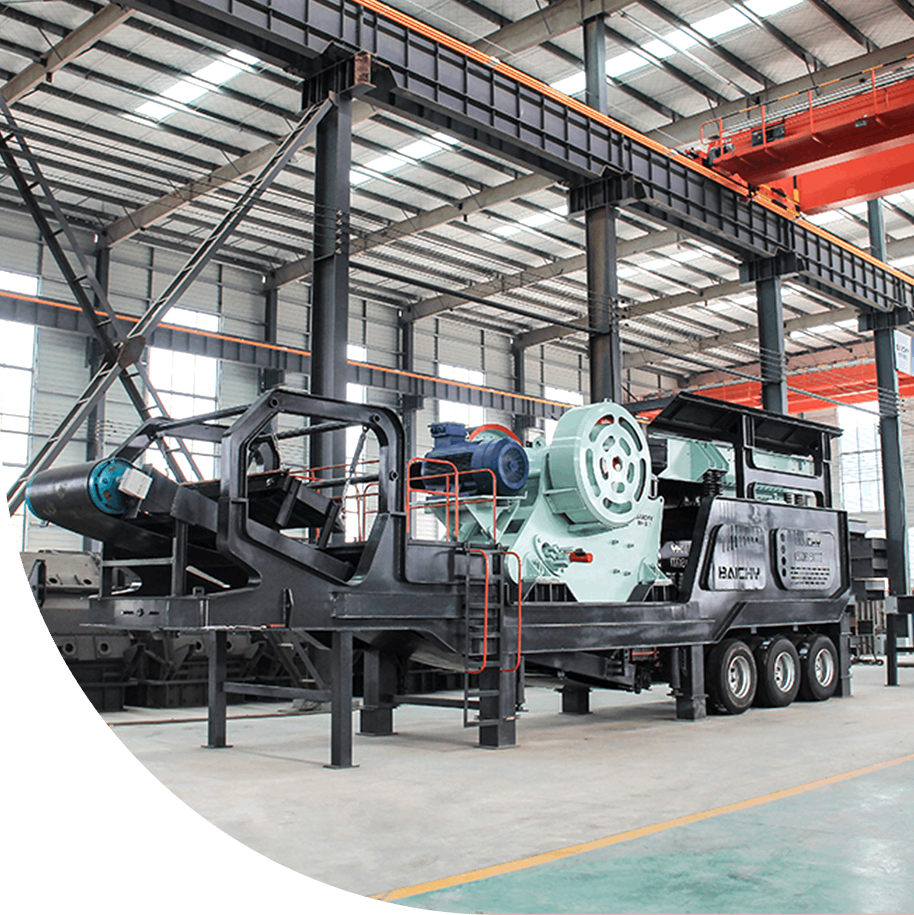
With a total weight of 6.5 tons, the PE400×600 is an ideal choice for integration onto mobile station chassis. Baichen has delivered multiple integrated wheeled mobile crushing stations—featuring a PE400×600 crusher, feeder, and screen—to projects in locations such as Chile and Venezuela; these units can be towed directly to the site and put into operation within two hours, requiring no concrete foundation.

PE400x600 Jaw Crusher Structural Diagram
III. Core Specifications Table
| Parameter Name | Specifications | Industry Value |
| Model | PE400×600 (16×24 in) | Globally standard model; spare parts are readily available |
| Feed Opening Size | 400 × 600 mm | Directly accepts raw ore ≤340 mm; eliminates need for secondary blasting |
| Max. Feed Size | ≤340 mm | Covers 90% of blasted material sizes from small-to-medium quarries |
| Discharge Adjustment Range | 40–100 mm | 40–60 mm for aggregates, 70–100 mm for road base material; dual-purpose capability |
| Processing Capacity | 16–65 t/h (limestone); 16–35 t/h (hard rock) | Daily output of 128–520 tons; capacity precisely matches small-scale production lines |
| Eccentric Shaft Speed | 275 r/min | High speed for its class; crushing efficiency ~10% higher |
| Motor Power | 30 kW | Electricity consumption 0.5–0.9 kWh/ton; cost <$0.1 per ton |
| Equipment Net Weight | ~6.5 tons | Installable with a 20-ton crane; ships as a complete unit in a 20GP container |
| Dimensions (L×W×H) | 1700 × 1732 × 1653 mm | Compact footprint; fits mobile station chassis |
| Jaw Plate Material | ZGMn13 High-Manganese Steel (Mn18Cr2 optional) | Service life: 500–800h (limestone), 60–90 days (hard rock) |
| Power Compatibility | 380V/50Hz, 400V/50Hz, 440V/60Hz, 480V/60Hz | Customized for destination country; no VFD required |
IV. Real-World Cases: From Ethiopian Basalt to Chilean Mobile Stations

PE400x600 Jaw Crusher Basalt Crushing Site

PE400x600 Jaw Crusher Production Line
4.1 Ethiopia: Termaber Basalt Crushing (380V/50Hz)
Baichen has delivered multiple PE400×600 units to Ethiopia for crushing basalt (compressive strength: 130–351 MPa) in the Termaber region of the East African Rift Valley. Equipped with standard ZGMn13 jaw plates and a discharge setting of 50–70 mm, the units deliver a stable output of 16–35 tph with a jaw plate lifespan of 60–90 days. The equipment was transported via sea to the Port of Djibouti and then by road to Addis Ababa, with total logistics costs kept under $3,500. This represents a model solution for crushing equipment procurement by landlocked countries.
4.2 Chile: PE400×600 Mobile Jaw Crushing Station
For a Chilean aggregate plant, Baichen integrated a PE400×600 crusher, a ZSW6520 grizzly feeder, and a hydraulic belt conveyor onto a single trailer chassis. Upon arrival at the site, the unit can be set up—deploying hydraulic legs and connecting to a 380V power supply—and begin discharging material within two hours, producing 100–400 tons of construction aggregates (0–5/5–10/10–20 mm) daily. As Chile is the only country in South America using a 50Hz grid, this solution features factory-customized 380V/50Hz motors that natively match the local power grid, eliminating the need for costly variable frequency drives (VFDs).
4.3 Venezuela: Mobile River Pebble Crushing Line (60Hz/Diesel)
The Venezuela project utilizes a dual-module mobile configuration—combining a PE400×600 jaw crusher and a PYB900 cone crusher—to process highly abrasive river pebbles. It achieves a capacity of 15–35 tph and employs closed-circuit screening to produce finished material sized ≤19 mm. The equipment comes standard with 60Hz motors or diesel generator drives, making it adaptable to the challenges of an unstable power grid and fuel shortages in Venezuela; the project has now entered the formal delivery phase.
4.4 South Africa: Primary Crushing for a 100 TPD Gold Processing Plant
In the design of a 100 TPD gold CIL processing plant in South Africa, a PE400×600 crusher handles the primary crushing stage, reducing run-of-mine ore (≤340 mm) to a size of 40–100 mm; this feeds into a PEX250×1000 crusher for fine crushing to ≤25 mm prior to grinding. The actual capacity of 16–40 tph is 3–6 times the plant's crushing requirement of 5–8 tph, meaning the main crusher unit does not need to be replaced if production is expanded to 200 TPD.
V. Recommended Related Equipment
The PE400×600 crusher typically does not operate in isolation; the following auxiliary equipment can be combined to form a complete production line:
| Equipment | Recommended Model | Role in the Production Line |
| Vibrating Feeder | GZD850×3000 / ZSW380×95 | Uniform feeding; grizzly section for pre-screening and soil removal |
| Fine-Crushing Jaw Crusher | PEX250×1000 | Secondary crushing; output size ≤25mm; links to the grinding stage |
| Cone Crusher | PYB900 / CS75 | Medium-to-fine crushing of river pebbles and granite; closed-circuit screening |
| Impact Sand-Making Machine | VSI8518 Sand making and shaping; supports 30–50 tph | Sand-making line |
| Circular Vibrating Screen | 3YK1230 / 3YK1545 | Multi-stage screening; produces 0–5mm, 5–10mm, and 10–20mm finished products |
| Ball Mill | Φ1500×3000 | Grinding stage for gold processing plants; feed size ≤25mm |
| Belt Conveyor | B650 / B800 | Connects various processing stages; length customizable |
• Recommended Combination 1 (Minimum production line setup, approx. $14,000): GZD850×3000 Feeder → PE400×600 Jaw Crusher → 3YK1230 Vibrating Screen → 3 Conveyors; capacity 20–30 tph; produces three grades of finished products (0–5mm, 5–10mm, 10–20mm).
• Recommended Configuration 2 (Secondary Crushing Line, approx. $28,000): GZD850×3000 → PE400×600 → PEX250×1000 (Fine Jaw Crusher) → 3YK1545 Vibrating Screen → 4 Conveyors; Capacity: 25–40 tph; includes a 20–40mm coarse aggregate fraction.
• Recommended Configuration 3 (Gold Processing Plant, approx. $150,000–$200,000): PE400×600 (Primary Crushing) + PEX250×1000 (Fine Crushing) + Φ1500×3000 Ball Mill + Classifier + CIL Leaching System; suitable for a 100 TPD (tonnes per day) whole-ore cyanidation process.
VI. FAQ (Frequently Asked Questions)
Q1: What materials can the PE400×600 jaw crusher process?
The PE400×600 utilizes the principle of extrusion crushing and is suitable for limestone, basalt, granite, river pebbles, iron ore, gold ore, construction waste, etc. It is designed for a maximum compressive strength of approximately 320 MPa and handles the vast majority of mining materials with a Mohs hardness of 7 or less. When processing extremely hard materials (such as quartzite), it is recommended to upgrade to Mn18Cr2 jaw plates and base equipment selection on 60–70% of the rated capacity.
Q2: How do I choose between the PE400×600 and PE500×750 jaw crushers?
Choose based on target daily output: For a daily output of under 300 tonnes, select the PE400×600 (main unit: $8,000–$12,000; total investment: approx. $14,000); for a daily output of 300–500 tonnes, select the PE500×750 (main unit: $15,000–$20,000; total investment: approx. $25,000). If you plan to expand production within a year, it is safer to reserve 20% excess capacity; if the long-term daily output target exceeds 500 tons, you should consider the PE600×900 model directly.
Q3: What are the lead times for equipment shipment and spare parts supply?
For standard models, production and inspection are completed within 15–25 days of order placement. Sea freight transit times are approximately 15–20 days to Southeast Asia, 25–35 days to the East Coast of Africa, and 30–40 days to the West Coast of South America. We recommend ordering two sets of jaw plates and one set of toggle plates (covering six months of operation) along with the initial equipment order; subsequent spare parts deliveries take 15–25 days via sea freight or 5–7 days via DHL air freight.