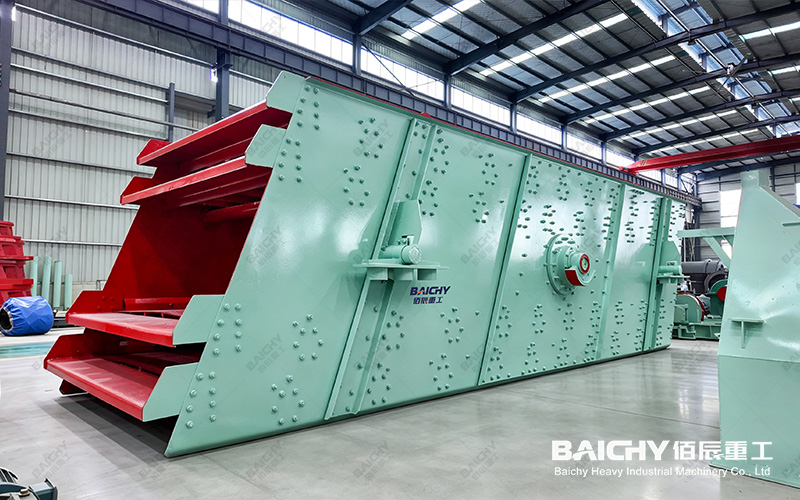
Horizontal Vibrating Screen
The Horizontal Vibrating Screen is a sophisticated piece of screening equipment featuring a screen surface arranged in an approximately horizontal orientation (typically with an inclination angle of 0° to 5°). Driven by an excitation force, the machine causes materials on the screen surface to be repeatedly tossed upward and propelled forward, thereby achieving highly efficient classification, dewatering, or impurity removal. As a core component of screening machinery, it plays a vital role across numerous industrial sectors.
Core Structure and Design Features
The structural design of the Horizontal Vibrating Screen aims to strike a balance between high throughput and high-precision screening. Its core components include:
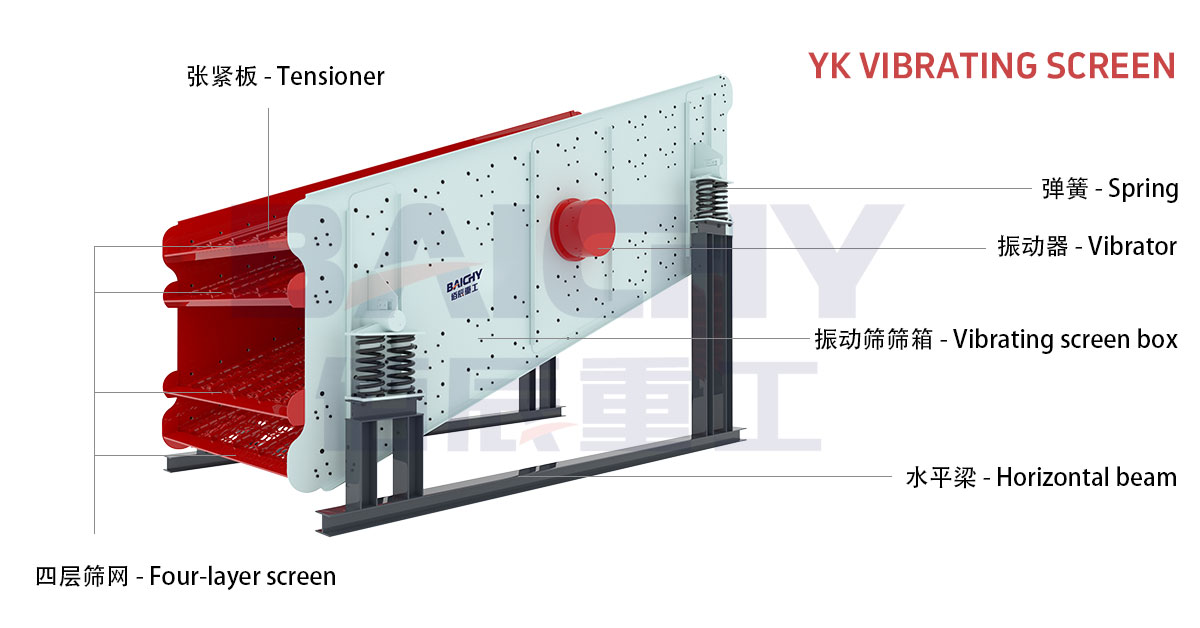
Vibrating-screen-structure-diagram
1. Low-Profile Screen Box: The screen body adopts a horizontal, low-center-of-gravity design with a low overall height, making it particularly suitable for installation in space-constrained facilities or for integration into mobile production lines. Double-layer or multi-layer screen decks are stacked within this limited vertical space to facilitate multi-stage screening.
2. High-Efficiency Vibration Source: Typically driven synchronously by two counter-rotating vibrating motors (or exciters), the system generates a powerful, directional excitation force. This force drives the entire screen box to execute stable linear or elliptical vibrations, ensuring the uniform dispersion and rapid conveyance of materials.
3. Multi-Layer Screen System:
◦ Upper Screen Deck: Features larger mesh openings, used for removing oversized particles or for coarse screening.
◦ Lower Screen Deck: Features smaller mesh openings, used for fine classification to obtain the final product of the desired particle size.
◦ The screen decks are secured via tensioning devices or modular screen panels (such as polyurethane panels), facilitating easy replacement and maintenance.
4. Elastic Support and Vibration Damping System: The screen box is supported on a machine frame or foundation via steel coil springs or rubber vibration-damping springs. This system serves to both support the weight of the screen body and effectively isolate operational vibrations, thereby protecting the foundation and ensuring equipment stability.
5. Sealed, Dust-Proof Structure: The screen box typically features a fully enclosed design, equipped with inspection windows and access doors. This design effectively prevents dust dispersion, ensuring compliance with environmental protection and workplace safety standards.
Horizontal Vibrating Screen Working Principle
Materials are fed through the inlet and distributed evenly across the screen surface. Under the influence of the intense excitation force generated by the vibrating motors, the screen box drives the screen decks to undergo high-frequency vibrations. Materials on the screen surface are continuously tossed upward and propelled forward in a jumping motion.
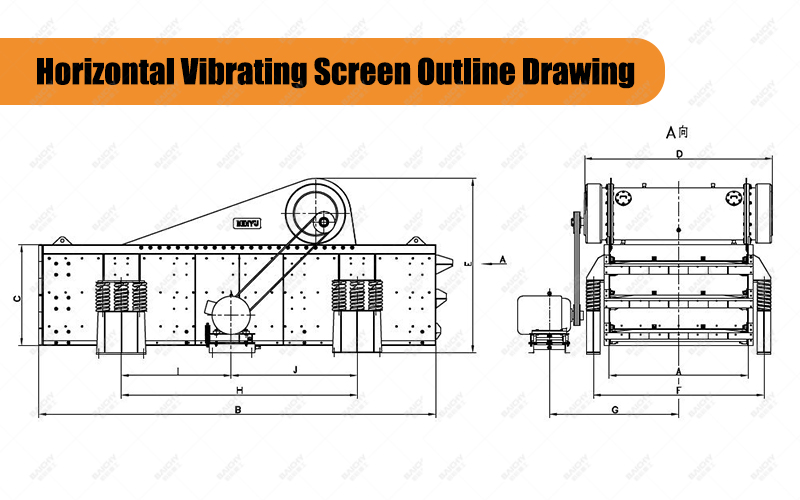
Horizontal Vibrating Screen Outline Drawing
• Stratification and Screening: During the vibration process, smaller particles rapidly settle onto the screen surface and pass through the mesh apertures (becoming "undersize" material), while larger particles remain in the upper layer and travel along the screen surface, discharging through the outlet at the end (becoming "oversize" material).
• Multi-stage Screening: In a double-deck horizontal screen, material that fails to pass through the upper screen deck continues to travel along the upper surface and is discharged; material that passes through the upper deck but is larger than the apertures of the lower deck continues to undergo screening on the lower surface, ultimately achieving the separation of materials into at least three product grades: coarse, medium, and fine.
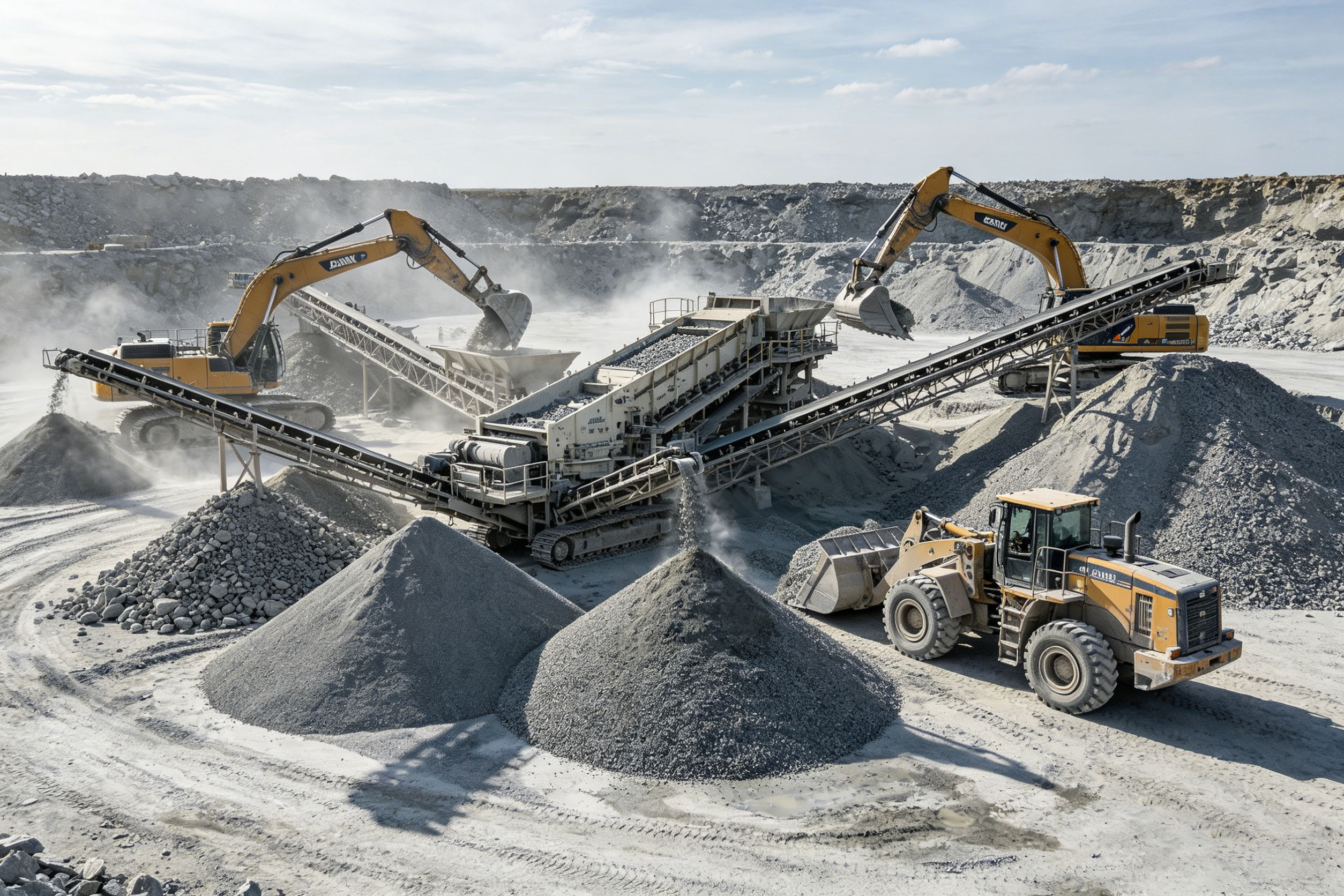
Horizontal-Vibrating-Screen-Field-Operations
Key Advantages and Applications
• Advantages:
◦ High Throughput: The horizontal screen surface allows for a wider distribution area of materials and controllable retention times, resulting in high processing capacity per unit area.
◦ High Screening Accuracy: Materials follow a long trajectory across the screen surface, allowing for thorough stratification; fine particles have ample opportunity to pass through the mesh, ensuring high screening efficiency.
◦ Flexible Installation: Featuring a low overall profile, the unit is easy to integrate into existing production lines or utilize within mobile crushing and screening units.
◦ Convenient Maintenance: The design features a mature, proven structure; the vibrating motors are standard components, and screen mesh replacement is quick and easy.
• Application Fields:
◦ Sand and Aggregates: Grading of crushed stone aggregates; screening and fines removal for manufactured sand.
◦ Mining and Metallurgy: Particle size classification for coal, iron ore, and non-ferrous metal ores.
◦ Construction Materials: Screening of quartz sand, feldspar, and ceramic raw materials.
◦ Chemicals and Food: Fine screening of plastic pellets, fertilizers, grains, and similar products.
By judiciously selecting a horizontal vibrating screen, enterprises can significantly boost production efficiency, ensure product particle size consistency, and reduce overall operating costs. It stands as an indispensable piece of key equipment for continuous and automated production processes in modern industry.
Frequently Asked Questions (FAQ)
1. Q: What are the main differences between a horizontal vibrating screen and a standard inclined vibrating screen (such as a circular vibrating screen)?
A: The core differences lie in the inclination angle of the screen surface and the trajectory of the material's movement. Horizontal vibrating screens feature a near-level screening surface (0°–5°); material is conveyed forward primarily through vibration. This design offers a long screening path and high precision, making it suitable for fine screening and high-throughput applications, though the equipment typically has a relatively large footprint. In contrast, inclined screening machines—such as circular vibrating screens (with an inclination angle of 15°–25°)—rely on a combination of gravity and vibration to move material downward. These machines offer faster conveying speeds and occupy a relatively smaller footprint; however, their screening precision and efficiency are generally lower than those of horizontal screens, making them better suited for the rapid classification of medium to coarse-grained materials.
2. Q: How do I select the appropriate screen media type (metal wire mesh, polyurethane screen panels, or rubber screen panels)?
A: The selection is primarily based on material characteristics, required throughput, and service life requirements:
• Metal Wire Mesh: Low cost, high open area ratio, and good air permeability. Suitable for the general screening of dry, non-corrosive materials, though its wear resistance is only moderate.
• Polyurethane Screen Panels: Excellent wear resistance, anti-clogging properties, low noise levels, and a long service life. Suitable for screening highly abrasive materials (such as mineral sands and crushed stone) as well as damp, fine-grained materials, though the cost is relatively higher.
• Rubber Screen Panels: Good elasticity, high impact resistance, and noise-reduction capabilities. Suitable for the primary screening of large, high-impact materials (common in mining and quarrying operations), though their heat resistance is relatively poor.
3. Q: What could be the cause if a horizontal vibrating screen exhibits excessive noise or abnormal vibration during operation? How can these issues be resolved?
A: Common causes and corresponding countermeasures:
• Loose Fasteners: Inspect and tighten all bolts, paying particular attention to the mounting bolts for the vibrating motors, screen box, and support springs.
• Damaged or Fatigued Springs: Inspect the support springs for any fractures or uneven stiffness; replace any defective springs immediately with new ones of the same specifications.
• Damaged or Insufficiently Tensioned Screen Mesh: Replace any damaged screen mesh and ensure that the mesh is tensioned uniformly across the surface to prevent localized fluttering or vibration.
• Inconsistent Adjustment of Vibrating Motor Eccentric Blocks: Ensure that the eccentric blocks on both vibrating motors are set to exactly the same angle to maintain synchronized operation. • Unstable Foundation: Inspect the equipment foundation to ensure it is secure and that its quality meets load-bearing and vibration-damping requirements.