
In industries such as cement, slag, and non-metallic minerals, grinding materials to below 45 micrometers to obtain ultrafine powders with high specific surface area is crucial for improving product performance and quality. However, traditional ball mills often face bottlenecks in this fine grinding range, including high energy consumption, low efficiency, and uneven particle size distribution.
So, is there a device that can efficiently, stably, and economically achieve the fine grinding target below 45 micrometers? The answer is yes—the vertical roller mill is the ideal solution to this challenge.
I. Why is grinding below 45 micrometers so challenging?
When the material particle size requirement is below 45 micrometers (325 mesh), the specific surface area of the material increases dramatically, surface energy rises, and particle agglomeration intensifies. This leads to:
• Decreased grinding efficiency: The "buffering" effect of fine particles means that further grinding requires more energy.
• Increased equipment wear: Traditional equipment operates under high pressure for extended periods, resulting in rapid wear of vulnerable parts.
• Increased Energy Consumption: Research shows that achieving the same fineness can consume several times more energy than ordinary fine grinding.
II. Vertical Roller Mill: How to Overcome the Challenge of Ultrafine Grinding?
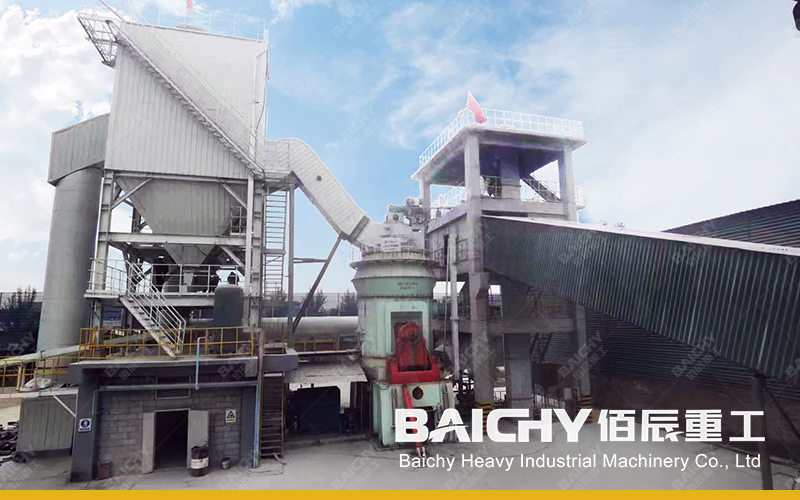
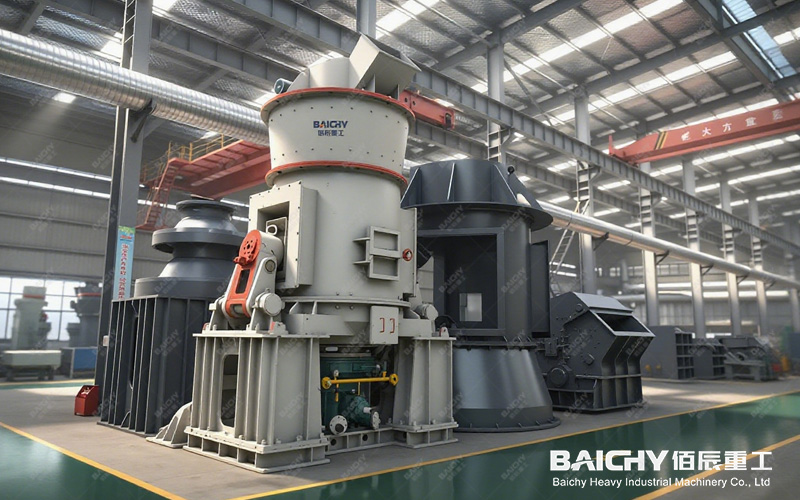
The vertical roller mill employs a unique bed-feed crushing principle, perfectly meeting the core requirements of ultrafine powder production.
Working Principle: Material enters the center of the grinding disc through a central airlock feeding device and is thrown towards the edge of the disc under centrifugal force. The grinding rollers, under the action of a hydraulic system, apply enormous grinding pressure to the material layer on the grinding disc. Qualified fine powder is carried away by the high-speed airflow and collected after being sorted by an upper classifier; coarse powder falls back to the grinding disc for regrinding.
Key Advantages for Grinding Below 45 Microns:
1. Extremely High Energy Efficiency and Low Overall Power Consumption:
The vertical roller mill uses bed-feed crushing, with an energy utilization rate far exceeding that of the point-contact crushing of ball mills. Under the same capacity and fineness requirements, its power consumption can be 30%-50% lower than that of a ball mill system, a significant advantage for high-energy-consuming fine grinding.
2. Uniform and Stable Particle Size Distribution
The built-in high-efficiency dynamic classifier allows for flexible and precise control of the finished product's fineness. By adjusting the classifier's speed, the product can be easily controlled to below 45 microns, with a concentrated particle size distribution, avoiding over-grinding and ensuring stable and excellent product quality.
3. High Grinding Efficiency and Simple System
Integrating crushing, grinding, drying, classifying, and conveying, the system has a simple flow and a small footprint. The unique design of the grinding rollers, which can be flipped out of the machine, makes inspection and maintenance very convenient, greatly improving equipment uptime.
4. Long Wear-Resistant Parts and Low Operating Costs
The grinding rollers and grinding discs are made of high-quality wear-resistant materials, resulting in uniform wear and a long service life. Simultaneously, during the grinding process, the un-crushed material acts as a cushion layer, reducing direct metal-to-metal contact and further reducing wear.
III. Typical Application Areas of Vertical Roller Mills
• Cement Industry: Production of high-grade cement and cement admixtures.
• Slag Micronized Powder: Ultrafine slag powder made by grinding granulated blast furnace slag to a specific surface area of over 420 m²/kg.
• Non-metallic Minerals: Used for the ultrafine processing of non-metallic minerals such as limestone, calcite, barite, and talc.
• Metallurgical and Chemical Industries: Used for processing solid wastes such as nickel slag and manganese ore, achieving resource utilization.
Faced with increasingly stringent environmental standards and fierce market competition, choosing efficient and energy-saving grinding equipment is key for enterprises to reduce costs, increase efficiency, and enhance their core competitiveness. Vertical roller mills, with their superior performance in fine grinding below 45 microns, are becoming a benchmark for modern industrial grinding technology.
If you are seeking solutions to energy consumption, cost, or product quality issues in ultrafine powder processing, vertical roller mills are undoubtedly a choice worth considering.
Further reading:
How To Choose A Suitable Industrial Grinding Mill?
Which Is Better Cement Vertical Roller Mill Or Ball Mill?
What Are the Differences between Dry and Wet Type Ball Mill?