
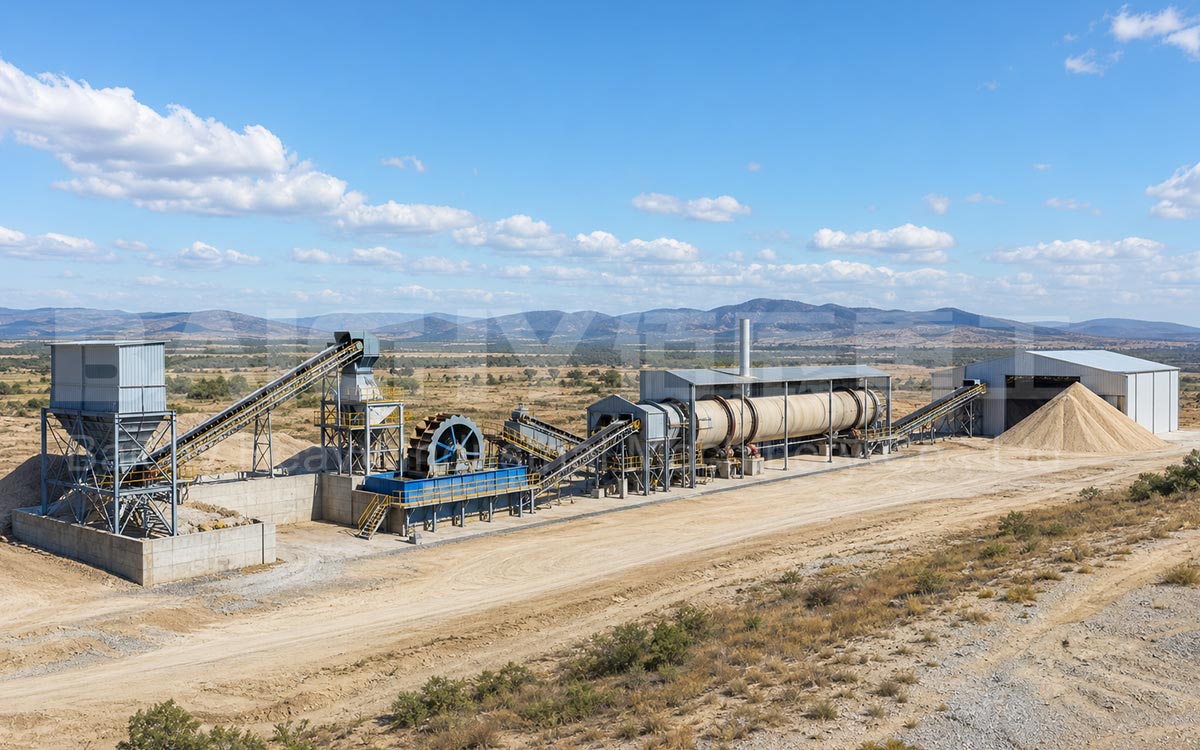
Quartz Sand Rotary Dryer
Moisture is the silent profit killer in every quartz sand plant. A quartz sand rotary dryer is the one machine that decides whether your silica sand meets contract specification — or gets rejected. This Baichy Heavy Industry guide explains how it works, how to size it, what it costs to run, and how to avoid the most expensive buying mistakes.
What Is a Quartz Sand Rotary Dryer?
A quartz sand rotary dryer — also called a silica sand dryer or rotary sand dryer — is a rotating, slightly inclined cylinder that strips free moisture from sand by direct contact with hot gas. Wet feed enters the elevated end, tumbles through internal lifting flights that shower it through the gas stream, and discharges with moisture cut from 8–12% down to below 0.5%.
Unlike batch or fluid-bed units, a rotary dryer for quartz sand handles abrasive, high-density material without particle segregation, which is why it remains the industry default for silica sand drying lines above 3 t/h. Key assemblies: rotating shell with wear liner, lifting flights, gear-ring drive with support rollers, hot gas generator, and cyclone plus baghouse dedusting.
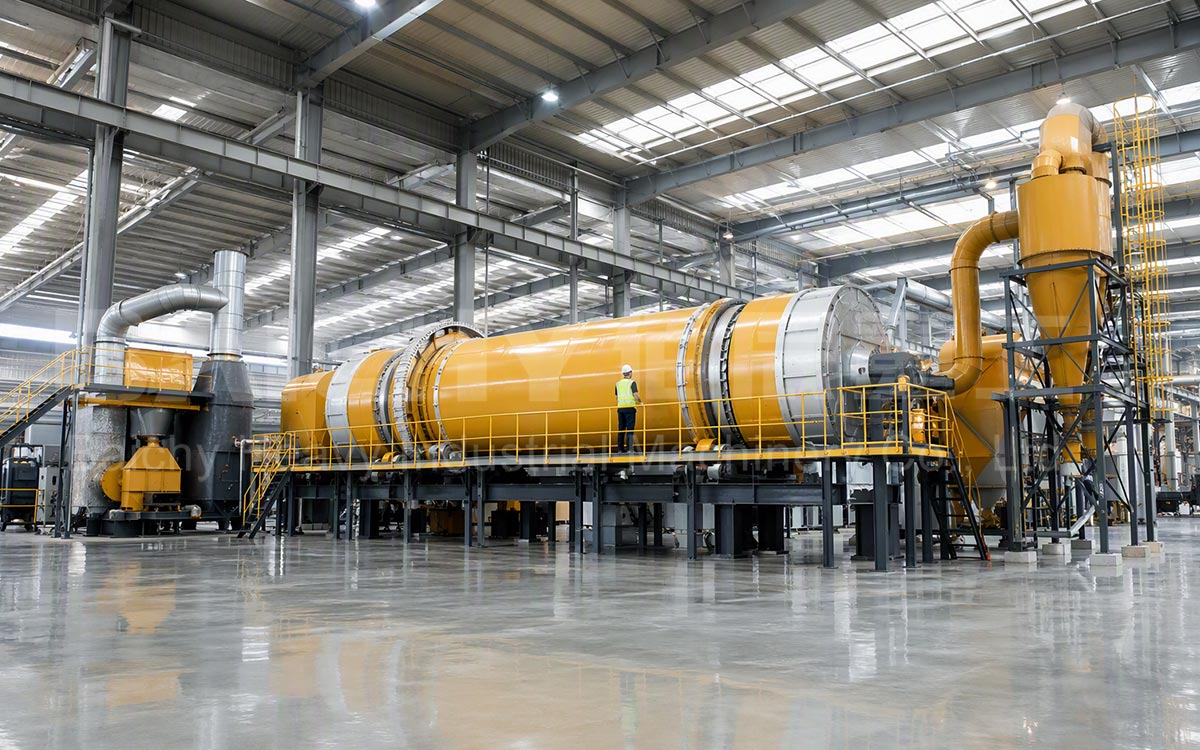
Quartz Sand Rotary Dryer
Why Moisture Control Decides Product Value
| End use | Product moisture | Why it matters |
|---|---|---|
| Engineered quartz stone | ≤0.3% | Resin bonding fails with residual water |
| Glass batch | ≤0.5% | Inaccurate weighing, foam defects in melter |
| Foundry / resin-coated sand | ≤0.2–0.3% | Core strength needs dry surfaces |
| Water filtration media | ≤1.0% | Prevents caking in storage |
| Frac sand (oil & gas) | ≤0.5% | Free-flow requirement for logistics |
| Dry-mix mortar | ≤0.5% | Screening precision and silo flow |
Every 1% of unremoved water is freight you pay for and specification risk you carry.
How a Quartz Sand Rotary Dryer Works
Feeding and Metering
Washed sand is conveyed into a sealed feed chute through a variable-speed weigh feeder. Overfeeding floods the drum and drops outlet temperature; underfeeding wastes heat.
Hot Gas Generation
Combustion air is heated to 700–850 °C at the dryer inlet. Direct firing gives the lowest fuel cost per ton; indirect steam or thermal-oil heating is specified when purity rules out contact with combustion gas — for example, high-purity quartz for photovoltaic and semiconductor crucibles.
Heat Transfer in Three Zones
The drum turns at 1.5–5 r/min on a 3–5° slope; flights cascade sand through the gas, and roughly 85% of heat transfer is convective. In the preheating zone sand reaches wet-bulb temperature; in the constant-rate zone most free water evaporates; in the falling-rate zone capillary moisture limits drying and sand temperature climbs.
Discharge, Cooling and Dust Control
Sand leaves at 90–120 °C, so a cooling section brings it below 60 °C to protect belts and prevent re-condensation in silos. Exhaust gas passes a cyclone then a baghouse or scrubber, targeting below 20–30 mg/Nm³.
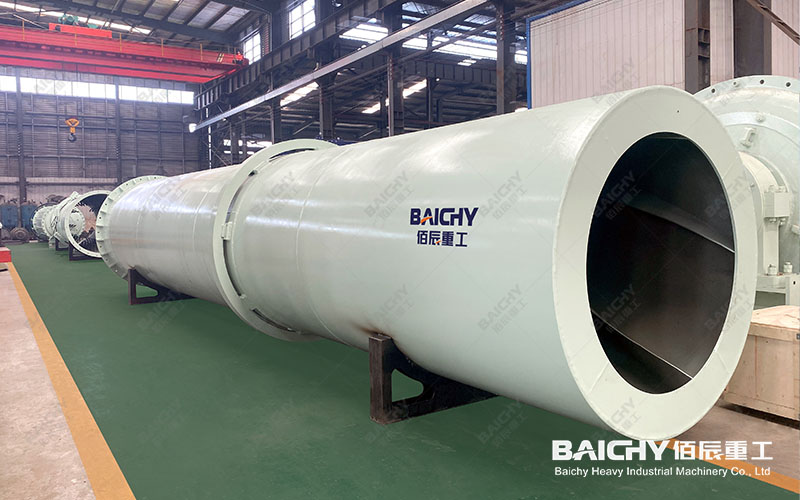
Single-drum dryer
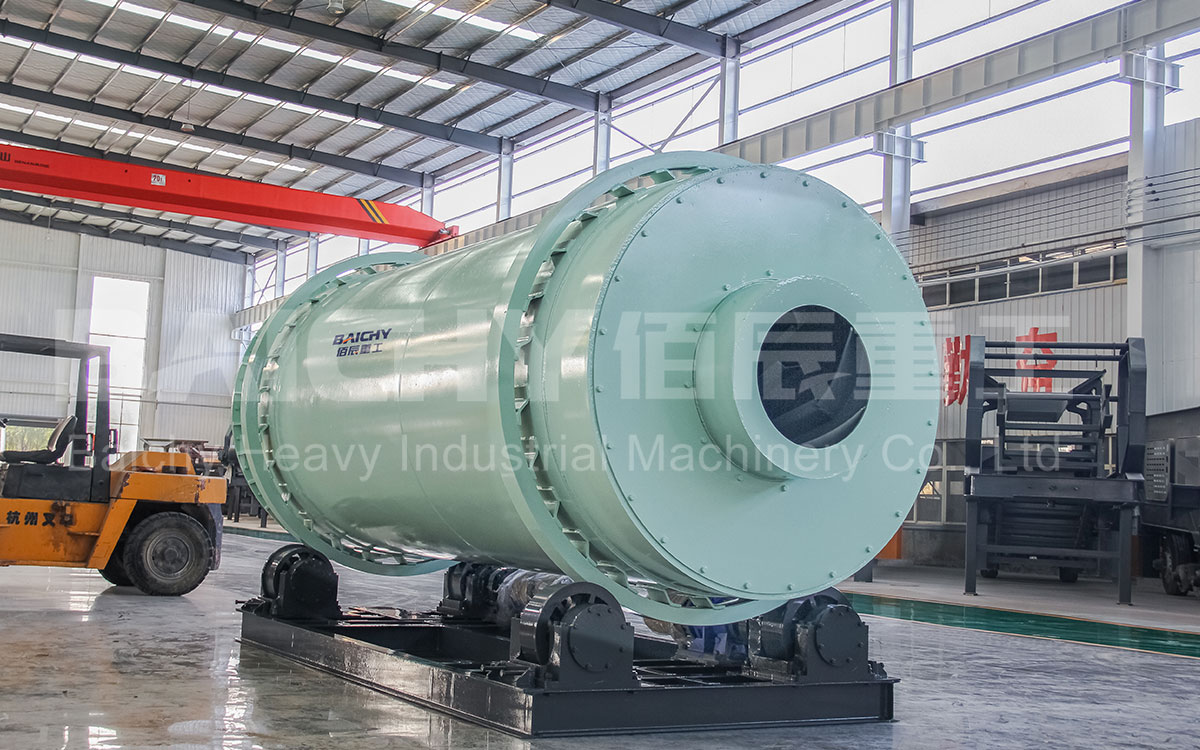
Triple-cylinder dryer
Single-Drum vs Triple-Pass Quartz Sand Rotary Dryer
• Single-drum — the high-tonnage workhorse: simple, high availability, lowest capital cost per ton.
• Triple-pass — sand travels three times through one shell length, giving 15–25% better thermal efficiency in a compact footprint; preferred for engineered-stone and dry-mortar plants at 5–40 t/h.
Indirect / steam-heated — for high-value quartz where iron pickup or gas contamination is unacceptable.
Technical Specifications (Standard Single-Drum Models)
Figures assume washed quartz sand at 8–10% feed moisture, product moisture ≤ 0.5%, inlet gas 750–850 °C, bulk density 1.5–1.6 t/m³.
| Model | Drum Ø × Length (m) | Speed (r/min) | Power (kW) | Throughput (t/h) | Evaporation (t H₂O/h) | Inlet temp (°C) | Weight (t) |
|---|---|---|---|---|---|---|---|
| BCRD-1208 | Φ1.2 × 8 | 3.0–5.0 | 7.5 | 1.5–3.0 | 0.15–0.30 | 750–850 | 6.5 |
| BCRD-1512 | Φ1.5 × 12 | 3.0–5.0 | 15 | 3.0–6.0 | 0.30–0.60 | 750–850 | 12.0 |
| BCRD-1814 | Φ1.8 × 14 | 2.5–4.0 | 22 | 6.0–10.0 | 0.60–1.00 | 750–850 | 18.5 |
| BCRD-2218 | Φ2.2 × 18 | 2.0–3.5 | 37 | 10.0–18.0 | 1.00–1.80 | 750–850 | 28.0 |
| BCRD-2622 | Φ2.6 × 22 | 2.0–3.0 | 55 | 18.0–28.0 | 1.80–2.80 | 750–850 | 41.0 |
| BCRD-3024 | Φ3.0 × 24 | 1.8–2.8 | 75 | 28.0–40.0 | 2.80–4.00 | 750–850 | 55.0 |
| BCRD-3226 | Φ3.2 × 26 | 1.5–2.5 | 90 | 40.0–55.0 | 4.00–5.50 | 750–850 | 68.0 |
| BCRD-3628 | Φ3.6 × 28 | 1.2–2.2 | 132 | 55.0–75.0 | 5.50–7.50 | 750–850 | 86.0 |
Size on Evaporation, Not Tonnage
A 20 t/h machine at 8% feed moisture may deliver only 12 t/h at 14%. The limiting factor is how much water the gas stream carries out per hour — not how much sand fits inside the shell.
Fuel Options and Operating Cost
Net heat consumption is 380,000–520,000 kcal per ton of dried sand for a tuned single-drum unit, and 300,000–420,000 kcal/t for a triple-pass design.
| Fuel | Cost level | Best for | Note |
|---|---|---|---|
| Natural gas | High | Strict emission zones, engineered stone | Cleanest, precise control |
| Coal | Low | Large tonnage with fuel logistics | Needs emission and ash handling |
| Biomass pellets | Low–medium | Regions with crop residues | Supply stability is the risk |
| Diesel / heavy oil | Highest | Remote or temporary sites | Simple but costly per ton |
| Steam / thermal oil | Medium–high | High-purity quartz sand | No gas contact |
Three levers cut cost immediately: recover exhaust heat to preheat combustion air, cut feed moisture with a high-efficiency dewatering screen, and run a steady matched feed rate instead of start-stop cycles.
How to Choose the Right Quartz Sand Rotary Dryer
• Specify moisture range, not average. Wet-season feed can hit 15% while dry-season feed is 6%; add a 10–15% design margin.
• Respect quartz abrasiveness. At Mohs 7, specify Mn13 or Hardox liners in the feed zone and hardened flight profiles — liner downtime costs far more than better material at purchase.
• Control iron contamination. For engineered stone and high-purity quartz, use stainless or ceramic contact surfaces, non-metallic flights in the hot zone, and magnetic separation after drying. Retrofitting rarely works fully.
• Match turndown and automation. Good units hold moisture stable from 60% to 110% load. Manual operation swings ±1.5%; automated feed feedback from outlet gas temperature holds ±0.3%.
• Verify emission compliance. Quartz dust contains respirable crystalline silica, so confirm particulate and NOx limits and keep the system under negative pressure.
Applications and Maintenance Essentials
Uses: engineered quartz slabs, float and container glass batch, foundry and resin-coated sand, filtration media, frac sand, dry-mix mortar, and high-purity quartz for PV and semiconductor crucibles.
Maintenance: start rotation before hot gas and keep the shell turning until inlet temperature falls below 200 °C; check support roller loading weekly; log exhaust temperature daily (falling means overfeeding, rising means underfeeding); inspect flights every shutdown; keep end seals tight; lubricate the gear ring with high-temperature grease.
Why Baichy Heavy Industry
Baichy Heavy Industry is a professional manufacturer of mining crushing, ore grinding and mineral processing equipment, delivering complete quartz sand drying lines from dewatering screen through dryer, cooler, screening and automatic packing. Every rotary dryer for quartz sand is sized from a project-specific heat balance, and each delivery includes layout and foundation drawings, installation supervision, commissioning and operator training.
FAQ
1. What moisture can a quartz sand rotary dryer achieve?
Typically 0.3–0.5% from 8–12% feed. For ≤0.2%, specify longer residence time, higher inlet temperature, or a triple-pass configuration.
2. How do I size the right model?
Work from evaporation load: throughput × moisture removed, plus 10–15% margin. Drying 30 t/h from 10% to 0.5% removes about 2.85 t water per hour — pointing to a Φ3.0 × 24 m single-drum or equivalent.
3. Which fuel is cheapest per ton?
Coal and biomass are cheapest per unit of heat, but the answer depends on local price, emission rules and purity needs. Gas wins where limits are strict; indirect steam wins when combustion gas must never touch the sand.
4. What does a quartz sand rotary dryer cost?
Cost scales with drum volume, material grade and emission package: small units run 1.5–6 t/h, mid-range 10–28 t/h are most purchased, and systems above 40 t/h are quoted as engineered projects. Fuel, not equipment, dominates ten-year cost.
5. Can quartz sand be dried without iron contamination?
Yes — stainless or ceramic contact surfaces, non-metallic flights, clean fuel and downstream magnetic separation. For PV or semiconductor grade, specify an indirect steam or thermal-oil dryer.
Conclusion: Specify on Water, Not on Sand
The best returns come from specifying evaporation capacity, moisture variability and contamination control — not headline tonnage. Get those three right and your quartz sand rotary dryer becomes the most predictable link in the line.
Baichy Heavy Industry engineers complete quartz sand processing lines — crushing, grinding, washing, drying, classifying and packing. Share your feed moisture, target moisture and hourly capacity, and our team will return a sized proposal with layout and cost breakdown.
Baichy Heavy Industry
Baichy Heavy Industry is a high-tech mining equipment company integrating R&D, manufacturing, sales, and after-sales service. Focusing on crushing, grinding, and mineral processing equipment, we provide professional solutions to our customers. We are ISO9001:2015 、certified, and our products include mobile crushing palnts, crawler crushing plant, construction waste crushing plants, jaw crushers, sand making machines, cone crushers, fine crushers, grinding mills, ball mills, etc., all with reliable performance to meet diverse project needs.
Baichy Heavy Industry – Your Trusted Partner
To ensure optimal performance of your equipment, Baichy Heavy Industry offers:
- Professional on-site installation guidance
- Comprehensive operator training
- 24/7 technical support & maintenance services
Our complete after-sales service system guarantees long-term, stable operation of your machinery with minimal downtime.
Protect Your Rights – Only Use Official Channels
To avoid scams and ensure authentic support, contact us exclusively through:
• Official Website: www.baichychina.com
• WhatsApp: +8615093222637
• Email: [email protected]
Your satisfaction is our priority – expect prompt, professional service every time.
(Note: Beware of unauthorized third parties claiming to represent Baichy. Always verify through official contacts.)