
Stationary Crushing and Screening Stations (30–800 t/h)
A stationary crushing and screening station is a complete production line comprising five units—feeding, primary crushing, secondary/fine crushing, screening, and conveying—all anchored to a permanent foundation for long-term, fixed-location operation. The configuration perges at only one key point: the number of crushing stages is determined by material hardness, while the production capacity dictates the size of the machinery. For instance, processing medium-hard rock at 150–200 t/h requires only two stages to directly produce 0–40mm aggregate, whereas processing hard rock at 200–250 t/h necessitates a third stage in a closed-circuit configuration.
I. A stationary crushing and screening station consists of five linked units, with material flowing along a single continuous line
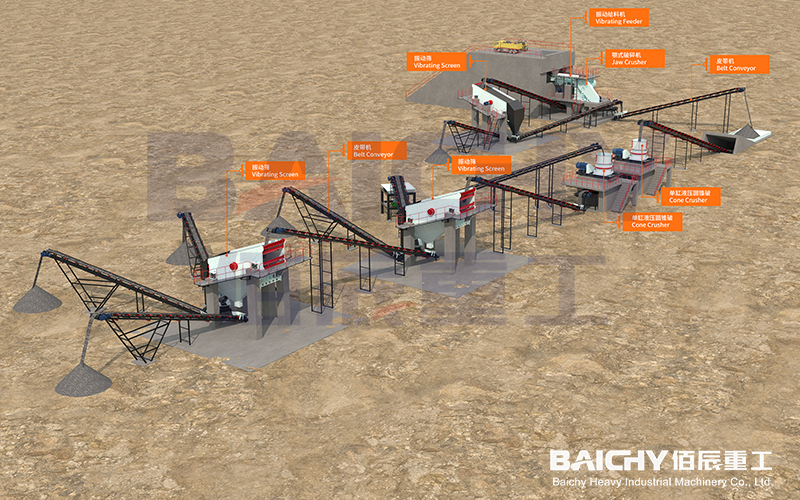
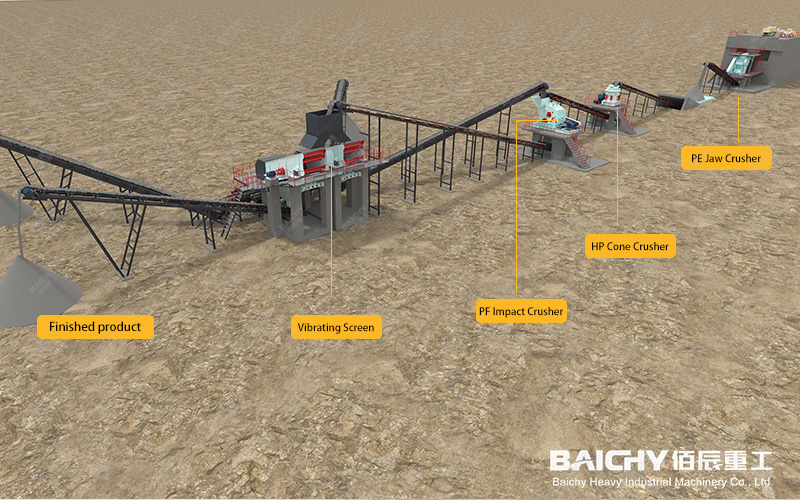
A complete stationary crushing and screening station operates along one primary flow path: vibrating feeder → primary jaw crusher → secondary/fine crusher (cone or impact crusher) → circular vibrating screen → finished product conveyor. Oversized material from the screen is recirculated to the secondary crusher, creating a closed-circuit loop.
The feeder delivers material into the jaw crusher evenly, continuously, and at a controlled rate. The jaw crusher performs primary crushing, reducing blasted rock to a size suitable for the secondary stage. The secondary stage employs either a cone crusher (utilizing inter-particle/lamination crushing) or an impact crusher (utilizing impact crushing); this stage determines the shape of the finished product and the total reduction ratio of the entire line. The circular vibrating screen separates the material into finished product specifications based on mesh size. Because the main equipment is installed on a permanent foundation and remains stationary, all inter-stage connections, chutes, and bins can be precisely positioned at fixed elevations during initial installation, eliminating the need for repeated dismantling or reassembly during operation.
II. Stationary crushing and screening stations cover a capacity range of 30–800 t/h, representing a comprehensive product series rather than a single capacity
Baichy’s stationary production lines span capacities from 30–60 t/h up to 800 t/h, handling materials such as granite, limestone, basalt, and construction waste. Within a specific capacity range, only the size of the machinery changes; a fundamental change in equipment type is only required when moving between capacity tiers. The table below lists seven common capacity tiers side-by-side; the number of crushing stages and equipment configuration in each row serve as the basis for selecting the appropriate crushing and screening plant:
| Capacity Tier (t/h) | Stages / Closed-Circuit | Core Equipment Configuration (Feeder → Primary Crushing → Secondary/Fine Crushing → Screening) | Max. Feed Size (mm) | Finished Product Size (mm) | Selection Criteria: What this tier implies |
|---|---|---|---|---|---|
| 30–60 | Two-stage closed-circuit | ZSW6525 → PE400×600 → PF1007 Impact Crusher → 4YK1237 | ≤300 | 0-5 / 5-10 / 10-20 / 20-40 | Entry-level tier for a single commercial concrete plant or small quarry; lines exceeding 100 t/h often require initial capital of over $150,000, whereas this tier avoids the financial waste associated with idle capacity |
| 80–100 | Two-stage (Jaw + Cone) | ZSW850×3000 → PE500×750 → CS75 Cone Crusher → YK1548 | <425 | 3-100 | The standard choice for small-scale hard rock processing; utilizes cone crushers for superior liner longevity; adjustable product size (3-100mm) |
| 100 | Two-stage closed-circuit | ZSW960×3800 → PE600×900 → PFW1214 Impact Crusher → 4YK1860 | <350 | 0-5 / 5-10 / 10-20 / 20-40 | Tier for single-pass shaping of medium-soft rock; the 75kW primary crusher is the defining power specification for this tier |
| 100–150 | Two-stage | ZSW960×3800 → PE600×900 → CS110 or PYB1200 Cone Crusher → 4YK1860 | <500 | 0-40 | Feeder, primary crusher, and 100 t/h capacity Configurations in the same tier, differing only in the secondary crushing stage: cone crushers for hard rock, impact crushers for medium-soft rock. |
| 150–200 | Two-stage | ZSW1100×4200 → PE750×1060 → PFW1320 Impact Crusher → 4YK2470 | <425 | 0–5 / 5–10 / 10–20 / 20–40 | Skipping the tertiary cone crushing stage saves $35,000–$50,000 in equipment investment and eliminates one screening loop; the most cost-effective option for medium-hard rock. |
| 200–250 (Hard Rock) | Three-stage closed-circuit | ZSW1142 → C100 Jaw Crusher → CS160 Cone Crusher ×2 → 2YK1860 ×3 | ≤600 | 0–30 | The only three-stage configuration in the lineup: dual cone crushers and three screens provide 60–70% residual capacity during maintenance days and a total screening area of 32.4 m². |
| 800 | Jaw Crusher + Impact Crusher | ZSW1560 → PE1200×1500 → PFW1315 Impact Crusher ×4 → YK Vibrating Screen + XL1120 Spiral Sand Washer | <800 | 0–5 ~ 20–40 | Top of the lineup: 1200×1500mm feed opening; primary crushing rated at 400–900 t/h; screening configured with 3–4 decks and ≥90% efficiency. |
Note: Capacities listed are rated values based on medium-hardness material and feed sizes matching the specified inlet dimensions. Calculations must be adjusted based on site-specific data if material hardness, moisture/clay content, or target product sizes deviate from these ratings. Product sizes represent common specification ranges; actual sizes depend on screen mesh selection. Equipment configuration is subject to the process layout drawing; parameters are subject to change without prior notice; actual equipment prevails.
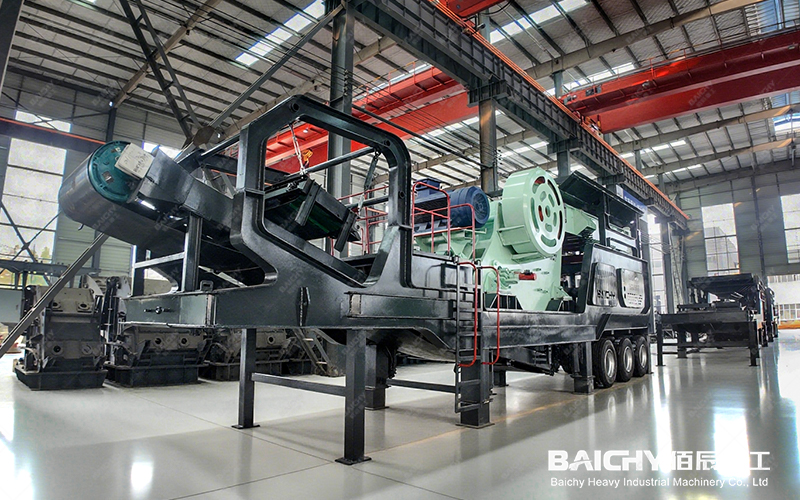
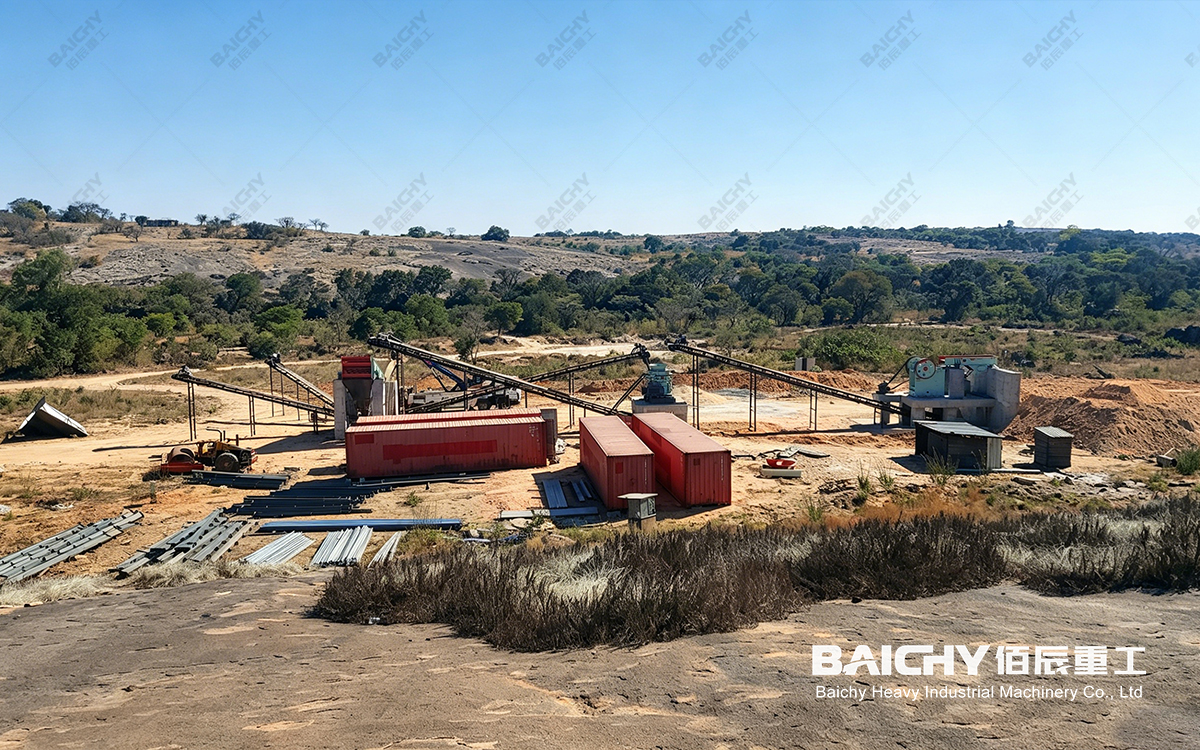
stationary crushing plant
III. Number of crushing stages is determined by hardness, not production capacity
A side-by-side comparison of the capacity tiers for stationary crushing and screening stations reveals a clear pattern: the tiers ranging from 30–60 t/h up to 150–200 t/h all utilize a two-stage configuration. Despite a fivefold difference in capacity across these tiers, the number of stages remains constant; only the equipment model changes—specifically, the primary crusher upgrades from the PE400×600 to the PE750×1060. There is only one exception among these tiers: the 200–250 t/h hard rock tier, which employs a three-stage closed-circuit process for feed sizes ≤600 mm.
The number of stages addresses the adequacy of the "crushing ratio," not the production capacity. For moderately soft rock, a two-stage process using impact crushers can achieve a 0–40 mm product size; for hard rock at the same capacity, a cone crusher's inter-particle (or "layer") crushing action is required to ensure a sufficient crushing ratio—increasing capacity alone does not necessitate adding another stage. In equipment selection discussions, these two factors are often conflated into a single issue.
IV. Closed-circuit operation ensures controllable particle size; the number of stages is merely a means to an end
In Baichy's specifications, the final product particle size is considered 100% controllable in both two-stage and three-stage closed-circuit systems. This controllability stems from the closed-loop design itself: oversize material is returned to the crusher, and simply changing the screen mesh alters the product gradation. The number of stages determines the crushing ratio and particle shape, whereas the closed-circuit configuration ensures control over particle size.
The parameter most frequently overlooked is the installed power of the primary crusher. Taking the 100 t/h tier as an example: the PE600×900 crusher processes blasted rock <500 mm, discharges material <150 mm, and has an installed power of 75 kW. This yields a primary crushing power intensity of 0.75 kW/(t·h⁻¹) (calculated as rated power pided by design capacity; this applies only to the primary stage and represents power intensity, not specific energy consumption per ton, so it cannot be used to reverse-calculate total energy use). At the top of the product range—the 800 t/h tier—a 3-to-4-deck vibrating screen is used, achieving a screening efficiency of ≥90%. For stationary plants, the screening process cannot be eliminated; the only variable is the number of screen decks. Reducing the number of decks means that any shortfall in specific finished product sizes must be compensated for through additional material handling and transport—an annual cost factor for a crushing and screening plant.
V. Three factors that truly create differentiation at the same capacity level
The feeder is a standard component, not a differentiator. The ZSW9638 (960×3800mm, 120–210 t/h) covers the 100 t/h and 100–150 t/h capacity tiers, while the ZSW1142 (1100×4200mm, 200–430 t/h) covers the 150–200 t/h and 200–250 t/h tiers. Only two models are used across four capacity tiers; thus, the feeder is not a differentiating factor for a crushing and screening plant.
Investing in redundancy essentially buys production output for maintenance days. A hard-rock configuration for the 200–250 t/h tier—equipped with two CS160 cone crushers and three 2YK1860 screens—is designed to maintain 60–70% of online capacity even when a single unit is undergoing maintenance, with a total screening area of 32.4 m². The true performance metric of a stationary crushing and screening plant is not its nameplate capacity, but its output on maintenance days.
Decisions regarding the primary crusher model are constrained by the requirements of both processing lines. For the 100 t/h tier (feed size <350mm), the PE600×900 is used; for the 150–200 t/h tier (feed size <425mm), the PE750×1060 (max feed size ≤630mm, 110–380 t/h) is employed. Feed inlet width dictates the handling of large rocks, while capacity requirements determine the specific machine model; if the rock size exceeds the inlet dimensions, a different model must be selected, regardless of how low the required throughput might be.
VI. Four Key Questions for Equipment Selection: Start with the Material; Budget Comes Last
Ask these four questions in order:
① Target production capacity (t/h);
② Material type, hardness, and abrasiveness;
③ Maximum feed particle size (mm);
④ Target finished product particle size.
These four items serve as the design inputs for any stationary crushing and screening plant scheme. "Budget" is not among these four questions; rather, the budget is an output determined *after* these questions are answered. If you try to determine the configuration based on the budget first, you are reversing the proper order: the budget does not determine the number of crushing stages (hardness does), nor does it determine the feed opening size (blasted rock fragmentation does).
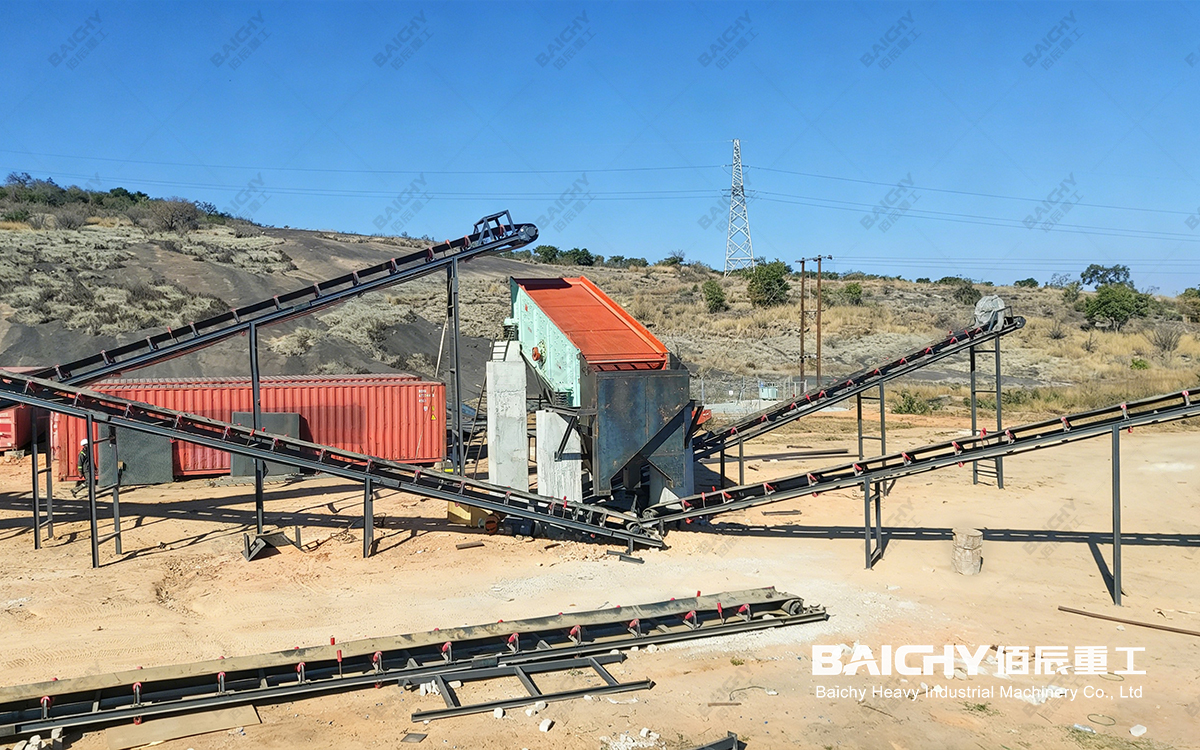
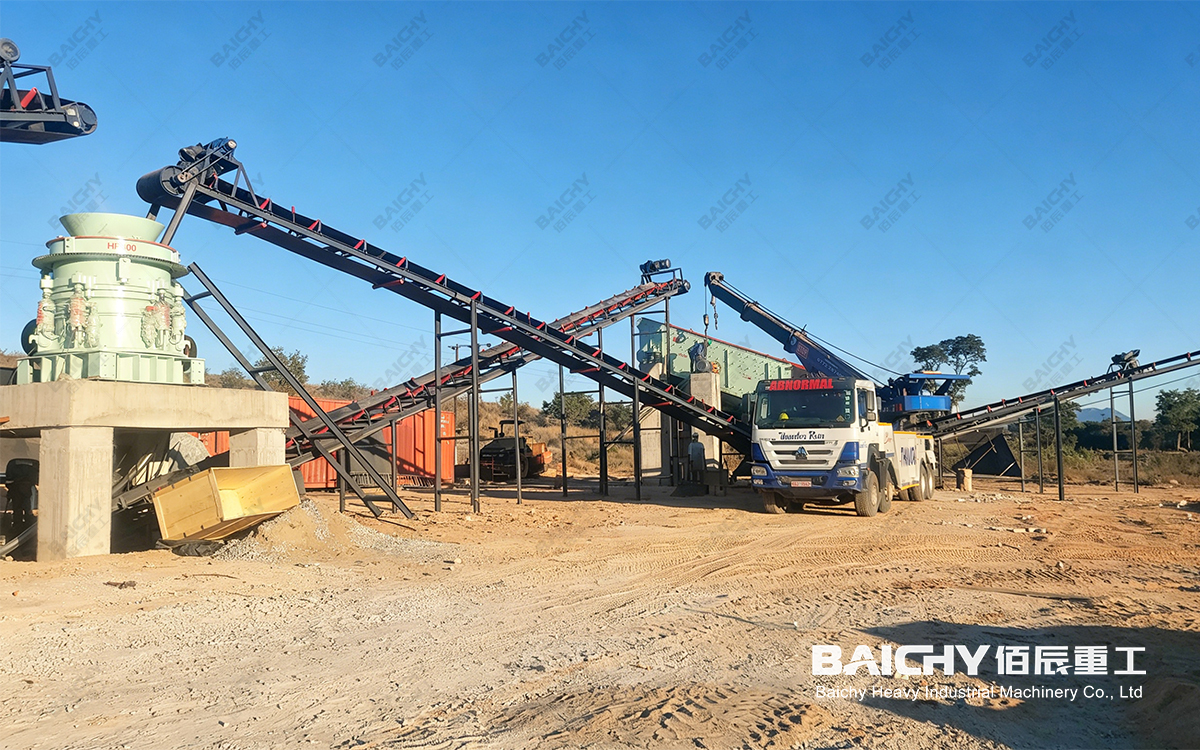
Stationary crushing and screening plant
VII. FAQ: Common Questions About Stationary Crushing and Screening Plants
Q1: How do I choose between a stationary crushing and screening plant and a mobile plant?
A: Consider three factors: whether the material source is fixed, whether the site requires relocation, and how low the cost per ton needs to be. Mobile plants offer the advantages of flexible relocation and no investment in foundations. Stationary plants offer returns based on production volume and operational lifespan: in the 150–200 t/h range, skipping the tertiary cone crushing stage can save $35,000–$50,000 in equipment costs and eliminate one screening loop. Additionally, for ultra-hard rock requiring fine crushing, mobile cone crushers are more expensive, whereas stationary production lines are usually more economical. Choose a stationary plant if the material source is fixed and the planned operational lifespan is long; choose a mobile plant if the material source is dispersed and the equipment needs to move between job sites.
Q2: Should a stationary crushing and screening plant processing hard rock include a tertiary crushing stage?
A: Base the decision on material hardness, not production capacity. For medium-hard rock at 150–200 t/h, a two-stage circuit suffices to reduce feed sizes under 425 mm directly to a 0–40 mm product. For hard rock at 200–250 t/h, a three-stage closed-circuit configuration is used: a C100 jaw crusher (feed opening 760×1060 mm; max feed size ≤600 mm; capacity 200–400 t/h), two CS160 cone crushers, and three 2YK1860 screens. The additional cone crusher stage is included to optimize the crushing ratio and particle shape.
Q3: Is there a difference in the controllability of the final product size between two-stage and three-stage closed circuits?
A: No difference. In Baichy's specifications, both two-stage and three-stage closed circuits offer 100% control over the final product size. This controllability stems from the closed-loop design itself: oversize material is returned to the crusher, and simply changing the screen mesh adjusts the product gradation.
Q4: Why do some capacity tiers feature two cone crushers and three screens?
A: It is about maintaining output during maintenance days. The 200–250 t/h hard rock tier uses two CS160 crushers and three 2YK1860 screens; the design ensures that 60–70% of production capacity remains online even when one unit is undergoing maintenance, with a total screening area of 32.4 m².
Q5: Is the primary crusher model selected based on production capacity or feed size?
A: Both factors are considered simultaneously. For the 100 t/h tier, the feed size is <350 mm, paired with a PE600×900 (600×900 mm opening; <500 mm feed; 90–180 t/h capacity); for the 150–200 t/h tier, the feed size is <425 mm, using a PE750×1060 (≤630 mm feed; 110–380 t/h capacity).
Baichy Heavy Industry
Baichy Heavy Industry is a high-tech mining equipment company integrating R&D, manufacturing, sales, and after-sales service. Focusing on crushing, grinding, and mineral processing equipment, we provide professional solutions to our customers. We are ISO9001:2015 、certified, and our products include mobile crushing palnts, crawler crushing plant, construction waste crushing plants, jaw crushers, sand making machines, cone crushers, fine crushers, grinding mills, ball mills, etc., all with reliable performance to meet diverse project needs.
Baichy Heavy Industry – Your Trusted Partner
To ensure optimal performance of your equipment, Baichy Heavy Industry offers:
- Professional on-site installation guidance
- Comprehensive operator training
- 24/7 technical support & maintenance services
Our complete after-sales service system guarantees long-term, stable operation of your machinery with minimal downtime.
Protect Your Rights – Only Use Official Channels
To avoid scams and ensure authentic support, contact us exclusively through:
• Official Website: www.baichychina.com
• WhatsApp: +8615093222637
• Email: [email protected]
Your satisfaction is our priority – expect prompt, professional service every time.
(Note: Beware of unauthorized third parties claiming to represent Baichy. Always verify through official contacts.)