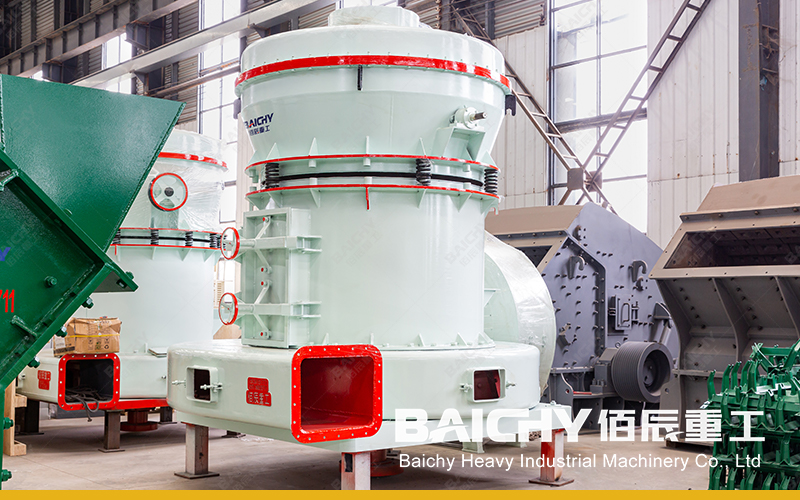
With the development of industries such as new materials, coatings, inks, and high-end plastics, the demand for ultrafine powders ranging from 1000 mesh (approximately 15 micrometers) to 1250 mesh (approximately 12 micrometers) is increasingly strong. Traditional Raymond mills are typically used for processing powders of 200-800 mesh. Once they enter the ultrafine range of 1000 mesh and above, they often face severe challenges such as a sharp decrease in output, soaring energy consumption, and accelerated equipment wear.
So, is there a solution that can meet the demand for considerable output (e.g., 1-3 tons/hour) while stably controlling the finished product within the 1000-1250 mesh ultrafine range? The answer is yes—the upgraded ultrafine vertical grinding mill (high-pressure suspension roller mill) was developed precisely for this purpose.
Key Indicators Explained: What do 1-3 tons/hour and 1000-1250 mesh mean?
• Output (1-3 tons/hour): This is not the output of a small experimental device, but a marker of commercially viable continuous production capability. This means your production line can operate efficiently, meeting the supply needs of medium to large-scale projects and achieving considerable economic benefits.
• Fineness (1000-1250 mesh): This fineness range falls under the category of ultrafine powders. The finished powder has a larger specific surface area, higher activity, and better application performance, and is widely used in high-value-added products, such as high-end coatings that make paint films smoother, and plastic fillers that enhance product strength.
Combining these two aspects is the core value of a powerful production equipment that combines "high efficiency" and "high precision."
Key Technologies for Achieving This Technical Goal
Conventional Raymond mills struggle to simultaneously achieve high output and ultrafine powder, while the upgraded Raymond mill designed specifically for ultrafine powders achieves a breakthrough through the following core technologies:
1. Enhanced Grinding Force and Optimized Grinding Roller and Grinding Ring Design: Utilizing larger grinding rollers and grinding rings made of special alloy materials, a stronger grinding pressure is provided under the action of high-pressure springs or a hydraulic system. Meanwhile, the curves of the grinding rollers and grinding ring are precisely calculated to ensure a longer residence time and more thorough compaction of the material within the grinding zone.
2. High-efficiency ultrafine classification system: This is the core component for achieving a 1250-mesh fineness. The equipment incorporates or is equipped with a high-precision turbine classifier. The classifier's speed is infinitely adjustable, thus precisely controlling the fineness of the output powder. Qualified fine powder is promptly separated, effectively avoiding over-grinding and ensuring the uniformity of the finished product's particle size.
3. High-flow ventilation system: Equipped with a high-powered induced draft fan, it forms a powerful internal circulating airflow. This not only improves production efficiency (output) but, more importantly, promptly removes qualified fine powder, cooling the grinding chamber, reducing the equipment's operating temperature, and protecting the material's properties.
4. Intelligent control system: Integrated with a PLC electrical control system, it allows for easy setting and maintenance of target fineness and output, enabling one-button start/stop and fault alarms. Operation is simple, greatly reducing reliance on manual labor and operational complexity.
Applicable Materials
This Raymond mill, suitable for producing 1000-1250 mesh ultrafine powder, can process a wide range of non-metallic minerals:
• Calcium carbonates: Calcite, marble, chalk
• Silicates: Talc, bentonite, kaolin, potassium feldspar
• Others: Barite, fluorite, gypsum, etc.
Note: The hardness, moisture content, and impurity content of the material directly affect the final output and fineness. Detailed material testing is recommended before selection.
Investment Value Analysis
Choosing such a high-performance ultrafine Raymond mill will give you:
• Product Upgrade: Easily enter the high-profit ultrafine powder market.
• Efficiency Improvement: A single unit can complete the one-time processing from lumps to ultrafine powder, with a short process flow and high efficiency.
• Energy Consumption Optimization: Compared to traditional ball mills and other equipment, it typically consumes less energy for the same fineness and output, aligning with energy conservation and environmental protection trends.
• Stable and Reliable: The equipment operates smoothly, producing uniform and controllable particle size in the finished product, ensuring the stability of the final product quality.
If you are looking for a solution for stable, high-volume production of 1000-1250 mesh ultrafine powders, then this upgraded ultrafine Raymond mill with a capacity of 1-3 tons per hour is undoubtedly your ideal choice. It successfully breaks through the technical barrier that "high output" and "ultra-high fineness" are mutually exclusive in the ultrafine powder processing field, making it a powerful piece of equipment to help enterprises achieve industrial upgrading and seize market opportunities.
Feel free to contact us anytime for free material testing and customized solution design! Let us use professional equipment to help your powder business reach new heights!