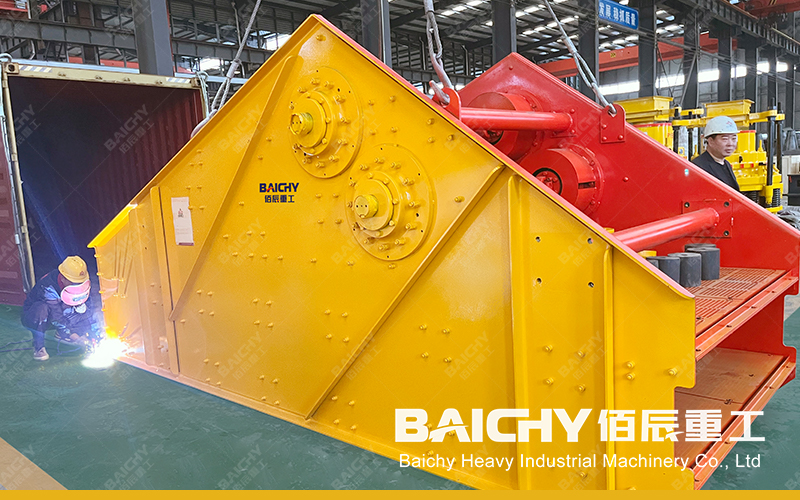
In many industrial sectors involving slurry processing, such as mining, chemicals, and environmental protection, achieving efficient and economical solid-liquid separation is a core issue. The dewatering vibrating screen is one of the key pieces of equipment for solving this problem. With its high processing capacity, stable operating characteristics, and relatively low operating costs, it has become an indispensable dewatering expert in modern industrial production. This article will take you through a comprehensive understanding of all aspects of the dewatering vibrating screen.
I. What is a Dewatering Vibrating Screen? Core Definition Revealed
A dewatering vibrating screen, as the name suggests, is a screening machine specifically designed for dewatering and desliming materials containing moisture. It uses a high-frequency, low-amplitude vibrating motor to generate excitation force, causing the screen box to continuously vibrate the screen mesh. The slurry or wet screening material to be processed is evenly fed into the inlet. Under the combined action of the vibration force and the screen surface inclination angle, solid particles jump forward on the screen surface, while water is quickly separated and discharged through the screen mesh, ultimately achieving the purpose of dry and wet separation. Simply put, it's like a highly efficient vibrating filter that can quickly separate solids and liquids in a mixture.
II. How Does a Dewatering Vibrating Screen Work? A Deep pe into its Working Principle
The high efficiency of a dewatering vibrating screen stems from its ingenious design and scientific working principle, primarily encompassing the following key aspects:
1. Vibration Source and Motion Trajectory: The core of the equipment is the vibrating motor mounted on the screen box. Two vibrating motors rotate synchronously in opposite directions, generating a combined excitation force that remains constant in direction, driving the screen box to vibrate along a straight or near-straight trajectory. This intense vibration prevents material from clogging the screen openings and provides power for material conveying and dewatering.
2. Screening and Dewatering Process: After entering the screen surface, wet material is thrown up and dispersed under high-frequency vibration. Fine particles and water (liquid phase) quickly pass through the screen openings under the influence of gravity and vibration, becoming the undersize material (filtrate). Larger solid particles (solid phase) are trapped by the screen and move towards the discharge end under vibration, thus achieving solid-liquid separation. 3. Enhanced Dewatering Effect: To improve dewatering efficiency, dewatering vibrating screens are typically designed with a certain inclination angle and employ a multi-layer screen structure. The upper screen separates coarse particles, while the lower, finer screen further dewaters the finer materials, minimizing the moisture content of the final solid product.
III. Outstanding Advantages: Why are dewatering vibrating screens so popular?
• High Dewatering Efficiency: High-frequency vibration rapidly removes moisture from solid particles, resulting in high throughput and excellent dewatering effect.
• Simple Structure and Easy Maintenance: The compact overall design with few core components leads to a low failure rate, making daily maintenance and screen replacement very simple.
• Low Energy Consumption: Compared to dewatering equipment such as centrifuges, it generally has a lower energy consumption and lower operating costs.
• Wide Applicability: By selecting screens made of different materials (such as stainless steel and polyurethane) and with different aperture sizes, it can handle various materials ranging from coarse particles to fine powders, and it exhibits strong corrosion resistance.
• Environmental Protection and Energy Saving: Effectively recovers water resources and useful solid materials, meeting the environmental protection requirements of green production.
IV. Wide Applications: In which industries do dewatering vibrating screens shine?
Dewatering vibrating screens are used in almost all industrial sectors requiring solid-liquid separation:
• Mineral Processing Industry: Used for slurry thickening, tailings dry discharge, and concentrate dewatering, it is a key piece of equipment for achieving environmental protection and safety in tailings ponds.
• Coal Industry: Dewaters and recovers coal slurry water from the coal washing process, realizing the resource utilization of coal slurry and closed-loop recycling of wash water.
• Sand and Gravel Aggregate Industry: Used for washing, dewatering, and grading manufactured sand, controlling the moisture content and stone powder content of the finished sand.
• Chemical Industry: Used for the separation and dewatering of various chemical crystals and precipitates.
• Environmental Protection Industry: In wastewater treatment plants, used for sludge dewatering, reducing sludge volume for easier subsequent transportation and treatment.
• Food and Pharmaceutical Industry: Used for dehydration and screening of food additives or pharmaceutical intermediates such as starch, sugar, salt, and monosodium glutamate.
V. How to Choose a Suitable Dewatering Vibrating Screen? Professional Selection Guide
Choosing the right dewatering vibrating screen is crucial to ensuring production efficiency and economic benefits. The following points should be considered during selection:
• Characteristics of the material being processed: Including particle size, shape, density, viscosity, solids content, and corrosivity.
• Processing capacity requirements: The amount of material to be processed per hour (tons/hour).
• Dewatering target: The desired moisture content of the final solid product.
• Screen configuration: Based on the required separation accuracy, select single-layer or multi-layer screens and determine the appropriate screen aperture size and shape.
• Equipment material: Based on the corrosivity of the material, select materials such as carbon steel, 304 stainless steel, or 316L stainless steel.
• Special process requirements: Such as whether sealing for dust prevention or explosion-proofing is required.
As a mature and efficient solid-liquid separation device, the dewatering vibrating screen continues to create enormous value for global industrial production due to its superior performance and wide adaptability. Whether for new projects or the upgrading of existing production lines, selecting a suitable dewatering vibrating screen is an important step in improving efficiency, reducing costs, and achieving environmentally friendly production.