
Comprehensive Comparison of Dry and Wet Ball Mills
Dry Grinding vs. Wet Grinding: An In-Depth Analysis of Choosing Between Dry and Wet Ball Mills
In the mineral processing, building materials, and chemical industries, ball mills are indispensable core equipment in the material crushing process. However, faced with the two main types dry ball mills and wet ball mills many customers are often confused when choosing: which one is better? In fact, the answer to this question is not absolute; it entirely depends on your material characteristics, process requirements, and final product goals. As an equipment manufacturer with twenty years of experience in the industry, we will provide you with a comprehensive comparison from multiple perspectives to help you find the most suitable solution.
| Key Words | Comprehensive Comparison of Dry and Wet Ball Mills |
|---|---|
| Product Model | Ball Mill |
| Feed Size | ≤25mm |
| Motor Power | 18.5-4500kw |
| Capacity | 0.65-615t/h |
| Core Functions | Grinding precision and particle size controllability |
| Brand | Baichy Heavy Industry |
| Packing | Standard containers,Nude Packing,Wooden boxes, etc |
| Installation | Engineer Guide |
| Factory visit | Welcomed Warmly |
| Export Countries | Southeast Asia, Central Asia, South America, North America, Africa |
| Payment | T/T,L/C payment,Paypal...etc |
| Please note: The above table data is for reference only. For specific information, please contact us. | |
I. Overview of Core Concepts
Before a detailed comparison, we first need to clarify the basic working principles of both.
Dry Ball Mill
A dry ball mill refers to equipment that grinds and pulverizes dry materials directly without adding water or other liquids during the grinding process. The material is ground to the required fineness in the cylinder through the impact and grinding of steel balls or liners, and then discharged by air or natural discharge methods.
Wet Ball Mill
A wet ball mill requires the addition of a certain proportion of water (or other liquid) during the grinding process. The material is mixed with water to form a slurry, which flows in the cylinder. After grinding, it is discharged in the form of a slurry, usually requiring subsequent dewatering.
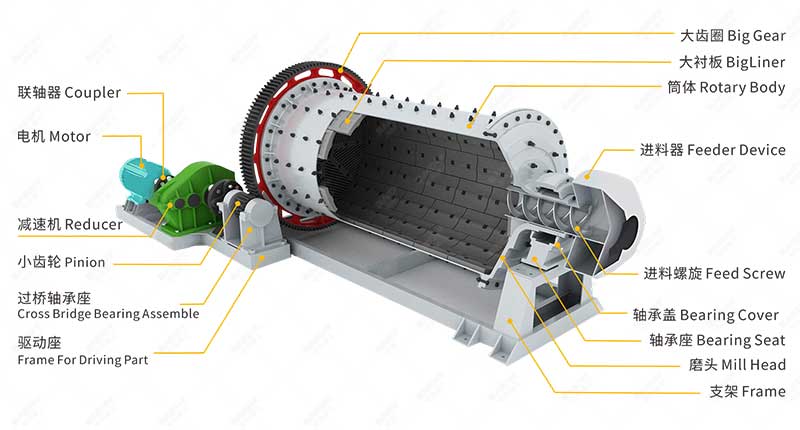
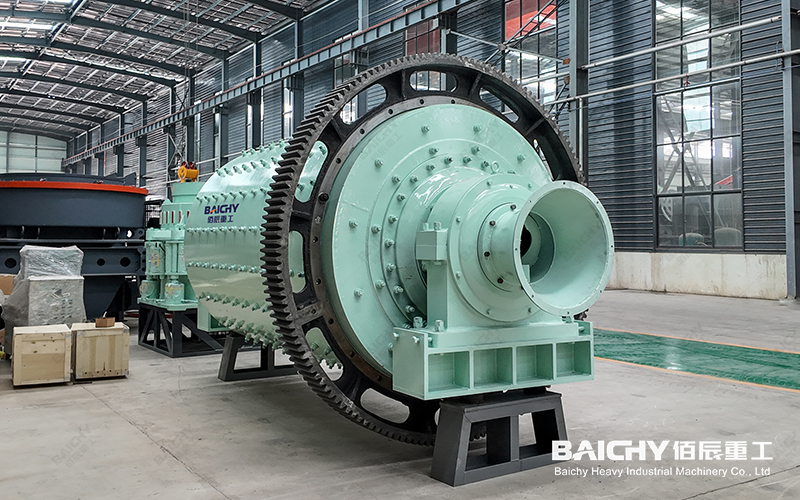
Ball mill structure diagram
II. In-Depth Comparison of Advantages and Disadvantages
Which equipment is better? The key is whether its advantages match your needs.
Advantages and Applicable Scenarios of Dry Ball Mills
Core Advantages
1. No dewatering required, product is ready for use: For industries where the finished product needs to be a dry powder, such as cement, silicate products, and refractory materials, dry grinding avoids expensive drying costs and the process is simpler.
2. Relatively lower investment and operating costs: It eliminates auxiliary equipment such as slurry transportation, concentration, and filtration, resulting in a relatively simpler system structure, and usually smaller initial plant investment and footprint.
3. Controllable environmental risks: It does not produce wastewater, avoiding the problem of treating heavy metal wastewater or mineral processing reagent wastewater, which is a significant advantage in areas with strict environmental requirements. 4. Friendly to water-sensitive materials: Suitable for materials that are sensitive to water, or for use in arid and water-scarce regions.
Limitations
• Relatively low grinding efficiency, prone to dust generation, requiring a high-efficiency dust removal system.
• When the material is too fine, caking or adhesion can easily occur, making fineness control slightly more difficult.
• Higher grinding temperature, not suitable for heat-sensitive materials.
Advantages and Application Scenarios of Wet Ball Mills
Core Advantages
1. High grinding efficiency and uniform particle size: The lubricating effect of water reduces material adhesion and improves fluidity, allowing the steel balls to impact and grind the material more thoroughly. Under the same conditions, the output is higher and the product particle size is more uniform.
2. Minimal dust pollution: Operating in the form of slurry fundamentally eliminates dust dispersion, resulting in a cleaner working environment.
3. Suitable for subsequent wet processes: In ore dressing plants, the product after grinding usually requires wet separation processes such as flotation and magnetic separation. Wet ball mills can directly provide slurry, ensuring smooth process衔接, and are the absolute mainstream in metal ore dressing.
4. Less over-grinding: Fine particles are promptly carried away by water, reducing over-grinding.
Limitations
• Inevitably produces wastewater, requiring a supporting treatment system, increasing investment and operational complexity.
• The corrosion and wear rate of mill liners and steel balls in water may be higher than in dry grinding.
• If the final product requires dry powder, additional processes such as concentration, filtration, and drying are needed, significantly increasing energy consumption and costs.
III. Practical Application Case Studies
• Case Study 1 (Dry Ball Mill): A large cement plant in North China, with raw materials including limestone and clay. Our dry ball mill is used for closed-circuit grinding, combined with a high-efficiency bag filter, to directly produce qualified cement raw meal powder. The system operates stably, meets environmental standards, and has a high overall energy efficiency ratio.
• Case Study 2 (Wet Ball Mill): A copper mine ore dressing plant in Africa, with the original ore being copper sulfide ore. By using our wet ball mill and spiral classifier to form a closed-circuit grinding system, the qualified fine-grained slurry is directly pumped to the flotation plant. This solution ensures high grinding efficiency and recovery rate, and is the core of the stable operation of the entire processing plant.
IV. How to Choose? Our Professional Recommendations
Situations where dry ball mills are preferred:
• The product requires dry powder (such as cement, coal powder, non-metallic mineral powders).
• The project location has scarce water resources or extremely strict environmental requirements for wastewater discharge.
• The material itself is sensitive to water or is viscous and may agglomerate when exposed to water.
• The investment budget is limited, and a simplified process flow is desired.
Situations where wet ball mills are preferred:
• Grinding in the pre-processing stage of metal ores (iron, copper, gold, lead-zinc, etc.).
• High requirements for grinding fineness and output, pursuing higher grinding efficiency.
• The process itself is a wet process (such as ceramic and glaze preparation).
• Strict control of dust explosion risk is required (such as certain specific chemical raw materials).
V. Frequently Asked Questions (FAQ)
1. Can it be used for both dry and wet grinding by adding/not adding water?
In principle, this is not recommended. The structure (such as the discharge end, liner type), sealing method, and supporting system design of the two types of ball mills are significantly different. Forcibly changing the working mode will seriously reduce efficiency, accelerate equipment damage, and pose safety risks. Please choose dedicated equipment based on the determined process.
2. Which type of ball mill has lower energy consumption?
It cannot be generalized. The energy consumption of a single wet ball mill is usually lower than that of a dry mill of the same specification because it is more efficient. However, considering the entire system (dust removal for dry grinding vs. dewatering and drying for wet grinding), the total energy consumption needs to be calculated specifically. Generally, when the final product requires dry powder, the total energy consumption of the dry grinding system is often superior; when the product is slurry, the total energy consumption of the wet grinding system is lower.
3. Which type of equipment has higher maintenance costs?
The maintenance focus is different for the two. Dry ball mills require special attention to the dust removal system and bearing seals. Wet ball mills require attention to the wear and corrosion of the slurry on the liners, grinding balls, and pumps and valves. Under the same material conditions, the consumption of grinding media in wet grinding may be slightly higher, but the overall maintenance cost is closely related to factors such as material abrasiveness and water quality, requiring case-by-case analysis.
Returning to the original question: which is better, a dry ball mill or a wet ball mill?
The answer is: there is no best, only the most suitable. Dry grinding excels in its simple process, no wastewater, and suitability for dry powder products; wet grinding excels in its superior efficiency, no dust, and compatibility with wet processes. Your material characteristics, target product form, local resource conditions, and environmental regulations will jointly determine the answer to this question.
As your reliable partner, we not only provide durable equipment but are also willing to leverage our twenty years of industry experience to provide you with professional process analysis and equipment selection advice to ensure you get the maximum return on your investment.
Perfect after-sales service
Baichy Heavy Industry provides professional on-site guidance for installation, training of workers, and other services to ensure that customers can use the equipment smoothly.
The company has a complete after-sales service system, which can provide customers with timely technical support and equipment maintenance services to ensure the long-term stable operation of the equipment.
To prevent the rights and interests of customers from being infringed, Baichy Heavy Industry reminds customers: please contact our customer service staff through the official website of Baichy Heavy Industry , or add WhatsApp: 15093222637 ; or send an email to: [email protected] , we will get in touch with you as soon as possible and provide you with the most professional service in the industry.
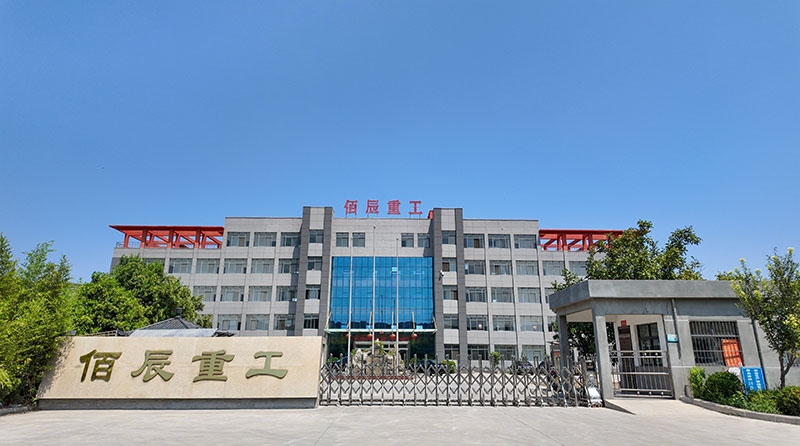
Baichy Heavy Industry
Baichy Machinery is a factory supplier of mining machinery, mainly focusing on stone crushers, powder grinding mills, and mineral beneficiation plants. We can offer you a free design and completed solutions according to your project.
Baichy Heavy Industry has grown into a high-tech mining equipment comprehensive enterprise, integrating R&D, manufacturing, sales, and after-sales service, Passing ISO9001:2015 quality management system certifications. The main products are mobile jaw crushing plants, construction waste crushing plants, PE jaw crushers, VSI sand-making machines, Symons cone crushers, single-cylinder hydraulic cone crushers, PCX high-fine crushers, grinding mills, ball mills, and full sets of beneficiation equipment with an excellent level.