
Portable Crushing Plants | Impact Crushers
In the fields of sand and gravel aggregate production, construction waste recycling, and mining, mobile crushing plants have become the preferred equipment for modern engineering projects due to their flexibility, high efficiency, and convenient relocation capabilities. Among the many types of crushers, the combination of an impact crusher and a mobile chassis has created a highly adaptable and efficient powerful tool that produces excellent aggregate particle shapes. As a manufacturer with 20 years of experience in mobile crushing equipment manufacturing, we will provide you with a comprehensive analysis of the advantages of this combination.
The theme Mobile Crushing Plant | Impact Crusher precisely points to a highly efficient and flexible solution in the current crushing and screening field. It is not simply a combination of equipment, but an ideal process configuration for medium-fine crushing of medium-hard materials (such as limestone, concrete waste, and weathered rock). The mobile plant provides crushing wherever you go mobility, while the impact crusher is responsible for producing high-quality finished materials with uniform, multi-faceted particles. The combination perfectly meets the stringent requirements for crushing efficiency and finished product quality in urban demolition, road construction, and small-scale mining operations.
| Key Words | Portable Crushing Plants | Impact Crushers |
|---|---|
| Product Model | Mobile Impact Crusher |
| Feed Size | 0-500mm |
| Motor Power | 60-300kw |
| Capacity | 30-600 t/h |
| Core Equipment | PF Impact Crusher |
| Brand | Baichy Heavy Industry |
| Please note: The above table data is for reference only. For specific information, please contact us. | |
Working Principle and Structural Characteristics
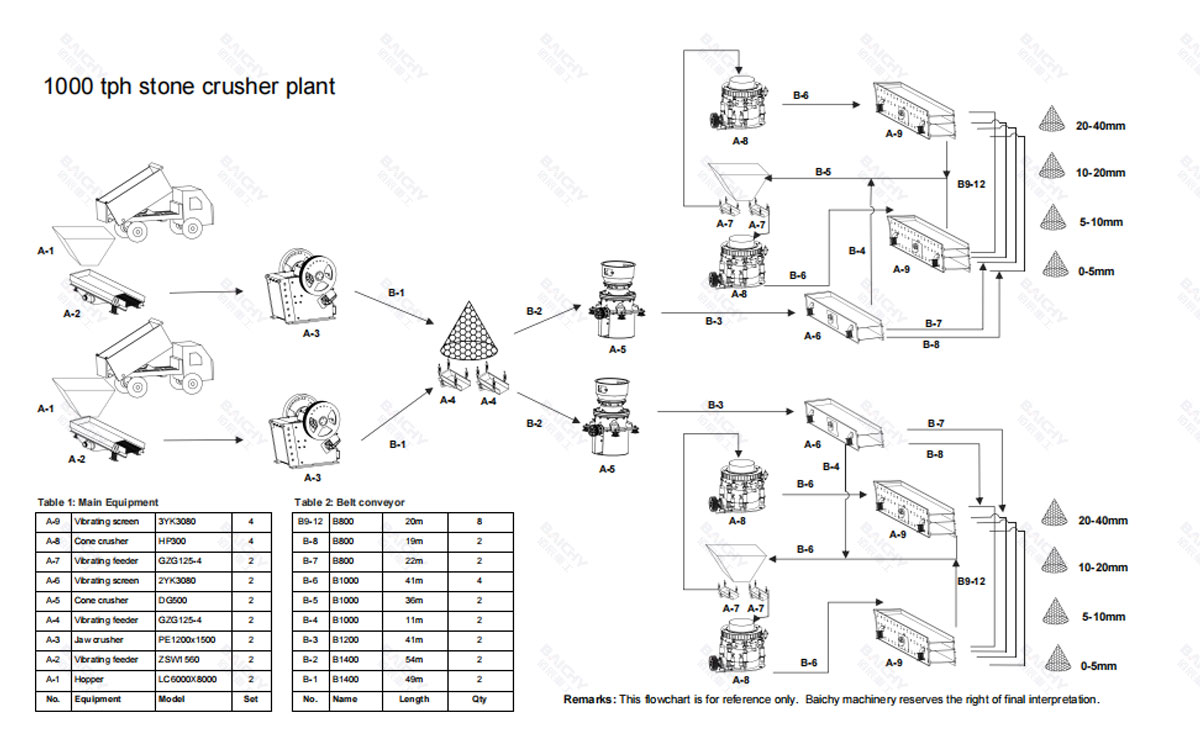
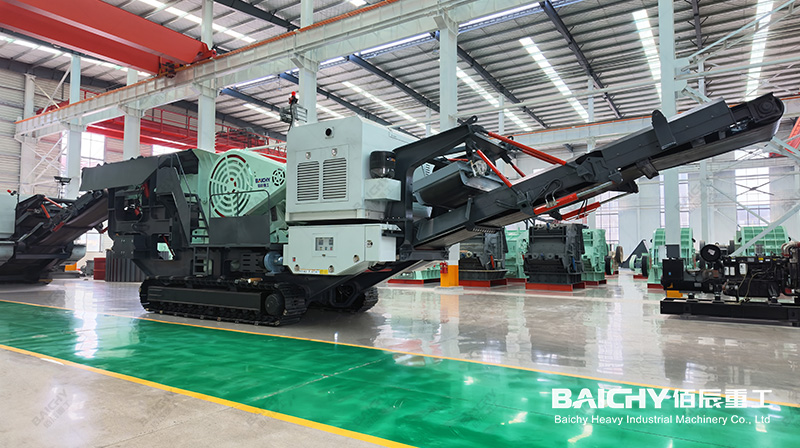
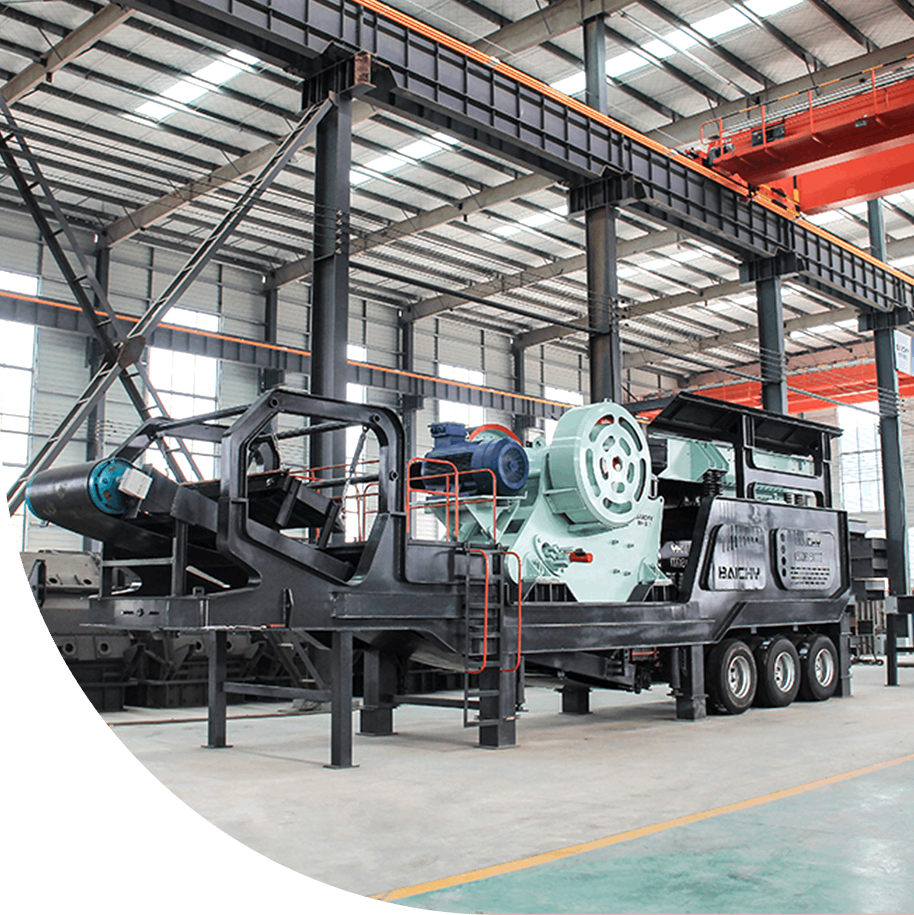
A mobile impact crushing plant typically consists of a feeder, an impact crusher, a vibrating screen, a belt conveyor, and a mobile chassis (wheeled or tracked). Its core component the impact crusher uses a high-speed rotating rotor to drive the hammer plates to impact the material, causing the material to repeatedly impact and collide within the crushing chamber. By adjusting the rotor speed and the gap between the impact plates, the output particle size can be easily controlled.
Compared with traditional jaw crusher mobile plants, impact crusher mobile plants are usually used as the main force for secondary crushing or single-stage crushing, with particular emphasis on controlling the particle shape of the finished product.
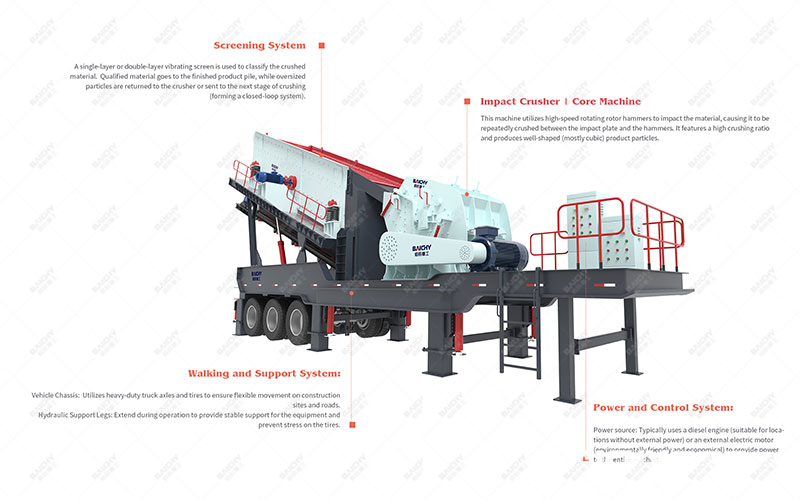
Structural-diagram-of-a-wheeled-mobile-impact-crushing-plant
Core Advantages: Why Choose It?
Based on our twenty years of technical expertise and customer feedback, the main advantages of the mobile impact crushing plant are:
1. Excellent finished product particle shape: The impact crusher uses the principle of impact crushing, producing materials that are mostly cubic, with uniform particles and low tension, making them the preferred material for high-standard concrete aggregates and asphalt pavements.
2. Flexible Mobility and Rapid Deployment: The equipment can be directly deployed to the work site, eliminating complex infrastructure and transportation costs, and allowing for the rapid assembly of a production line. This is especially suitable for projects with complex terrain and scattered work sites.
3. Strong Material Adaptability: Particularly suitable for processing medium-to-low hardness, non-abrasive materials. It performs exceptionally well in the field of construction waste recycling, effectively crushing concrete blocks and asphalt blocks, and separating rebar and other impurities.
4. Integrated Intelligent Control: Modern high-end mobile crushing plants integrate feeding, crushing, screening, and conveying, using a PLC intelligent control system for easy operation. One person can monitor the entire crushing process.
5. Environmental Protection and Cost Reduction: On-site crushing reduces dust and fuel consumption associated with material transportation, aligning with green construction principles. The rapid relocation capability also significantly reduces overall operating costs.

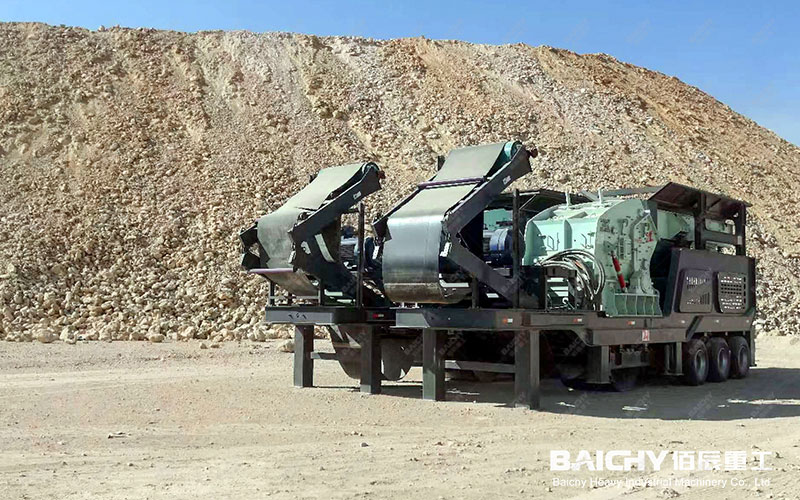
Mobile-impact-crusher-shipped
Case Studies: Testimonials from 20 Years of Experience
Case Study 1: Urban Construction Waste Resource Utilization Project
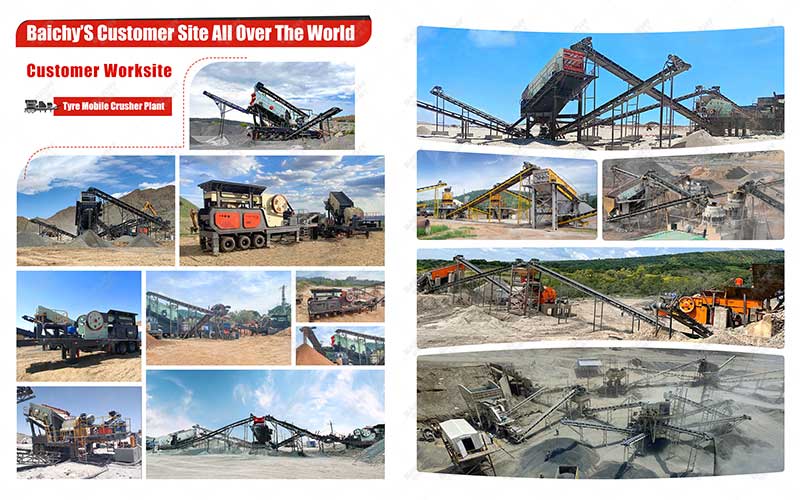
In a demolition project in a city in East China, our crawler-mounted impact crusher mobile plant was deployed to the site to crush concrete beams, columns, and bricks from the demolished buildings on-site. The finished products were separated into various sizes, including 0-5mm, 5-10mm, and 10-31.5mm, and directly used for site backfilling and brick making, achieving turning waste into treasure. The client highly praised its high efficiency, good particle shape, and convenient mobility.
Case Study 2: Riverbed Pebble Sand Production Line
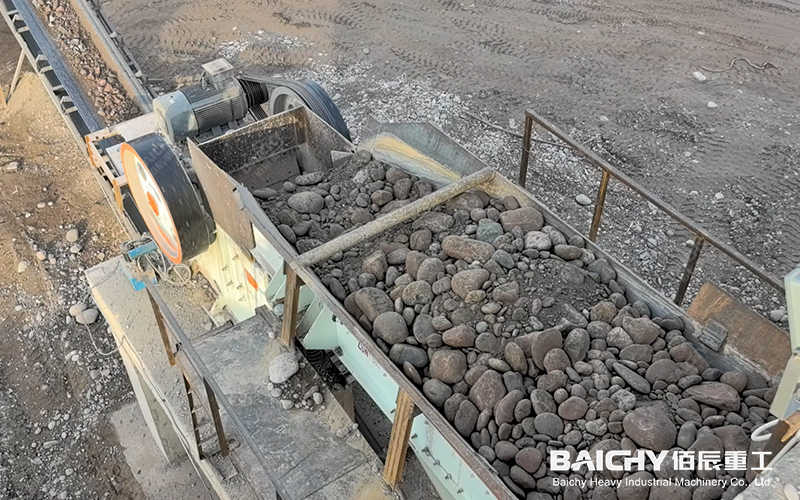
In a river management project in Southwest China, the client needed to use the cleared pebbles to produce manufactured sand. We recommended a configuration of a wheeled mobile impact crusher combined with a vibrating screen. The equipment was arranged along the riverbank, producing high-quality sand with a rounded particle shape, fully meeting local construction sand standards.
Related Equipment Recommendations
In addition to impact crushers, we can provide more complete mobile crushing and screening solutions based on different working conditions:
Jaw Crusher + Impact Crusher Mobile Combined Unit: Suitable for high-hardness rocks requiring two-stage crushing. The jaw crusher performs coarse crushing, and the impact crusher performs medium and fine crushing, resulting in high output and flexible product combinations.
Mobile Cone Crushing Plant: The core choice for crushing high-hardness, highly abrasive ores (such as granite and basalt), featuring strong wear resistance and stable operation.
Mobile Screening Plant: Can be flexibly combined with various types of crushing plants to achieve multi-stage precise screening of materials.
Frequently Asked Questions (FAQ)
Q: Is a mobile impact crusher suitable for crushing granite?
A: Impact crushers are suitable for medium to low hardness materials. For high-hardness granite, long-term crushing will lead to rapid wear of the blow bars and impact plates, resulting in high costs. We recommend using a mobile cone crusher to process such materials.
Q: How to choose between wheeled and tracked chassis?
A: Wheeled chassis are easy to move and rely on a tractor for towing, suitable for projects with good factory and road conditions; tracked chassis have their own track drive, strong off-road capabilities, and can climb slopes, adapting to more complex mountainous and wetland terrains, but the price and transportation costs are relatively higher.
Q: What are the equipment's capacity and maintenance difficulty?
A: The capacity ranges from tens to hundreds of tons per hour, depending on the specific model and material characteristics. Modern equipment design focuses on ease of maintenance; key components such as blow bar replacement and belt tensioning are designed for user-friendliness, and daily maintenance can be performed by trained operators.
Q: As a manufacturer with 20 years of experience, what unique support can you provide?
A: We not only provide reliable equipment but also offer process solution design based on our extensive experience, equipment selection guidance, comprehensive operation training, and global rapid spare parts supply services to ensure the stable and efficient operation of our clients' projects.