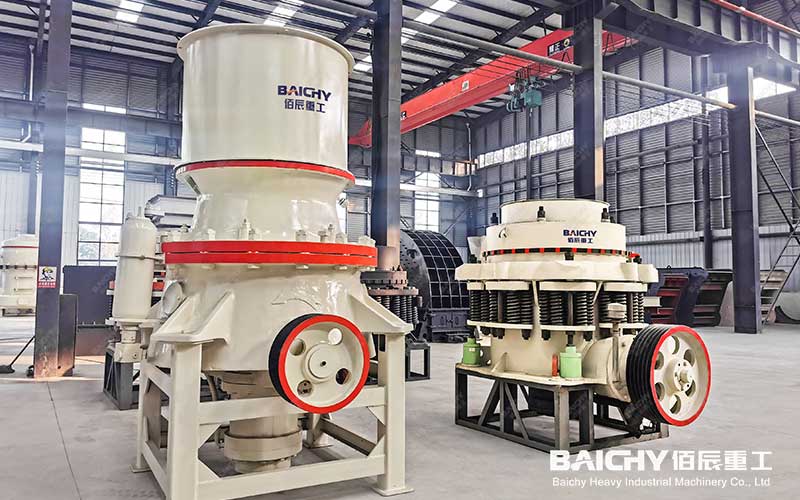
Single-cylinder hydraulic cone crushersare widely used in mining, building materials, and metallurgy due to their high crushing efficiency, excellent particle shape, and intelligent hydraulic adjustment system. However, as core equipment for high-intensity crushing operations, some internal components gradually fail after continuous exposure to significant impact and wear; these components are called "wear parts."
Understanding the types, replacement cycles, and maintenance points of these wear parts is crucial for equipment managers to control production costs and ensure continuous and stable equipment operation. This article will provide a detailed overview of the core wear parts of a single-cylinder hydraulic cone crusher.
I. List of Core Wear Parts
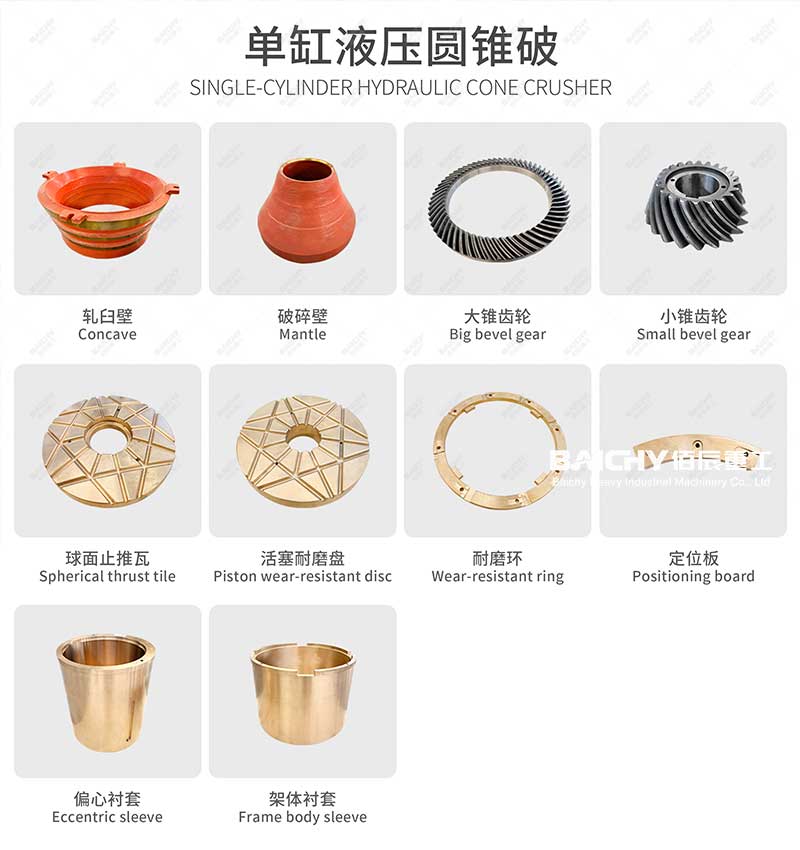
1. Crushing Wall (Moving Cone Liner)
◦ Function: Installed on the moving cone, it is the main component that directly contacts and crushes the material.
◦ Causes of Wear: It withstands continuous impact, compression, and sliding friction from the material. Its service life is closely related to the material's hardness, particle size, moisture content, and equipment operating parameters.
2. Mantle (Stable Cone Liner)
◦ Function: Fixed to the adjusting sleeve, it forms the crushing chamber together with the crushing wall, serving as another major bearing surface for the material.
◦ Cause of Wear: Also subjected to enormous pressure and wear. Typically, the crushing wall and mantle need to be replaced in pairs to ensure optimal crushing effect and particle shape.
3. Main Shaft Copper Bushing (Upper and Lower Bushings)
◦ Function: Located between the main shaft and the moving cone, it acts as a sliding bearing, bearing enormous radial and axial loads and ensuring stable operation of the moving cone.
◦ Cause of Wear: Normal wear under long-term operation. Poor lubrication or the introduction of impurities will rapidly accelerate wear, leading to increased equipment vibration and excessive temperature rise.
4. Thrust Bearing (Planar Bearing)
◦ Function: Bears the axial load generated by the weight of the moving cone assembly and the crushing force, ensuring the vertical stability of the main shaft.
◦ Cause of Wear: Working under high loads for extended periods, lubrication and cleanliness are crucial factors affecting its lifespan.
5. Seals
◦ Function: Includes dust seals, hydraulic cylinder seals, etc., primarily used to prevent external dust from entering the machine body and to prevent hydraulic system leaks.
◦ Causes of Wear: Aging, wear, or scratches from sharp objects. Seal failure can lead to serious problems such as lubricant contamination and unstable hydraulic system pressure.
6. Other Wear Parts
◦ Cup-shaped bushing (base bushing): Supports the entire moving cone assembly.
◦ Spring (overload release device): Provides protection during overload; elasticity may weaken over long-term use.
◦ Feed distribution plate/distribution disc: Ensures material enters the crushing chamber evenly, reducing localized impact wear on the liner.
II. How to Effectively Extend the Life of Wear Parts?
• Standardized Operation: Ensure uniform feeding, avoid overload and overload operation.
• High-Quality Lubrication: Use the specified grade of lubricating oil and regularly check oil quality and level, keeping the lubrication system clean.
• Regular Inspections: Establish a regular maintenance plan and promptly identify potential problems through observation, listening, and temperature measurement.
• Material Matching: Avoid crushing excessively hard or wet materials beyond the equipment's design range.
Summary: Effective management of the vulnerable parts of a single-cylinder hydraulic cone crusher is key to achieving high equipment availability and low cost per ton. By familiarizing yourself with these components and implementing scientific maintenance strategies, you can maximize equipment efficiency.