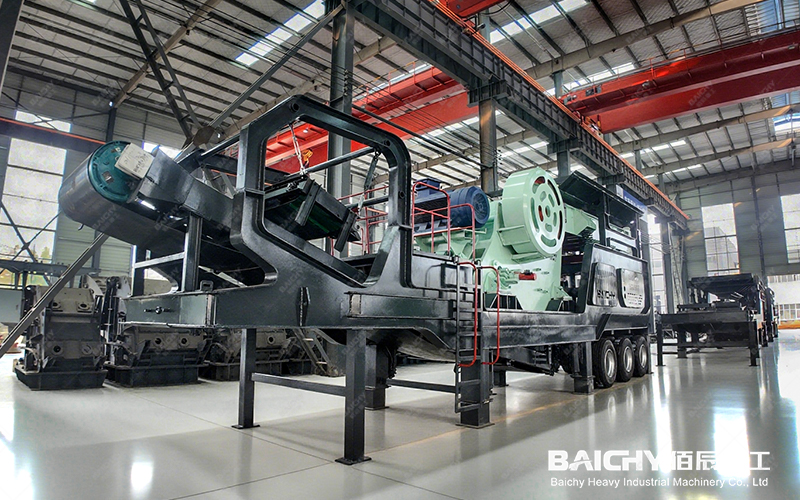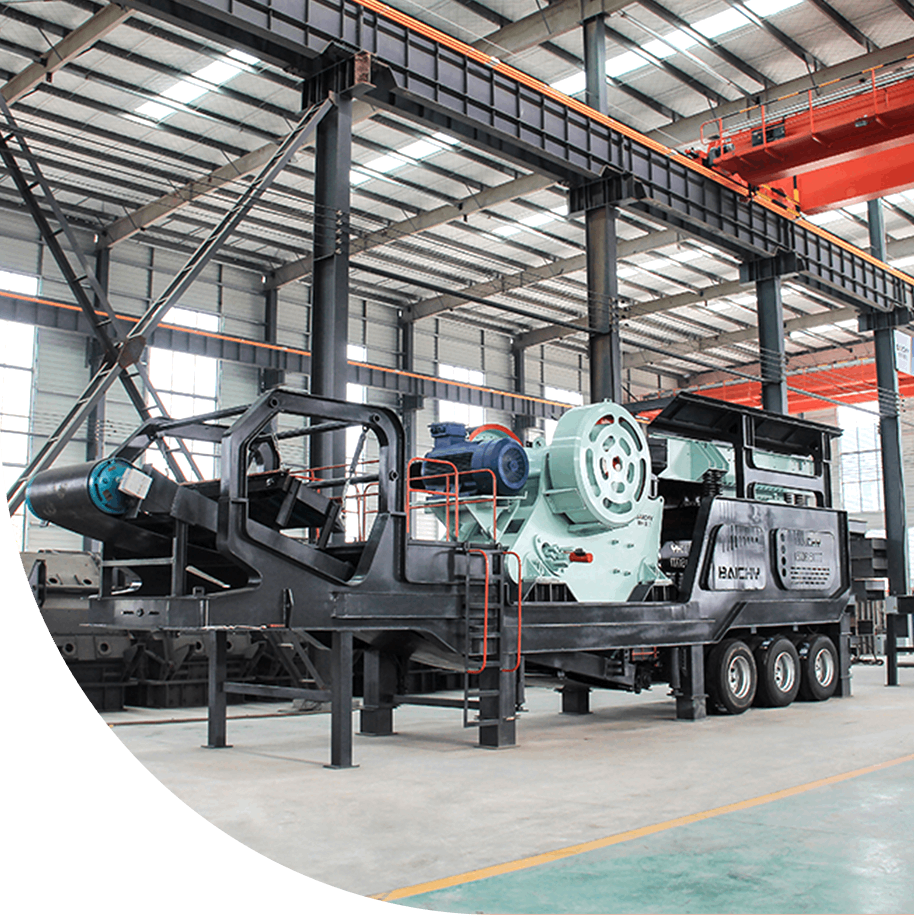

A portable jaw crusher is only worth its chassis if the jaw on it is the jaw your feed needs. In the PE600x900 jaw crusher class that condition holds: the portable configuration carries the identical 600×900 mm feed opening, the identical 500 mm maximum feeding size and the identical 90–180 t/h rated capacity as the fixed primary station of the same model — on a chassis measuring 11,500×2,300×4,120 mm.
The figures below are drawn from Baichy's published heavy-duty jaw crusher and mobile jaw crusher specification tables, so the two packages can be checked against the same source.
What the wheels save is construction, not crushing capacity. A fixed primary station has to be built before it earns: foundation, concrete pad, power routing, site works. When the deposit is worked out or the road contract moves to another site, that construction budget stays in the ground, because you can move a crusher but you cannot move a foundation. Baichy states the mobile case plainly — it suits projects "with multiple locations and short construction periods", it "eliminates the need for infrastructure construction, and allows for rapid production". That sentence, more than the motor rating, is usually the entire investment case for a portable jaw crusher.
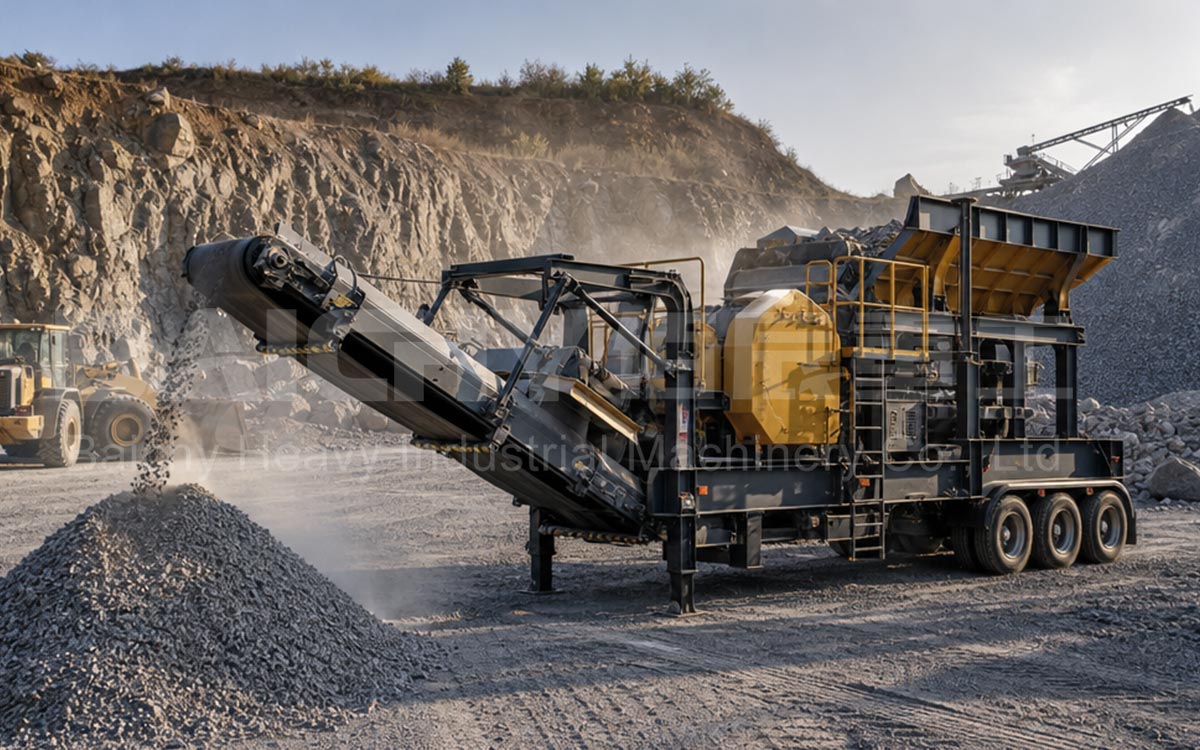
Portable Jaw Crusher
The same jaw in two packages
Item Fixed PE600×900 primary unit PE600×900 on the portable chassis (YDPZ69-9638)
| Parameter | Stationary (PE600×900) | Mobile Station (YDPZ69-9638) |
|---|---|---|
| Feed opening (mm) | 600×900 | 600×900 |
| Max. feeding size (mm) | 500 | 500 |
| Jaw unit outlet adjusting range (mm) | 60–125 | 60–125 (the chassis does not change the crusher's own setting range) |
| Rated capacity (t/h) | 90–180 | 90–180 |
| Drive power, jaw crusher (kW) | 55 | 55 |
| Total installed drive power (kW) | 55 (crusher motor only) | 70 (11 + 55 + 4) |
| Overall dimension / chassis size (mm) | 2,500×2,010×2,350 | 11,500×2,300×4,120 |
Note: The two right-hand columns describe the same jaw crusher. Figures are taken from the Baichy PE jaw crusher specification table and the Baichy mobile jaw crusher specification table. Original note on both tables: "The output will vary according to different materials, feed particle size and other factors." Rated capacity is quoted as published by Baichy; no unpublished hardness-derating factor is applied here, so treat 90-180 t/h as a design envelope to be confirmed by a site trial on your own material.
Two rows decide most of the argument: feeding size and capacity. The chassis changes the transport envelope, not the crushing duty. Maximum feeding size is 500 mm in both columns; rated capacity is 90-180 t/h in both columns. An operator who already runs a fixed PE600x900 jaw crusher keeps the same feed acceptance and the same tonnage band after moving to the portable crushing plant — which is the only sound reason to accept the larger transport footprint.
Where the two packages differ is the drive, and the difference is not a loss of crushing power. On the fixed unit, 55 kW is the crusher motor alone. On the portable chassis, the specification sheet lists drive power as three components — vibrating feeder, jaw crusher and discharge belt — written 11+55+4 for the YDPZ69-9638. Read as installed power on the frame, that is 11 + 55 + 4 = 70 kW, because the feeder and the discharge belt that a fixed line mounts separately now travel on the same chassis. The site's own series figures confirm this notation: the line spans 7.5 + 45 + 4 = 56.5 kW at the small end and 15 + 132 + 4 = 151 kW at the top, matching the published series range of 56.5-151 kW. The jaw crusher itself remains a 55 kW machine in every case.
Which portable model carries which jaw
| Model (primary stage) | Vibrating feeder | Jaw crusher | Feeding size (mm) | Belt conveyor | Motor power (kW) | Capacity (t/h) | Overall size (mm) |
|---|---|---|---|---|---|---|---|
| YDPZ57-8530 | ZSW8530 | PE500×750 | ≤425 | B650 | 7.5+45+4 | 40–130 | 10000×2300×4020 |
| YDPZ80-8530 | ZSW8530 | C80 | ≤400 | B650 | 7.5+55+4 | 50–160 | 10000×2300×4020 |
| YDPZ69-9638 | ZSW9638 | PE600×900 | ≤500 | B800 | 11+55+4 | 90–180 | 11500×2300×4120 |
| YDPZ96-9638 | ZSW9638 | C96 | ≤480 | B800 | 11+90+4 | 60–160 | 11600×2250×3710 |
| YDPZ75-1142 | ZSW1142 | PE750×1060 | ≤630 | B1000 | 15+110+4 | 110–380 | 12500×2550×4570 |
| YDPZ106-1142 | ZSW1142 | CJ106 | ≤580 | B1000 | 15+110+4 | 150–300 | 12850×2280×3950 |
| YDPZ116-1242 | ZSW1142 | CJ116 | ≤680 | B1000 | 15+132+4 | 200–400 | 13000×2550×4150 |
Note: Table reproduced from the Baichy mobile jaw crusher specification table. Motor power is written in the manufacturer's own three-part notation: vibrating feeder + jaw crusher + discharge belt. Capacity as published by Baichy; actual output varies with material hardness, feed particle size and operating conditions.
Three facts in that table settle most enquiries. First, the PE600×900 sits in the middle of the portable line, not at its ceiling: below it are PE500×750 (40-130 t/h) and C80 (50-160 t/h), above it PE750×1060 (110-380 t/h) and the C-series models (CJ106, CJ116). Second, feeding size tracks the jaw, so the portable chassis that accepts 500 mm is YDPZ69-9638, while the top of the line accepts 680 mm. Third, the model code is readable: the number after the dash is the feeder (YDPZ69-9638 → ZSW9638), and the prefix tracks the jaw (as the table shows: 69 → PE600×900, 96 → C96, 116 → CJ116) — useful when you are matching a spare-parts list to a quotation.
Position the model against Baichy's own line-scale guidance. The manufacturer classifies the 100-300 t/h band as "medium" and recommends PE600×900 and PE750×1060 for it. A portable jaw crusher built on the PE600x900 therefore lands in the same band as its fixed equivalent, with the same 10:1 crushing ratio ceiling that Baichy publishes for the PE series.
Tire-mounted or track-mounted?
A tire-mounted mobile jaw crusher and a track-mounted unit are not interchangeable choices — they are built on different crusher families. Which family you need is decided before price is discussed.
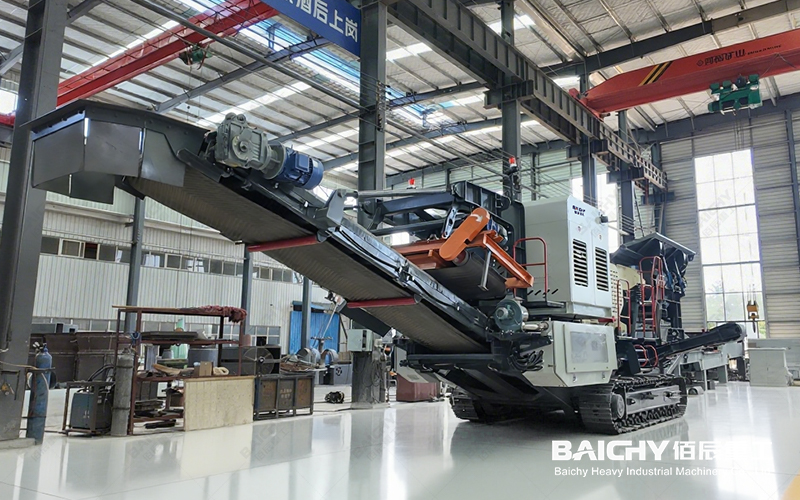
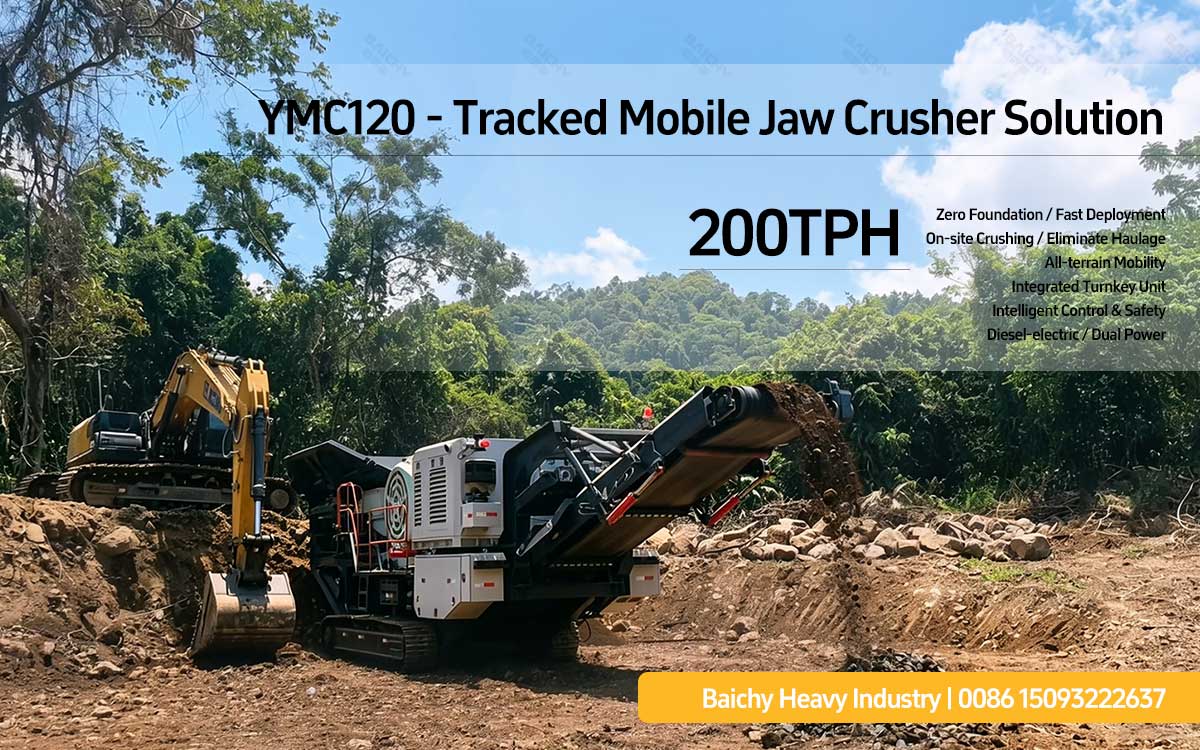
Crawler Jaw Crusher
Item Tire-mounted portable line Track-mounted line
| Parameter | Series A | Series B |
|---|---|---|
| Host jaw crusher options | PE500×750, C80, PE600×900, C96, PE750×1060, CJ106, CJ116 | C80, C96, C106, C116, C120 |
| Feeding size | ≤425 to ≤680 mm (per model) | 0–950 mm (series level) |
| Rated capacity | 40–400 t/h (per model) | 80–125 / 100–250 / 160–360 / 200–450 / 300–520 t/h (per model) |
| Deployment | No foundation construction needed; quick to put into production | No foundation construction needed; quick to put into production |
Note: Compiled from the Baichy mobile jaw crusher page and the Baichy track-mounted mobile jaw crusher page. Feeding size for the track-mounted line is published at series level only, so no per-model feed figure is quoted. Both lines are stated by the manufacturer to require no foundation construction after arrival on site.
The decision rule is blunt: if your specification names a PE600x900, the track-mounted line does not offer it. The track-mounted models are built around C80, C96, C106, C116 and C120 jaws — a different crusher family. That matters for more than the purchase order: a contractor running a fixed PE600x900 station plus a portable unit can standardise jaw plates, and a tire-mounted mobile jaw crusher is the one that preserves that interchangeability. Choose the track-mounted route when you need a wider feed opening or higher tonnage than the PE600×900 class provides, and when hydraulic self-propulsion over difficult ground is worth paying for.
Five selection mistakes that cost money
1. Treating maximum feeding size as a target instead of a limit. For the PE600×900, 500 mm is the published maximum. Feed it oversize rock and you are outside the design envelope of the machine, not inside a margin. If your blasted rock regularly runs larger, the answer is the next model up — PE750×1060 at ≤630 mm — or a controlled blast pattern, not a hopeful hopper.
2. Buying down to the small-portable class. Baichy builds a separate small-scale portable line rated 15-60 t/h with a ≤350 mm feed opening and a 30 kW motor. It is a good machine for what it is, but it is not a smaller version of this one. If your required tonnage is in the 90-180 t/h band, the PE600x900 chassis and the small portable plant are not alternatives to be compared on price.
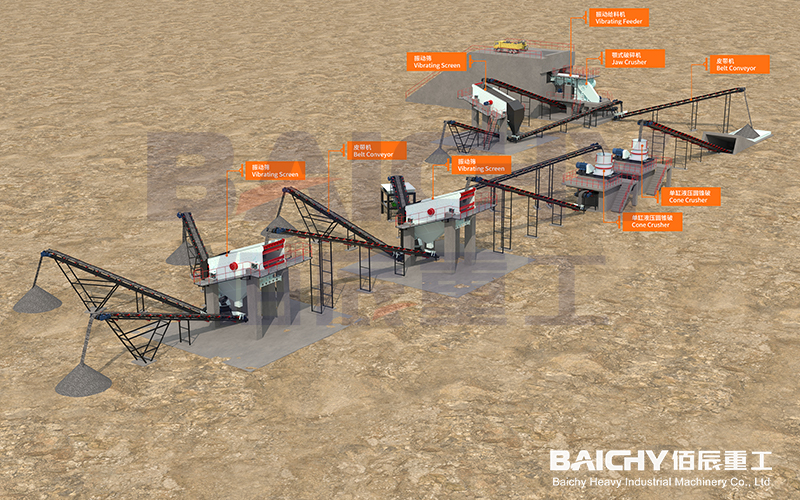
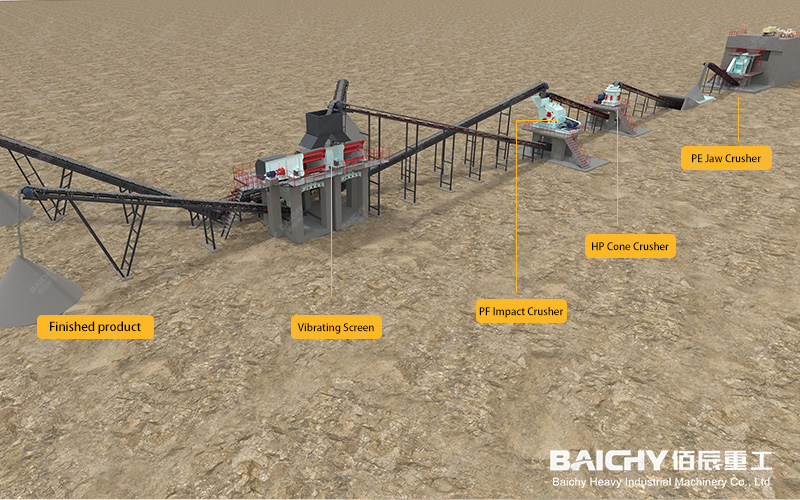
3. Expecting graded aggregate from the jaw alone. A portable jaw crusher produces crushed rock, not a finished specification. To deliver 0-5 mm, 10-20 mm and 20-30 mm simultaneously you need a vibrating screen downstream of the crusher — Baichy states this requirement explicitly, and publishes a wheel-mounted screening configuration for exactly that multi-size output. A combined mobile crushing and screening plant carries both stages on one chassis. Budget the screen module in the first quotation, not in the second purchase order.
4. Choosing diesel power where the grid is available. Diesel is the right answer for sites with no grid connection, and it keeps maintenance simple; but running costs over years are higher than electric drive. Baichy's stated recommendation is dual-power (diesel-electric): run electric where the grid reaches the site, and keep diesel for the sites it does not.
5. Reading "11+55+4" as a single motor. It is not. The notation is three drives on one chassis, and a quotation that lists a single figure may not include the feeder or the discharge belt. Confirm which components a drive-power figure covers before you compare two offers.
What the machine needs on site
Site area is where a portable unit wins on paper. For a stationary line, Baichy describes a footprint of "thousands of square meters"; for a small mobile crushing station, 30-100 square metres of level, hardened ground is enough to start production. For the PE600x900 chassis itself the published transport envelope is 11,500×2,300×4,120 mm — plan the operating area and the haul-road turning circle against that figure rather than against a rule of thumb. Feed material with a loader, and plan one or two trucks to clear finished product. Compare the full mobile crushing range against your site count before you fix the chassis type.
Control and housekeeping come as part of the package. The mobile jaw crusher is specified with hydraulic adjustment of discharge particle size, a pre-screening vibrating feeding system, a PLC control system that supports remote monitoring, and an environmental package of noise control and spray dust reduction (published at ≤75 dB for the noise device). Hydraulic adjustment is the one operators notice daily: the discharge setting moves between jobs without a manual shim change, which is how one portable jaw crusher produces roadbed material one week and construction aggregate the next.
Field evidence
Baichy's own case references put the PE600×900 in production, not only on a specification sheet. A Mexican iron mine running a PE600x900 jaw crusher reached the target output of 120 t/h — inside the published 90-180 t/h band, and a useful anchor for what the model does on a hard ore. A Brazilian quarry whose challenge was the cost of moving material between multiple dispersed mining sites reports overall transportation costs reduced by 40 percent with on-site mobile jaw crushing (as stated by Baichy Heavy Industry; actual results vary with site layout, haul distance and operating conditions). The manufacturer also documents PE600x900 units at customer sites in Kazakhstan.
What to take from that, and what not to. The 120 t/h figure is a production outcome on iron ore, and it sits mid-band — a reminder that "90-180 t/h" is a range, not a number, and that hard, abrasive ore pulls you toward its lower half. The 40 percent figure is a logistics outcome, not a crushing outcome; it is the relocation-and-haul saving that the portable route is designed to create. Neither figure replaces a trial on your own material.
FAQ
Q1. What capacity can I expect from a portable jaw crusher with a PE600x900?
The published capacity range is 90-180 t/h, with a 500 mm maximum feeding size and a 600×900 mm feed opening — identical to the fixed PE600×900 unit. Where you land inside that range depends on material hardness, feed particle size and the discharge setting you run. Baichy's published case data includes a PE-600×900 installation on iron ore achieving 120 t/h, which sits mid-band.
Q2. Will a portable jaw crusher accept 500 mm granite feed?
Yes, at 500 mm and below — that is the published maximum for the PE600×900. It is a design limit rather than a working target: material consistently near the ceiling leaves no room for oversize lumps, and hard, abrasive rock such as granite or basalt is better matched with the setting chosen for the finished product you actually sell. If your feed regularly exceeds 500 mm, compare the next model up, PE750×1060, which accepts up to 630 mm.
Q3. Tire-mounted or track-mounted mobile jaw crusher — which should I choose?
Choose by the jaw you need. The tire-mounted portable line offers PE500×750, C80, PE600×900, C96, PE750×1060, CJ106 and CJ116, with capacities from 40-130 t/h to 200-400 t/h. The track-mounted line is built on C80, C96, C106, C116 and C120 jaws only — it does not include a PE600×900 option. If your specification names a PE600x900, the tire-mounted route is the one that carries it and keeps jaw-plate commonality with a fixed station of the same model.
Q4. Can one portable jaw crusher produce 0-5 mm, 10-20 mm and 20-30 mm aggregate at the same time?
No — not from the jaw alone. A jaw crusher is a primary crushing stage: it reduces run-of-quarry rock and the discharge setting defines the top size, not a graded product. To produce several finished sizes at once you must install a vibrating screen downstream of the crusher. Baichy states this requirement directly for portable plants, and separate wheel-mounted screening configurations are published for multi-size output.
Q5. How much ground does a portable jaw crusher need, and does it need a foundation?
No foundation construction is required — the unit is built onto its own chassis and can go into production shortly after arrival. Baichy documents 30-100 square metres of level, hardened ground as sufficient for a small mobile crushing station, against "thousands of square meters" for a stationary line. For the PE600×900 chassis, work from the published transport envelope of 11,500×2,300×4,120 mm when you lay out the operating pad, the feed ramp and the truck path.

Baichy Heavy Industry
Baichy Heavy Industry is a high-tech mining equipment company integrating R&D, manufacturing, sales, and after-sales service. Focusing on crushing, grinding, and mineral processing equipment, we provide professional solutions to our customers. We are ISO9001:2015 、certified, and our products include mobile crushing palnts, crawler crushing plant, construction waste crushing plants, jaw crushers, sand making machines, cone crushers, fine crushers, grinding mills, ball mills, etc., all with reliable performance to meet diverse project needs.
Baichy Heavy Industry – Your Trusted Partner
To ensure optimal performance of your equipment, Baichy Heavy Industry offers:
- Professional on-site installation guidance
- Comprehensive operator training
- 24/7 technical support & maintenance services
Our complete after-sales service system guarantees long-term, stable operation of your machinery with minimal downtime.
Protect Your Rights – Only Use Official Channels
To avoid scams and ensure authentic support, contact us exclusively through:
• Official Website: www.baichychina.com
• WhatsApp: +8615093222637
• Email: [email protected]
Your satisfaction is our priority – expect prompt, professional service every time.
(Note: Beware of unauthorized third parties claiming to represent Baichy. Always verify through official contacts.)