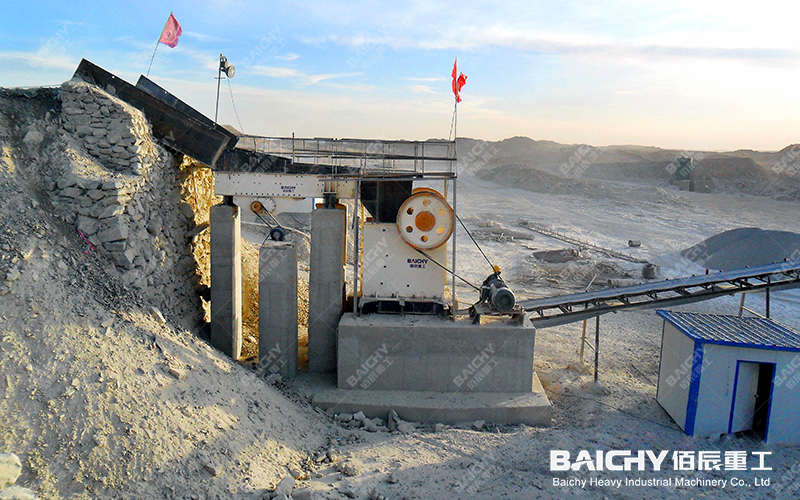
80–100 t/h Granite & River Pebble Crushing Lines
Amidst the current infrastructure boom, the demand for high-quality sand and aggregate continues to soar. For small-to-medium-sized stone quarries or supporting engineering projects, a production line with a capacity of 80–100 tons per hour (tph) has emerged as the "golden choice" in the market, thanks to its moderate investment threshold, short payback period, and compact footprint.
However, when processing highly hard and abrasive materials—such as granite, basalt, and river pebbles—standard equipment configurations often lead to rapid wear on components and frequent downtime for maintenance. Today, we will provide an in-depth analysis of a production line configuration specifically designed for hard rock—one that delivers both "high efficiency" and "low wear."
I. The Core Pain Point: Why is "Solution 1" Essential for Hard Rock?
In the aggregate industry, there is a common saying: "Choose the wrong crusher for the rock, and your equipment will be ruined in a flash."
Impact Crusher (Solution 2): While it produces aggregates with excellent particle shape, crushing hard rock with an impact crusher can limit the lifespan of the blow bars to a mere few days, resulting in massive replacement costs and significant losses due to downtime.
Cone Crusher (Solution 1): Utilizing a compression-based crushing principle, the cone crusher features long-lasting wear parts (such as the bowl liner and mantle) and can effortlessly process materials with a Mohs hardness of 6 or higher. For quarry owners focused on long-term profitability, the cone crusher serves as the "heart and soul" of any hard rock production line.
II. The Perfect Match: Equipment List for the 80–100 tph Hard Rock Production Line
This specific configuration has been extensively validated by the market, achieving the optimal balance between output capacity and energy consumption:
1. The First Stage: Stable Feeding
Equipment: GZD-850×3000 Vibrating Feeder
Key Feature: Equipped with a pre-screening function. As it feeds the raw material, it simultaneously screens out any accompanying soil or fine debris, thereby preventing unnecessary crushing and reducing the operational load on the primary crushing unit.
2. Stage 2: The Coarse Crushing Vanguard
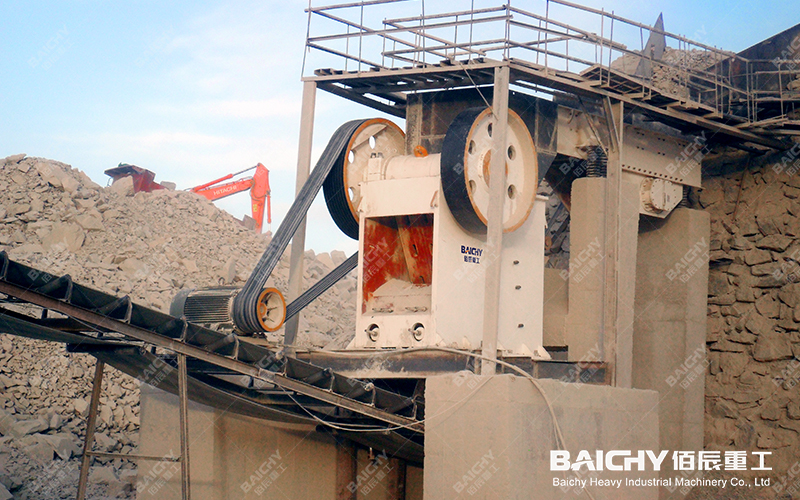
PE600x900 jaw crusher
Equipment: PE-600×900 Jaw Crusher
Performance: Capable of handling a maximum feed size of up to 500mm, it boasts a high crushing ratio. Serving as the "throat" of the production line, the PE6090 utilizes deep-cavity crushing technology to ensure that even large-sized raw materials are efficiently processed.
3. Stage 3: Core Medium-to-Fine Crushing
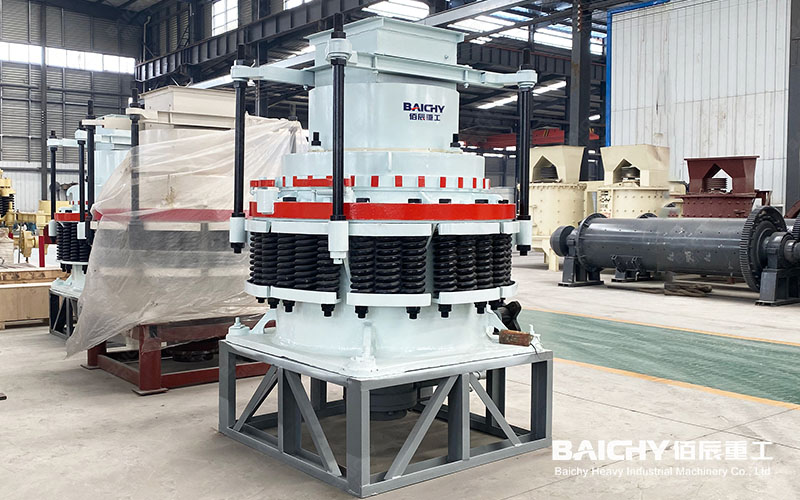
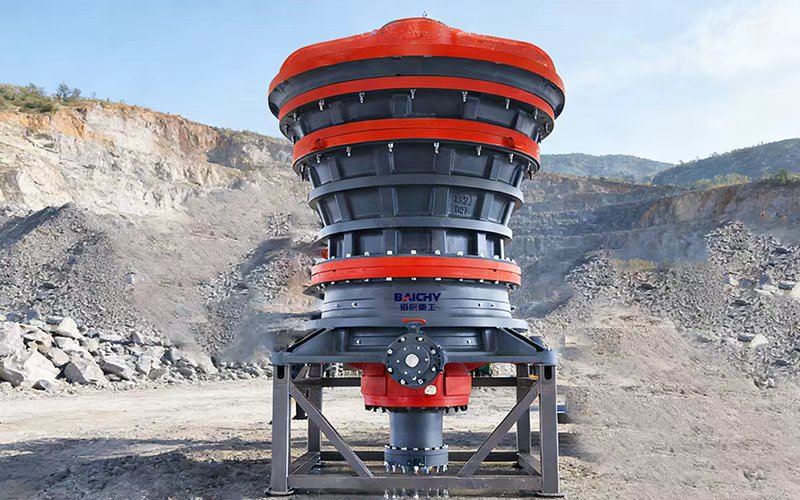
Spring Cone Crusher PYB900
Equipment: PYB-900 (Spring Cone Crusher) or HST100 (Single-Cylinder Hydraulic Cone Crusher)
The Essence: The cone crusher represents the premium core of this solution. Not only is it highly wear-resistant, but it also features a fully automated control system capable of automatically adjusting the discharge opening based on the load, thereby ensuring the consistent stability of the finished product's particle size.
4. Stage 4: Precision Screening
Equipment: 3YK-1548 Circular Vibrating Screen
Output: Featuring a 3-layer screen design, it can simultaneously sort and separate high-quality aggregates into various specifications—such as 0–5mm (manufactured sand), 5–10mm, 10–20mm, and 20–30mm—precisely meeting the specific requirements of concrete batching plants.
III. Process Flow Diagram: The Transformation from Raw Stone to Gold
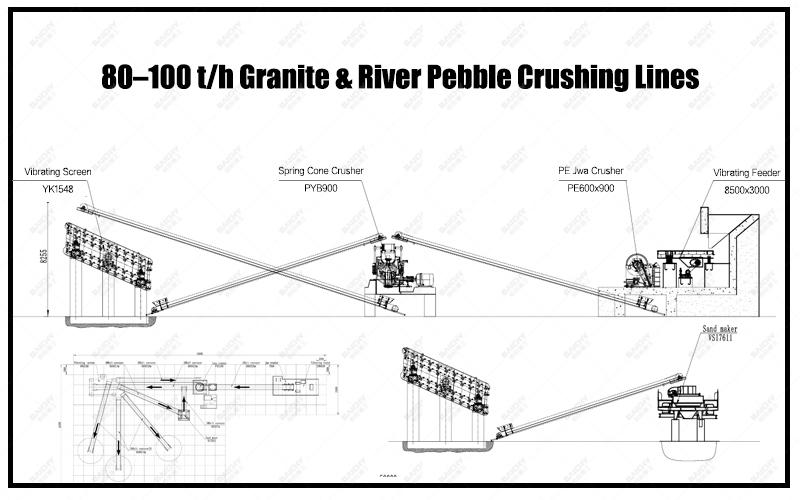
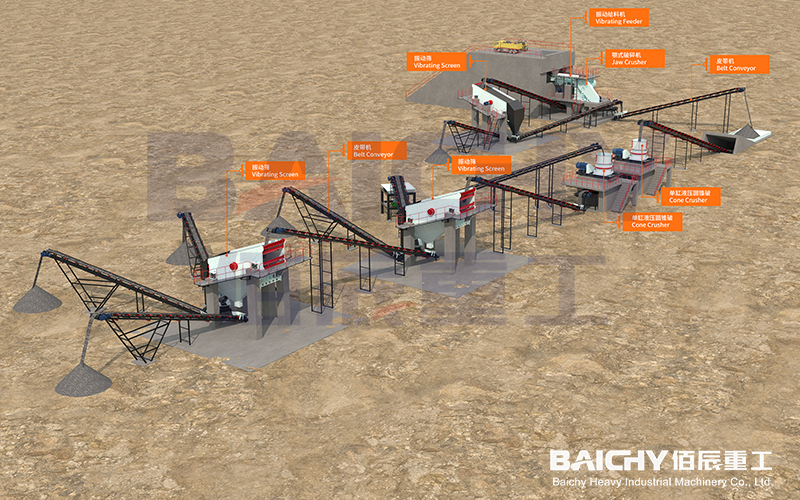
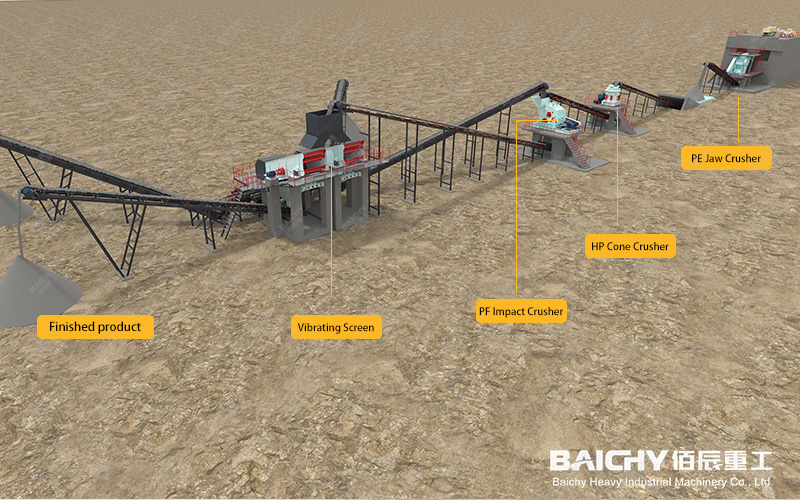
80–100 t/h Granite & River Pebble Crushing Lines
1. Feeding: Raw materials are fed uniformly into the jaw crusher via a feeder.
2. Primary Crushing: The jaw crusher reduces large stones to a size of approximately 100mm.
3. Transfer: The material is conveyed to the cone crusher via Conveyor Belt No. 1.
4. Fine Crushing: The cone crusher performs compression crushing, further refining the material.
5. Screening: The mixed material enters the vibrating screen, where qualified materials are transported away by their respective finished-product conveyor belts.
6. Closed-Circuit Loop: Oversized particles are returned to the cone crusher via a return conveyor belt, undergoing reprocessing until they fully meet the required specifications.
IV. Core Value of the Solution: Why Does This Investment Make Sense?
1. Post-commissioning operational costs reduced by over 30%: Although the initial purchase cost of a cone crusher is higher than that of an impact crusher, when processing granite, the service life of its wear parts is 3 to 5 times longer than that of an impact crusher. This saves not only on parts expenses but, more importantly, on precious production time.
2. Stable finished product quality: The aggregates produced by a cone crusher feature a continuous gradation curve and a low crushing value, making them better suited to meet the requirements of high-grade concrete applications (such as bridges and high-speed rail projects).
3. Strong environmental adaptability: The modular design facilitates the easy installation of dust covers and water spraying systems, allowing the facility to effortlessly pass dynamic monitoring inspections conducted by local environmental protection authorities.
V. Investment Advice: Helpful Tips for Establishing a Stone Crushing Plant
Infrastructure: It is recommended to utilize a steel structure platform or a robust concrete foundation to minimize vibrations generated during the cone crusher's operation.
Power Configuration: The total power requirement for this production line is approximately 150–180 kW; it is advisable to plan the transformer capacity in advance.
Site Planning: An 80–100 t/h production line typically requires a site area of approximately 1,500–2,000 square meters; a well-planned layout of conveyor belts can result in significant savings on transportation costs.
Frequently Asked Questions (FAQ)
Q1: Why is the "Jaw Crusher + Cone Crusher" combination recommended over the "Jaw Crusher + Impact Crusher" combination for processing hard rocks such as granite and river pebbles?
A: This recommendation is based on long-term operational cost considerations. Impact crushers utilize an impact-style crushing mechanism; when processing high-hardness materials, the hammer plates wear out extremely quickly. Frequent replacements lead to extended downtime and high labor costs. In contrast, cone crushers employ a lamination crushing principle, offering a wear- part service life that is 3 to 5 times longer than that of impact crushers. Although the initial equipment purchase cost is slightly higher, the subsequent maintenance cost per ton of crushed aggregate can be reduced by over 30%.
Q2: What are the specific site and power requirements for a production line with an hourly output of 80–100 tons?
Site: It is recommended to reserve an area of 1,500–2,500 square meters, encompassing the feeding zone, crushing zone, screening and separation zone, and finished product stockpile area. Power Requirements: The total installed power capacity for the entire production line is approximately 150 kW to 200 kW. Given the high instantaneous current surges that occur during equipment startup, it is recommended to install a transformer with a capacity of 250 kVA to 315 kVA.
Q3: What should be done if the finished product produced by the cone crusher has poor particle shape (specifically, an excessive proportion of flaky or needle-like particles)?
A: This is a common misconception. Particle shape can be significantly improved by adjusting the Cone Crusher's Closed Side Setting (CSS) and by maintaining a "full-chamber feed" (which utilizes the principle of inter-particle crushing to achieve self-shaping). If the client has extremely stringent requirements regarding particle shape (e.g., for high-grade concrete), we can incorporate a small Vertical Shaft Impact (VSI) crusher into the process—positioned after the screening stage—specifically for the purpose of particle shaping.
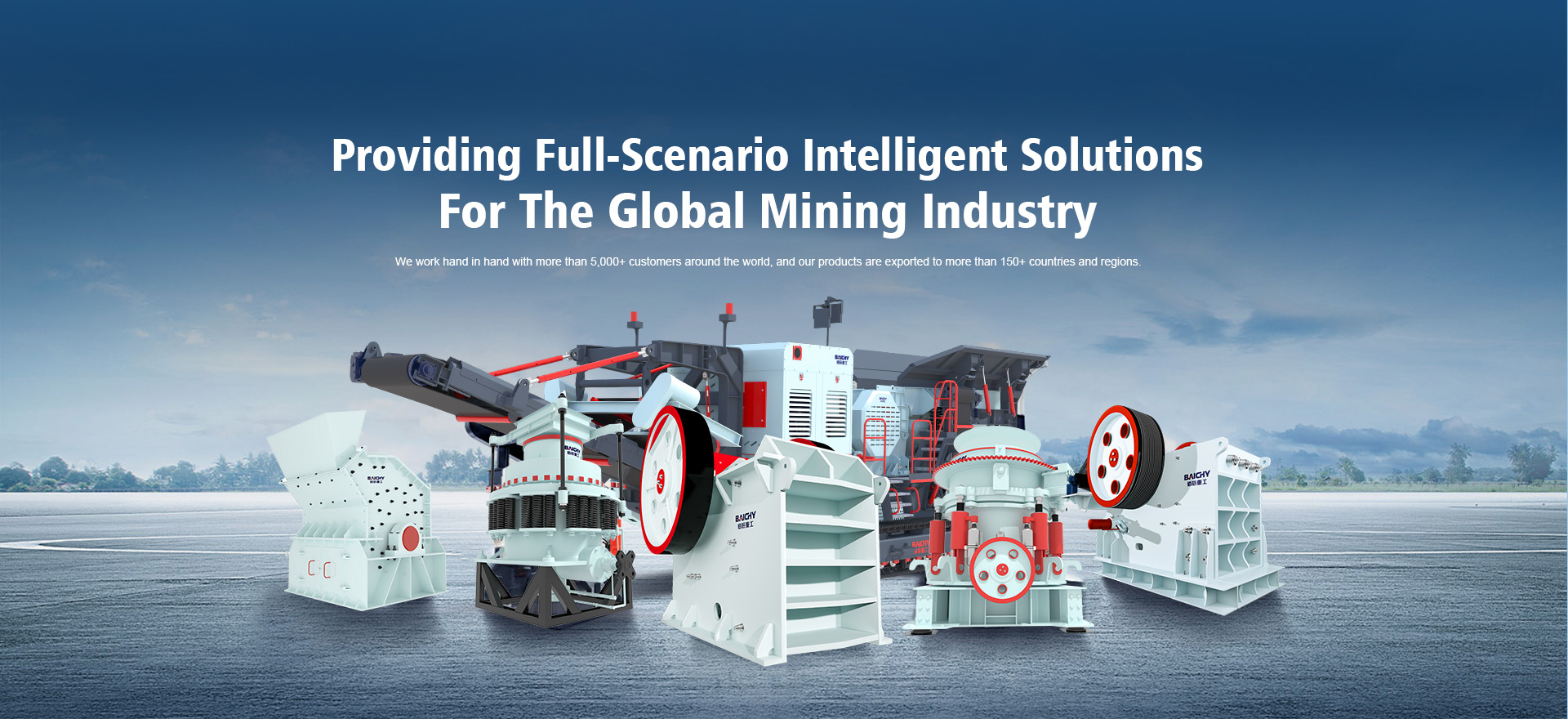
About of Baichy Heavy Industry
Baichy Heavy Industry is a high-tech mining equipment company integrating R&D, manufacturing, sales, and after-sales service. Focusing on crushing, grinding, and mineral processing equipment, we provide professional solutions to our customers. We are ISO9001:2015 、certified, and our products include mobile crushing palnts, crawler crushing plant, construction waste crushing plants, jaw crushers, sand making machines, cone crushers, fine crushers, grinding mills, ball mills, etc., all with reliable performance to meet diverse project needs.
Our advantages:
• Professional pre-sales support: Free project design and comprehensive solutions to help you accurately select the right equipment;
• Comprehensive on-site service: Providing installation guidance and worker training to ensure smooth equipment commissioning;
• Reliable after-sales guarantee: A complete after-sales system, timely response to technical inquiries and equipment maintenance, ensuring long-term stable operation.
To protect your rights, please contact us through the following official channels for professional service:
Official Website Customer Service
https://wa.me/+8615093222637
Email: [email protected]
We are committed to providing high-quality equipment and full-cycle services to deliver comprehensive intelligent solutions for the global mining industry!