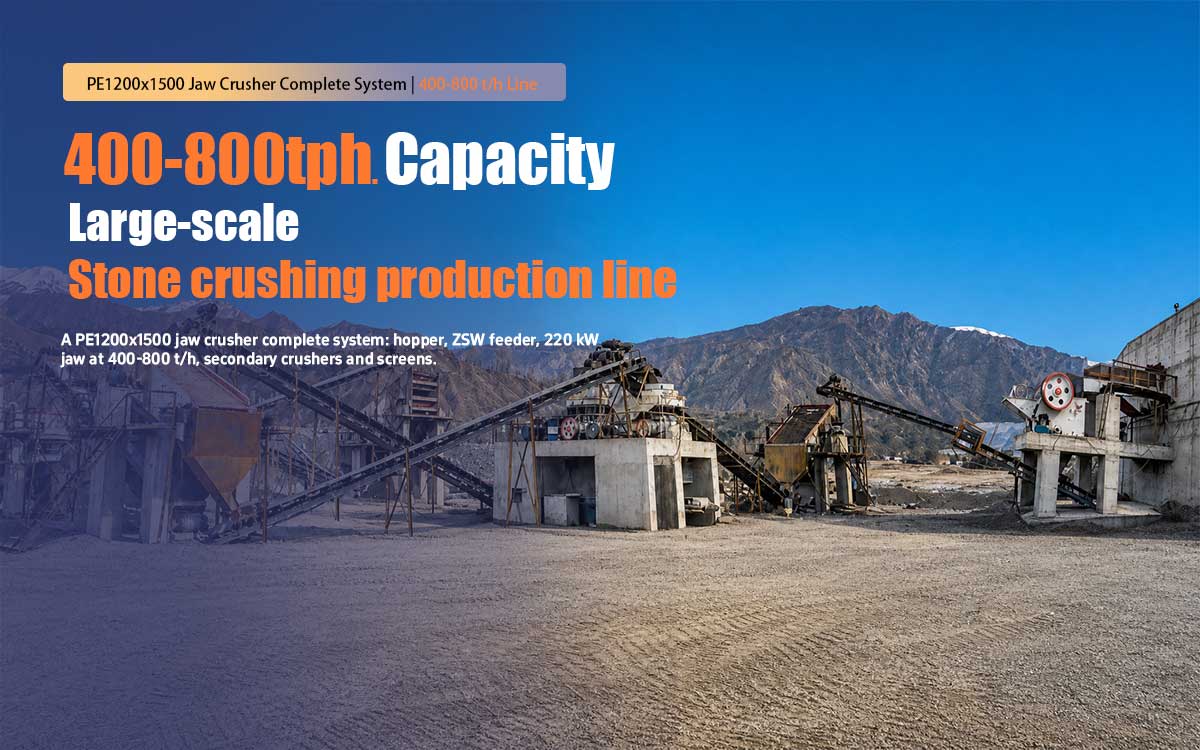

In large-scale mining, water conservancy, and hydropower projects, the efficient processing of hard rocks (such as granite and basalt) is crucial to project progress. A crushing and screening production line with a processing capacity of 250-350 tons/hour is an ideal solution for such high-hardness, large-scale production needs. This article will analyze the core configuration and advantages of this solution in depth.
Core Equipment Configuration: A Powerful Combination for Tackling the Hardest Rocks
A production line in this capacity range cannot be handled by a single piece of equipment; it is an organic system composed of multiple heavy-duty machines, emphasizing collaborative operation and process optimization.
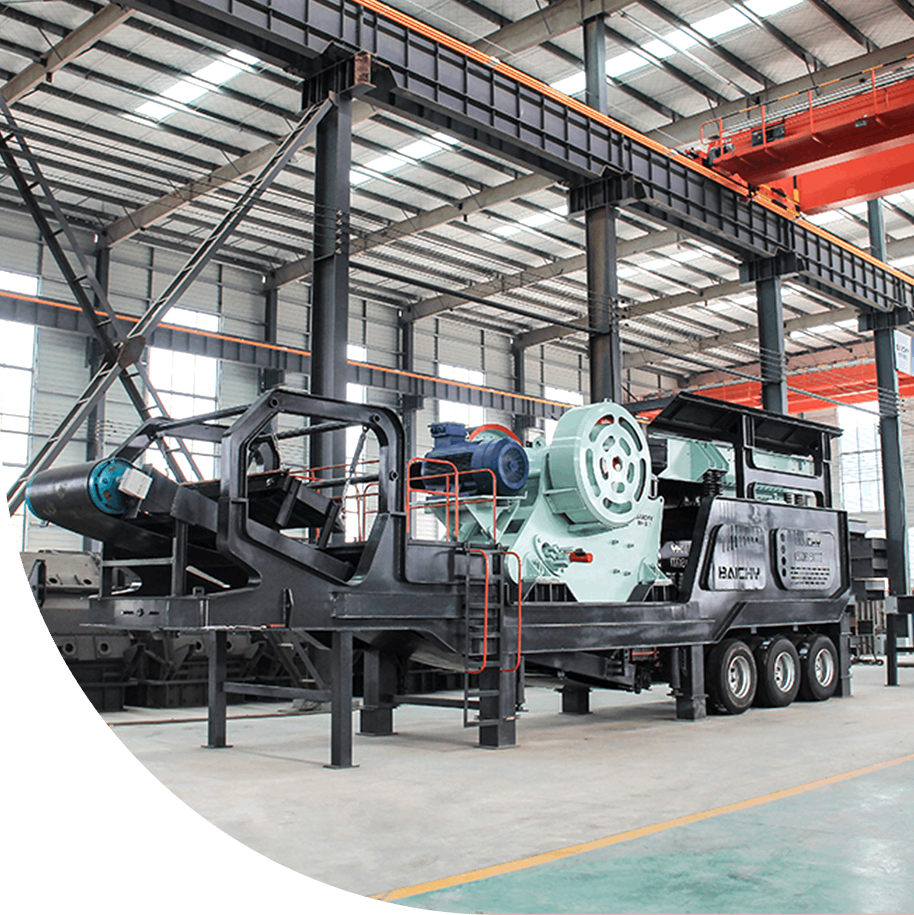
1. Coarse Crushing Stage – Jaw Crusher
◦ Role: The "vanguard" of the production line, responsible for the initial crushing of large pieces of raw rock (particle size up to 1000mm or more) from the blasting site.
◦ Equipment Requirements: A heavy-duty or super-heavy-duty jaw crusher with enormous crushing force and high wear resistance must be selected. The plates of the moving and fixed jaws must be made of high-strength manganese steel to withstand the strong abrasion from hard rock.
2. Medium Crushing Stage – Cone Crusher
◦ Role: The "backbone" of the production line, responsible for further crushing the coarsely crushed stones (approximately 200-300mm) to a medium particle size (e.g., 40-80mm).
◦ Equipment Requirements: For hard stone crushing, a hydraulic cone crusher is the absolute first choice. Utilizing the principle of layered crushing, it is not only highly efficient but also allows for easy adjustment of the discharge port and iron protection via a hydraulic system, effectively controlling product particle shape, reducing needle-like and flaky content, and extending the life of wear parts.
3. Screening and Fine Crushing Stage – Vibrating Screen and Shaping Sand Making Machine (Optional)
◦ Role: "Commander" and "Fine Processor". The vibrating screen classifies the material after medium crushing. Qualified aggregates are separated, while unqualified coarse materials are returned to the cone crusher for closed-loop recycling. If high-quality manufactured sand needs to be produced simultaneously, a vertical shaft impact crusher (sand making machine) can be configured for shaping and sand making, greatly increasing the added value of the product.
Production Line Flow and Layout Key Points
A typical process flow is: Feeding → (Coarse Crushing) → Screening (pre-screening to remove soil) → (Medium Crushing) → Screening (Closed-Circuit Circulation) → (Fine Crushing/Shaping) → Finished Product Stockpile.
• Layout Flexibility: Depending on the site terrain, a "stepped" or "linear" layout can be adopted to minimize material lifting height and save energy.
• Environmental Protection and Intelligent Control: Modern production lines are equipped with enclosed corridors, centralized dust removal systems, and spray dust suppression devices. Simultaneously, a central control system is provided to achieve real-time monitoring of equipment operating status, output, current, and other parameters, ensuring stable and efficient production.
Core Advantages Summary
• High Efficiency and High Output: Stable throughput of 250-350 tons/hour, meeting the centralized material supply needs of large-scale projects.
• Superior Product Quality: Multi-stage crushing and screening processes ensure that the final aggregate has rounded particle shape, reasonable gradation, and high compressive strength, fully meeting high-grade building material standards.
• Durable and Reliable: The core crushing equipment is designed for hard rock, with key components exhibiting high wear resistance, low failure rate, and strong continuous operation capability.
• High Return on Investment: Although the initial investment is relatively large, the extremely high production efficiency and long-term stable operating cycle will bring you significant economic benefits.
A scientifically designed and precisely selected 250-350t/h hard rock crushing and screening production line is not only a guarantee of production capacity but also the cornerstone for enhancing product competitiveness and achieving green and intelligent mine operation. During planning, it is essential to seek technical support from professional manufacturers, conduct detailed material tests and on-site surveys, and tailor the optimal solution to your specific needs.