
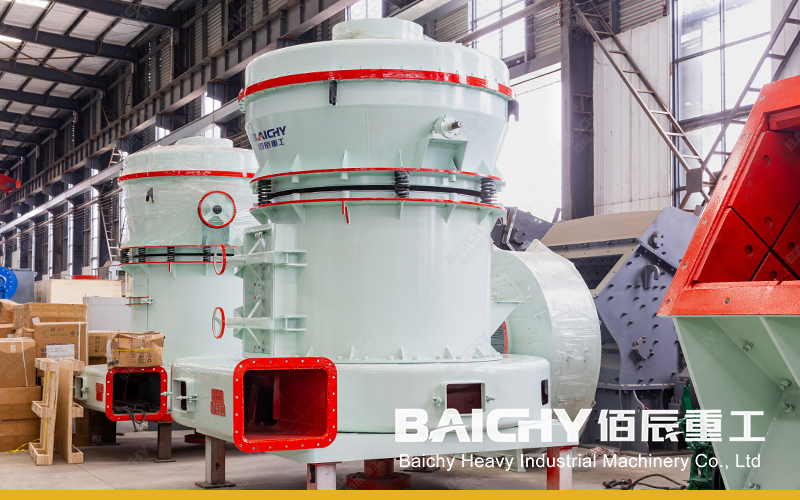
On production lines in industries such as mining, building materials, and chemicals, a type of equipment silently undertakes the crucial task of transforming lumpy materials into fine powder—the Raymond mill. As a grinding equipment with a long history, the Raymond mill, after nearly a century of technological evolution, continues to play an irreplaceable role in modern industrial production.
What is a Raymond Mill?
A Raymond mill, also known as a Raymond grinding mill, is a vertical roller mill. It was first developed by the Raymond Mill Company in the United States in the 1920s, hence its name. Its core working principle is to pulverize materials to the required fineness through the mutual crushing and grinding between the grinding rollers and the grinding ring.
Core Structure and Working Principle of a Raymond Mill
A typical Raymond mill consists of a main unit, feeder, classifier, blower, piping system, and dust collector. Its workflow can be summarized as follows:
1. Feeding System: Material is evenly fed into the mill via a feeder.
2. Grinding Process: The grinding rollers, under centrifugal force, press tightly against the grinding ring, crushing the material.
3. Classification and Separation: The crushed material is blown up by an airflow and sorted by particle size using a classifier.
4. Finished Product Collection: Qualified fine powder enters the collection system with the airflow, while coarse powder is returned for regrinding.
This closed-loop design ensures that the Raymond mill can efficiently produce powder products with uniform particle size.
Technical Advantages of the Raymond Mill
Wide Applicability: The Raymond mill can process various non-flammable and non-explosive mineral materials with a Mohs hardness of 7 or less and a moisture content of 6% or less, such as limestone, calcite, barite, and kaolin.
Precise Particle Size Control: By adjusting the analyzer speed, powders in the range of 80-600 mesh can be produced, meeting the fineness requirements of different industries.
High Efficiency and Low Energy Consumption: Adopting a three-dimensional structural design, it occupies a small area and is highly integrated. Compared to ball mills, energy consumption is reduced by approximately 30-40%.
Stable and reliable operation: The transmission system is smooth, wear parts are made of high-quality materials, resulting in a long service life and convenient maintenance.
Modern applications of Raymond mills:
Building materials industry: Used for grinding cement raw materials and admixtures, improving cement quality and saving energy.
Mining and metallurgy: Processes various metallic and non-metallic ores, providing raw materials of suitable particle size for mineral processing and smelting.
Chemical industry: Produces powders of various chemical raw materials, such as pigments, coatings, and fillers.
Environmental protection: Used for grinding limestone for power plant desulfurization, promoting cleaner production.
Technological Innovation and Development Trends
With technological advancements, modern Raymond mills have undergone numerous improvements over traditional models:
• Intelligent Control System: Achieves automated operation and real-time equipment status monitoring.
• High-Efficiency Dust Removal Technology: The application of pulse dust collectors significantly improves the working environment.
• New Material Applications: Significantly extends the service life of wear-resistant materials.
• Energy-Saving Design: Optimizes air duct and grinding chamber structure, reducing energy consumption.
Considerations for Selecting a Raymond Mill
When selecting Raymond mill equipment, the following factors should be considered comprehensively:
1. Material characteristics (hardness, moisture, particle size requirements)
2. Production capacity requirements (tons/hour)
3. Finished product fineness range
4. Equipment investment and operating cost budget
5. Site conditions and environmental protection requirements
As a classic piece of equipment in the powder processing field, the Raymond mill maintains its strong vitality in modern chemical production due to its mature technology, stable performance, and wide applicability. With the deepening of intelligent manufacturing and green manufacturing concepts, Raymond mill technology will continue to innovate, providing more efficient and environmentally friendly powder processing solutions for various industries.
Whether for large-scale industrial production or small and medium-sized processing enterprises, understanding the principles, characteristics, and applications of Raymond mills is of great significance for optimizing production processes, improving product quality, and reducing production costs.