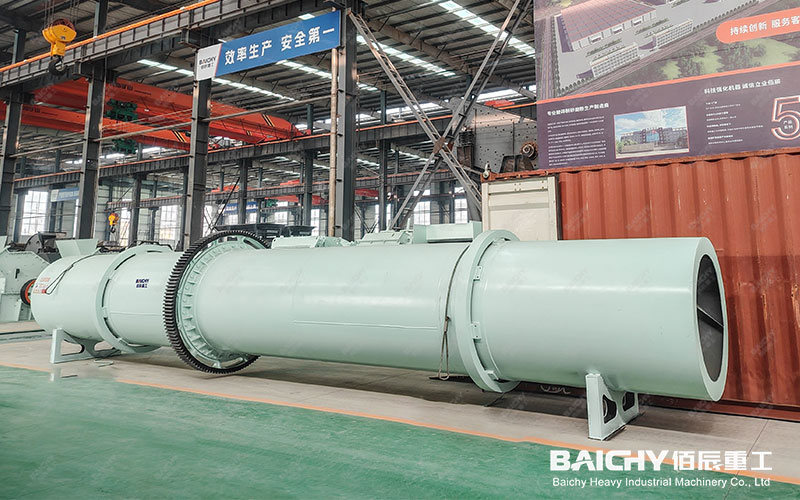
High-Efficiency Drying Solution for Thiourea Phosphate Fertilizer
Based on the client's requirements, we conducted an in-depth analysis of the Thiourea Phosphate Fertilizer Drying project, outlining the core requirements, technical challenges, and potential solutions to provide clear guidance for subsequent equipment selection and process design.
I. Summary of Core Process Requirements
1. Core Objective: To reduce the moisture content from 25% wet basis to 1% wet basis.
2. Processing Capacity: 24 tons/hour of final product (dry basis).
◦ Calculation Basis:
The wet material feed rate needs to be calculated based on the dry basis output. Assuming the final product (containing 1% water) is 24 t/h, then the dry matter content is 23.76 t/h. The initial wet material (containing 25% water) also contains 23.76 t/h of dry matter, accounting for 75% of the total weight; therefore, the wet material feed rate is approximately 31.68 t/h. The evaporated moisture content is 7.68 t/h. This is a key parameter for equipment selection.
3. Material Characteristics: Powdered, sticky when wet, prone to agglomeration, bulk density 882 kg/m³, particle size 0.1-1 mm. These characteristics directly affect the drying method and internal equipment design.
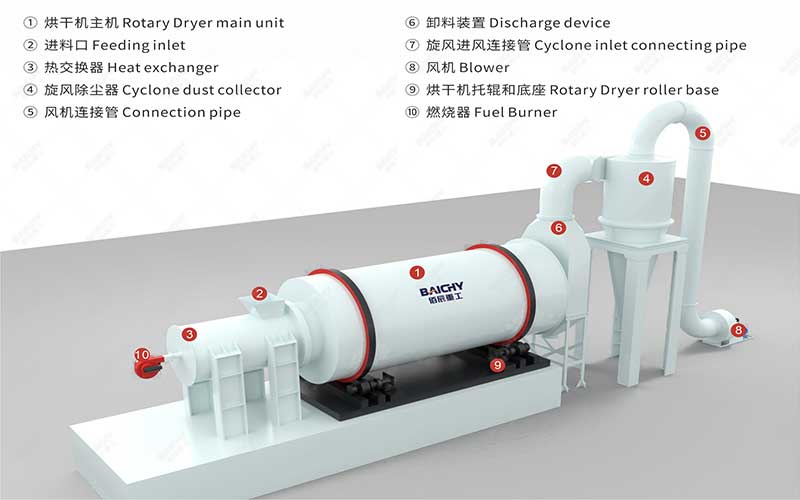
Dryer process demonstration
II. Key Challenges and Solutions
Challenge Analysis and Solutions
1. Material Stickiness and Agglomeration: This is the biggest challenge. At 25% moisture content, the material is already sticky, easily sticking to the walls and agglomerating during drying, affecting heat and mass transfer and product uniformity.
2. Deep Drying: From high moisture (25%) to extremely dry (1%), efficient and stable deep dehydration needs to be achieved in single-machine or combined processes.
3. Continuous and Stable Operation: As part of the production line (downstream of the belt mixer), continuous and stable processing must be guaranteed 24 hours a day, requiring high equipment reliability.
4. Preventing Agglomeration and Ensuring Flowability: The dried product tends to agglomerate, requiring crushing and dispersing devices inside the dryer or at the outlet, and possibly post-treatment cooling.
5. Material and Corrosion Protection: Thiourea phosphate may be corrosive. The material used for equipment contact parts (e.g., 316L stainless steel, 2205 duplex stainless steel) or wear-resistant and corrosion-resistant linings should be selected based on the material characteristics.
III. Dryer Selection Recommendations
Due to the high moisture, viscosity, and tendency to agglomerate powder drying characteristics, using a single traditional dryer (e.g., fluidized bed, spray dryer) carries a high risk. The following options are recommended:
1. Preferred Option: Combined Drying Process
◦ Pretreatment (Pre-drying): High moisture (25%) viscous materials are initially dehydrated (e.g., reduced to ~15%) using a paddle dryer or disc dryer. These two types of dryers effectively handle viscous materials and prevent wall agglomeration through indirect heating and stirring blades.
◦ Main Drying: The pre-dried material (with improved flowability) is fed into a vibrating fluidized bed dryer (VFB) for final drying to 1%. Vibration facilitates material transport and fluidization, direct hot air contact is high-efficiency, and a cooling section can be integrated.
Advantages: Staged drying effectively avoids the difficulties and agglomeration problems associated with direct fluidization of high-moisture materials in a fluidized bed. It combines the advantages of two different dryers, ensuring stability and reliability.
2. Alternative/Integrated Solution: Rotary flash dryer with crushing device
The high-speed rotating crushing device breaks up wet clumps. Hot air flows concurrently with the material, instantly drying the surface and preventing agglomeration. Suitable for paste-like and filter cake-like materials. However, for powders with an initial moisture content of 25%, it is necessary to assess whether they have already formed a paste, as well as energy consumption and operational stability.
IV. Item-by-item responses to customer's Notes
1. Datasheet: Reviewed. Key physical properties (viscosity, agglomeration, particle size, density) have been included as the core of the analysis.
2. Dryer Type: As mentioned above, the recommended solution is a combination of paddle/disc pre-drying + vibrating fluidized bed final drying to achieve efficient, stable, and agglomeration-free continuous production.
3. Materials/Liners: SS316L or superior material is recommended for the main body parts in contact with materials. Depending on wear conditions, wear-resistant hardening treatment or tungsten carbide coating should be added to vulnerable areas such as the agitator and inner walls.
4. Design Margin: A 10-15% design margin will be reserved for key parameters such as heat source, fan, and processing capacity to accommodate material fluctuations and ensure long-term stable production and moisture content requirements.
5. Anti-caking System:
◦ Inside the Dryer: Agitation is used in paddle/disc dryers; a built-in or external gentle crusher/granulator can be installed at the fluidized bed outlet.
◦ Post-processing: A cooling section is integrated into the fluidized bed, or a vibrating fluidized bed cooler is connected to reduce product temperature and minimize agglomeration caused by residual heat.
6. Pre-treatment/Post-treatment Processes:
◦ Pre-treatment: Before entering the drying system, a return mixing process can be incorporated into the feed screw to mix a portion of the dried powder (~1%) with the wet material (25%) in a proportional manner. This reduces the average feed moisture content and improves initial flowability. This significantly reduces the load on the main dryer and the risk of sticking to the walls.
◦ Post-treatment: As mentioned above, cooling is a crucial post-treatment step to prevent agglomeration and facilitate packaging and storage. A screening system can be considered to remove any large lumps that may be generated.
7. Installation Location: The installation is clearly located downstream of the belt mixer. The feed and interface will be designed accordingly to ensure smooth connection with upstream equipment.
8. Electrical Design: The attachment has been received. Detailed power load calculations and integration for the drying system (main unit, fans, pumps, instrumentation, controls, etc.) will be based on this.
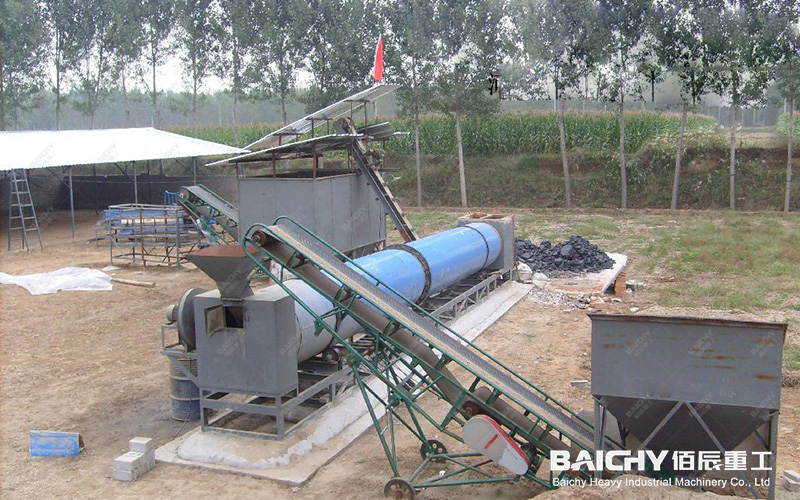
Single-drum dryer customer site
V. Next Steps
1. Provide/Confirm Data: More detailed material characteristic data (such as thermal analysis DSC/TG, adhesion, allowable temperature, dust explosion characteristics, etc.) will facilitate a more precise design.
2. Process Simulation and Pilot Testing: For such special materials, it is strongly recommended to conduct material drying experiments (small-scale or pilot-scale) to verify the feasibility of the combined process and obtain key drying kinetic data (such as drying curves, temperature sensitivity).
3. Scheme Refinement: Based on the above analysis and possible experimental data, a detailed technical solution including PID diagrams, equipment dimensions, material specifications, heat balance calculations, layout suggestions, and automatic control schemes can be provided.
In summary, this project requires a targeted design to overcome the challenges of high material viscosity and agglomeration. A combined drying process is the most reliable option under current technological conditions. We look forward to further discussions with you to jointly determine the optimal solution.
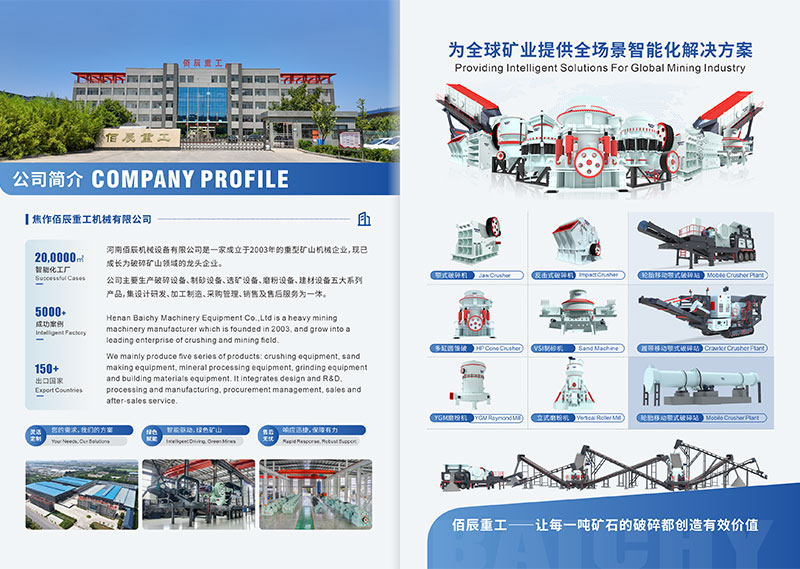
About of Baichy Heavy Industry
Baichy Heavy Industry is a high-tech mining equipment company integrating R&D, manufacturing, sales, and after-sales service. Focusing on crushing, grinding, and mineral processing equipment, we provide professional solutions to our customers. We are ISO9001:2015 、certified, and our products include mobile crushing palnts, crawler crushing plant, construction waste crushing plants, jaw crushers, sand making machines, cone crushers, fine crushers, grinding mills, ball mills, etc., all with reliable performance to meet diverse project needs.
Our advantages:
• Professional pre-sales support: Free project design and comprehensive solutions to help you accurately select the right equipment;
• Comprehensive on-site service: Providing installation guidance and worker training to ensure smooth equipment commissioning;
• Reliable after-sales guarantee: A complete after-sales system, timely response to technical inquiries and equipment maintenance, ensuring long-term stable operation.
To protect your rights, please contact us through the following official channels for professional service:
Official Website Customer Service
WhatsApp: 0086-15093222637
Email: [email protected]
We are committed to providing high-quality equipment and full-cycle services to deliver comprehensive intelligent solutions for the global mining industry!