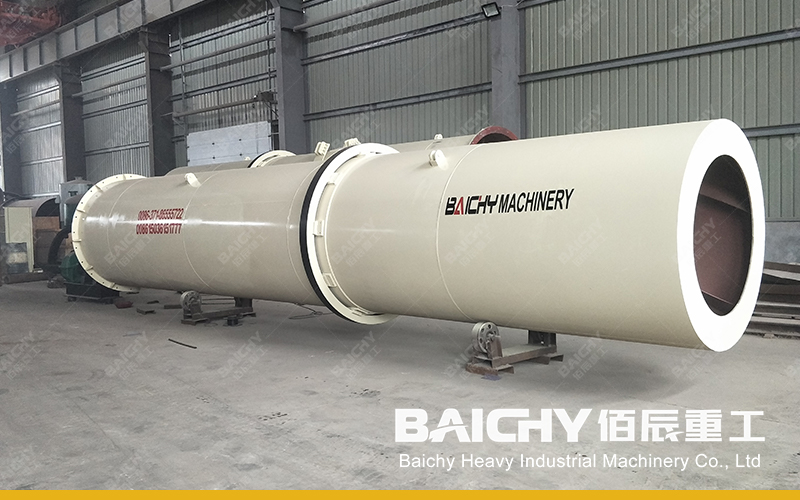
In the increasingly competitive mining industry, efficiency improvements in every production stage directly impact a company's core profits. From crushing and screening to grinding and beneficiation, efficient and stable equipment is key to ensuring continuous production and reducing operating costs. In the dehydration and drying process of concentrates, tailings, or raw ore, a high-performance drying device is crucial.
Today, we will focus on a "legendary piece of equipment" in the mining drying field—the direct-heating rotary dryer—and uncover how its classic and efficient design continues to create significant value for mining companies worldwide.
I. What is a Direct-Heating Rotary Dryer?
As the name suggests, the core feature of a direct-heating rotary dryer is the "direct" contact between hot air (or hot flue gas) and wet materials within a rotating cylinder, resulting in efficient heat and mass exchange. It consists of a large, slightly inclined, uniformly rotating steel cylinder, support devices, transmission devices, feeding and discharging devices, and a hot air furnace. Wet material enters from the upper end of the drying cylinder and is continuously dispersed by the lifting plates on the inner wall, where it is thoroughly mixed with high-temperature hot air introduced from the lower end (or the same end). As the material moves towards the lower end under gravity, the moisture is rapidly evaporated, and the finally dried product is discharged from the lower end, while water vapor and exhaust gas are discharged after dust removal.
This direct contact method offers high thermal efficiency and high drying intensity, making it particularly suitable for processing high-volume, high-moisture mining materials where product purity requirements are not high.
II. Why Does It Remain the Mainstay of Mine Drying?
As seasoned professionals, we understand that customers need not the most cutting-edge concepts, but rather stable, reliable solutions that deliver real returns. The enduring popularity of direct-heating rotary dryers stems from the following core advantages:
1. Extremely high thermal efficiency and processing capacity: Direct heat transfer avoids the losses associated with indirect heat exchange, maximizing heat energy utilization for moisture evaporation. This results in high evaporation intensity per unit volume, with a single unit capable of processing hundreds of tons per hour, perfectly matching the large-scale production needs of large mines.
2. Strong material adaptability: Whether it's highly viscous tailings slurry, unevenly sized concentrate powder, or even corrosive chemical minerals, the equipment can achieve stable and uniform drying results by adjusting the cylinder rotation speed, tilt angle, hot air temperature, and internal baffle configuration.
3. Robust structure and stable, reliable operation: The main structure of the equipment is simple, with core components such as the cylinder, rollers, and support rollers employing heavy-duty design. This allows it to withstand the rigorous test of 24-hour continuous operation, resulting in a long mean time between failures (MTBF) and relatively low maintenance costs.
4. High return on investment: Compared to some new drying technologies, direct-heating rotary dryers are technologically mature, have a more advantageous manufacturing cost, and require lower initial investment. Combining its low operating and maintenance costs with high processing capacity, it offers customers an excellent return on investment period.
5. High Operational Flexibility: By adjusting parameters such as feed rate, hot air temperature, and rotation speed, the moisture content of the final product can be flexibly controlled, easily coping with fluctuations in incoming materials and changes in production requirements.
III. Typical Application Scenarios: Solving Your Practical Drying Problems
• Iron/Copper Concentrate Drying: Drying the flotation concentrate slurry to the moisture content required for safe transportation and smelting, preventing freezing and caking, and increasing product added value.
• Tailings Dry Disposal: The dried tailings are in the form of dry powder or low-moisture lumps, facilitating safe storage or comprehensive utilization, greatly reducing the environmental risks and water resource consumption of tailings ponds, aligning with the trend of green mining development.
• Clay, Bentonite, and Other Non-metallic Mineral Drying: Providing qualified dry raw materials for subsequent deep processing (such as grinding and modification).
• Pulverized Coal Drying: Increasing the calorific value of coal and improving combustion efficiency.
In today's pursuit of intelligent and green technologies, the direct-heating rotary dryer remains relevant. On the contrary, by integrating advanced automated control systems and efficient dust removal and waste heat recovery devices, this classic piece of equipment is experiencing a resurgence. With its superior practicality, economy, and reliability, it continues to provide powerful drying solutions for mining companies worldwide.
Choosing us means receiving not only a high-quality drying machine, but also comprehensive support from a seasoned partner, encompassing process design, equipment customization, and installation and commissioning. Let us use our professional technology and equipment to "dry" away moisture and boost profits in your mining business!