
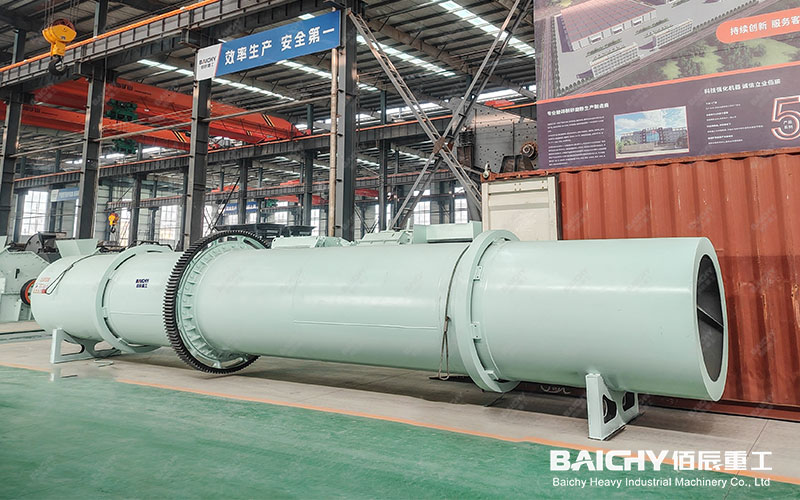
In the field of industrial drying, choosing the right technology is crucial for optimizing production, controlling costs, and ensuring the quality of the final product. When dealing with large volumes of high-humidity bulk materials (such as mineral powder, fertilizer, feed, or chemical intermediates), a classic and powerful option often appears in the list of choices: the counter-current rotary dryer.
But the question arises: is it truly the most effective choice for your specific needs?
To answer this question, we cannot simply say yes, but need to deeply understand its working principles and precisely match its advantages with the characteristics of your materials. Let's analyze it together to help you make an informed decision.
I. The Core of Counter-current Drying: The Intelligent Encounter of Heat Energy and the Material Being Dryed
The superior efficiency of the counter-current rotary dryer stems from its ingenious design of material and hot air flow. Imagine this:
• The wettest material (at the inlet) encounters exhaust gas that has already cooled but has higher humidity. This achieves gentle preheating, preventing the surface from hardening too quickly (caking), and allowing internal moisture to migrate outwards.
• Materials with moderate moisture content (middle section of the cylinder) encounter the hottest, most energy-rich air. At this point, evaporation efficiency reaches its peak, and most moisture is rapidly removed.
• The driest materials (outlet) encounter fresh hot air with high temperature but extremely low humidity. This ensures the product achieves an extremely low final moisture content, resulting in deep drying.
This counter-current heat exchange mode creates a perfect temperature and humidity gradient, ensuring that every unit of heat energy is efficiently utilized where it is most needed.
II. Why it might be your most effective choice? Four unparalleled advantages
If your business addresses the following pain points, the answer is likely to be yes.
1. Pursuing ultimate energy efficiency and reducing operating costs
The counter-current design is the energy-saving champion. High-temperature hot air first contacts the material about to be dried, and its residual heat is used to preheat the wettest material, maximizing the tiered utilization of heat energy. In today's energy-intensive world, this translates to a significant long-term cost advantage.
2. Requires extremely low and uniformly stable moisture content in the final product
For products requiring deep drying (such as mineral powders or chemical raw materials meeting specific standards), counter-current dryers are ideal. At the outlet, the dry material encounters the hottest, driest airflow, effectively removing bound water and ensuring not only low product moisture content but also extremely high batch-to-batch stability.
3. Handles high-temperature resistant materials without fear of thermal degradation
Is your material, like sand, slag, or certain inorganic salts, capable of withstanding high temperatures? If so, counter-current dryers can use high-temperature hot air without worry, significantly increasing drying intensity and processing capacity while shortening drying time.
4. Requires processing large volumes of material and continuous, stable operation
Rotary dryers are renowned for their robust structure and continuous operation capabilities. The counter-current design inherits this advantage, capable of processing materials from several tons to hundreds of tons per hour 24/7, providing reliable support for large-scale industrial production.
III. Key Choice: Counter-current vs. Co-current – When is it not the best answer?
Most effective is relative. Frankly, counter-current drying is not a panacea. Understanding its limitations is just as important as understanding its advantages.
A core criterion is: Is your material heat-sensitive?
• Counter-current drying is more suitable for: High-temperature resistant materials.
◦ Typical applications: Mineral sand, silica sand, fertilizer, slag, clay, crushed stone, etc.
• Co-current drying is more suitable for: Heat-sensitive materials.
◦ Reason: In co-current drying, the wettest material meets the hottest air. Rapid evaporation of moisture absorbs a large amount of heat, keeping the material itself at a lower temperature for most of the drying process. This perfectly protects heat-sensitive materials such as food, feed, and organic polymers, preventing them from charring, spoiling, or losing their activity.
In short: If your product is heat-resistant and you prioritize low moisture content and energy efficiency, counter-current drying is likely your most effective choice. If your product is heat-sensitive, then co-current drying or other drying methods may be more suitable.
IV. How to make the final decision for your business? A Practical Selection Checklist
When evaluating whether a counter-current rotary dryer is right for you, be sure to clarify the following questions:
• Material Characteristics:
◦ What are the initial and target moisture contents?
◦ What is the maximum allowable temperature of the material (heat sensitivity)?
◦ What are the particle size distribution, viscosity, and corrosiveness?
• Production Requirements:
◦ What is the required throughput per hour?
◦ Is it continuous or batch production?
• Cost Considerations:
◦ What are the available energy types (natural gas, steam, electricity) and their costs?
◦ What are the trade-offs between initial investment and long-term operating costs?
Back to the initial question: Is a counter-current rotary dryer the most effective choice for meeting your bulk material drying needs?
Now you can see that the answer depends on your unique business requirements. If your core task is the efficient and economical deep drying of large quantities of high-temperature resistant bulk materials, then a counter-current rotary dryer, with its unparalleled thermal efficiency and drying effect, is undoubtedly a powerful solution approaching the definition of most efficient.
However, if heat sensitivity is your primary concern, then other options should be considered.
Next Step: The best approach is to bring your specific material samples and production parameters to an experienced drying equipment supplier for in-depth discussions. Professional engineers can provide you with the most scientific and economical customized solution through testing and analysis.