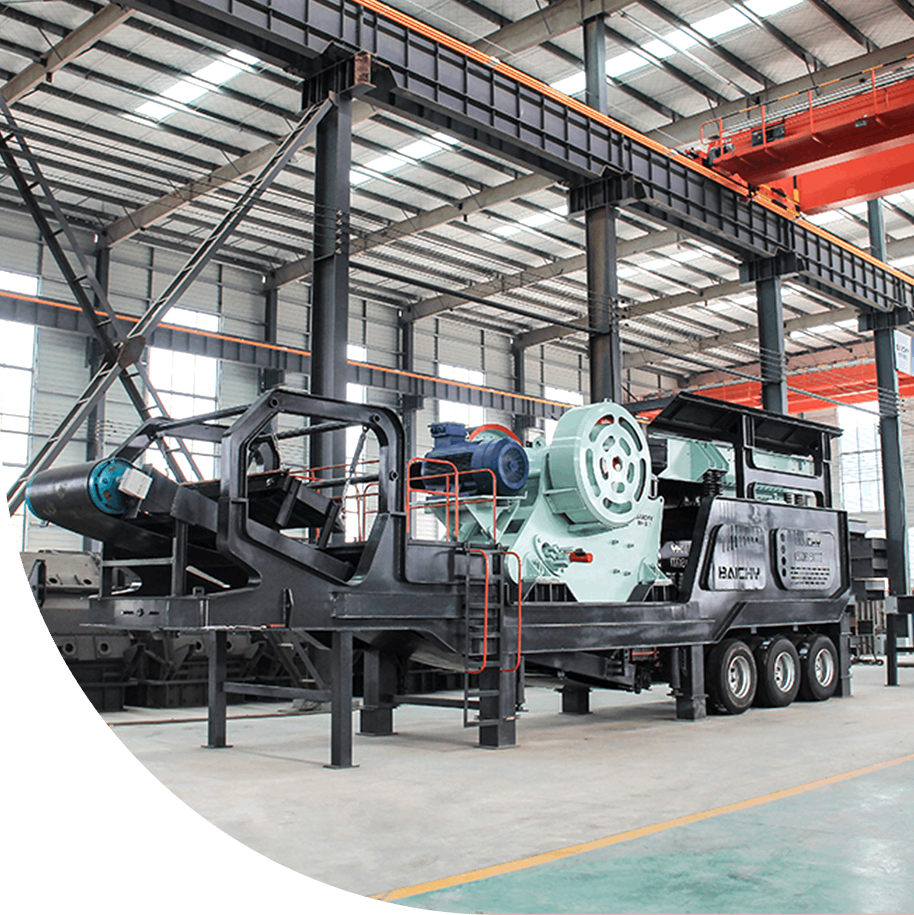

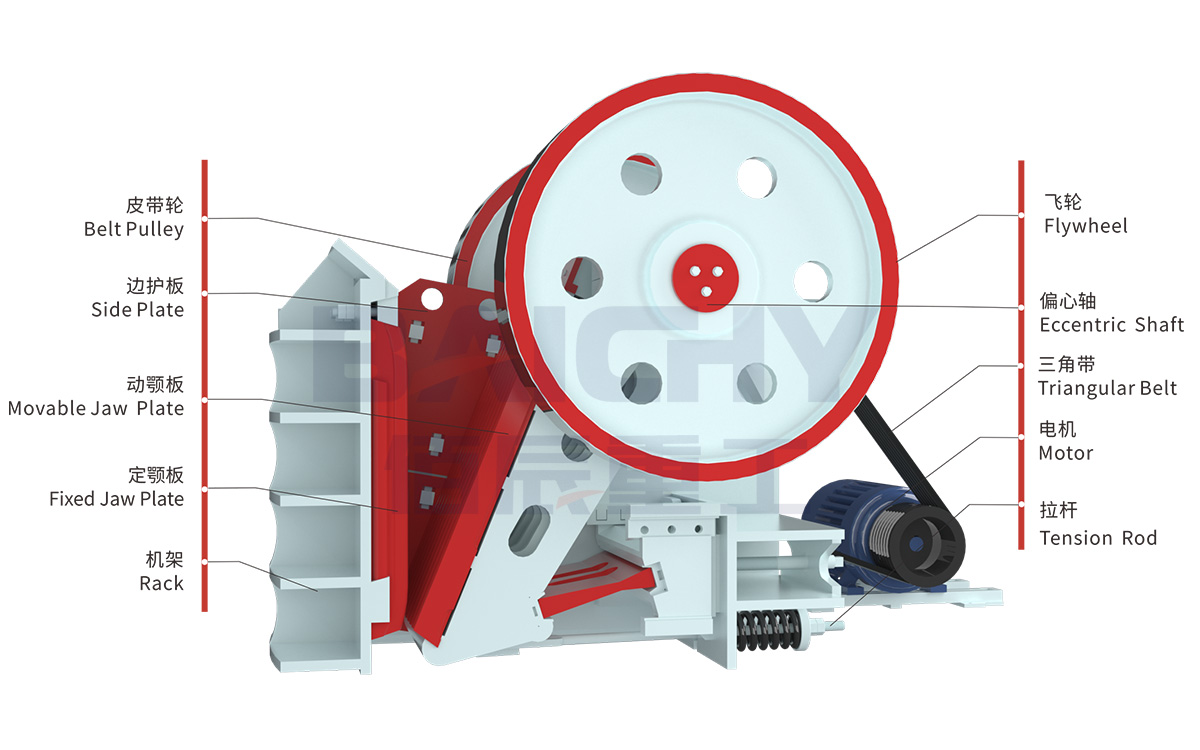
Structural diagram of the PE jaw crusher
I. Working Principle of the Jaw Crusher
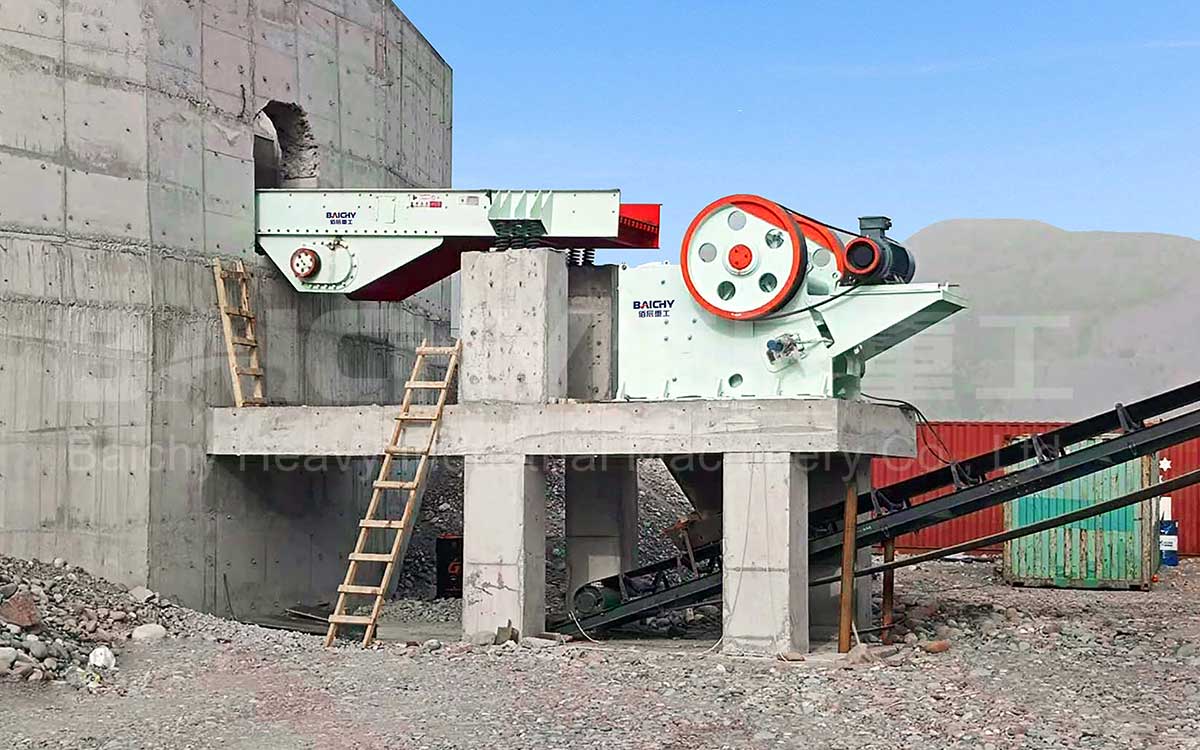
The jaw crusher achieves material breakage through the periodic reciprocating motion between a fixed jaw plate and a movable jaw plate, applying compressive and splitting forces. An electric motor drives the rotation of an eccentric shaft, causing the movable jaw to swing around a suspension axis; material is crushed as the movable jaw approaches the fixed jaw, and material of the desired size is discharged under gravity during the return stroke, creating a continuous production cycle.
The working principle of the jaw crusher can be broken down into four clear steps:
1. Feeding: Large ore chunks are evenly fed into the V-shaped crushing chamber by a vibrating feeder, preventing clogging and uneven loading;
2. Compression Crushing: The rotation of the eccentric shaft drives the movable jaw toward the fixed jaw; material between the jaw plates is subjected to compressive and splitting stresses in the range of 200–320 MPa, causing it to fracture along cleavage planes;
3. Discharge: During the movable jaw's return stroke, the volume of the crushing chamber increases, allowing material that meets the discharge opening size to exit freely under gravity;
4. Cycling: The movable jaw swings continuously, seamlessly linking the feeding, crushing, and discharge stages to enable round-the-clock continuous operation.
The jaw crusher utilizes a compound-pendulum (single-toggle) structure, where the movable jaw follows an elliptical compound-swing trajectory; compared to simple-pendulum designs, this offers faster discharge speeds and higher single-unit capacity. With no complex transmission components other than the flywheel, its simple operating principle has made it the most widely used primary crushing equipment in quarries and mines worldwide.
II. Key Application Scenarios for Jaw Crushers
The jaw crusher serves as the "first stage" of the crushing process, appearing in virtually any scenario where ore must be reduced from "massive boulders" to "manageable sizes":
| Application Scenario | Typical Materials | Operating Conditions |
|---|---|---|
| Quarry Primary Crushing | Granite, basalt, limestone, andesite | Open-pit mining; 50–450 t/h capacity |
| Metal Mine Coarse Crushing | Iron, gold, manganese, and copper ores | Underground or open-pit; paired with vibrating feeders |
| River Pebble/Cobble Sand Making (Pre-stage) | River pebbles, cobbles | Primary crushing stage in manufactured sand lines |
| Construction Waste Recycling | Concrete blocks, brick rubble, asphalt pavement material | Mobile stations or fixed lines; on-site recycling |
| Infrastructure Aggregate Production | Crushed stone for highways, railways, and water conservancy projects | Large-scale fixed crushing lines |
Whether in a small-scale pilot line with a 5 t/h capacity or a mining-grade production line handling 450 t/h, jaw crushers are renowned for their ability to handle "hard rock"—as long as the material's compressive strength does not exceed 320 MPa, they reliably perform the primary crushing task.
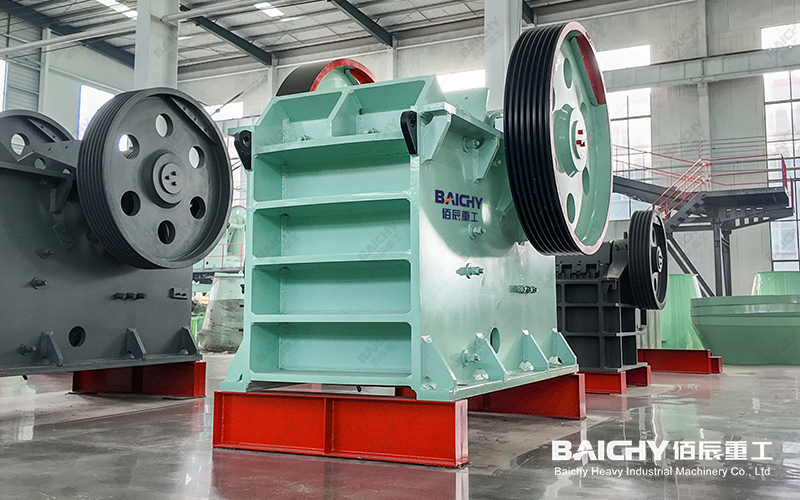
compound pendulum jaw crusher
III. Five Core Advantages of Jaw Crushers
Simple structure and low failure rate: Jaw crushers feature a short drive train (motor → pulley → eccentric shaft). Routine maintenance involves only checking the jaw plates, toggle plates, and bearings. Unskilled workers can operate the machine after brief training, and mining downtime can be reduced by over 30%.
High crushing ratio and controllable particle size: The crushing ratio typically ranges from 4:1 to 6:1. Combined with hydraulic or shim-based discharge opening adjustments, the output particle size can be flexibly set between 20 mm and 200 mm, directly meeting the feed requirements for secondary crushing stages.
Large feed size and suitability for hard rock: Taking the PE900×1200 model as an example, the maximum feed size reaches 750 mm. Coarse crushing of igneous rocks—such as granite and basalt—no longer requires secondary blasting, directly lowering costs at the mining stage.
Low operating costs and long service life for wear parts: High-manganese steel (ZGMn13) jaw plates last 3–6 months when processing moderately abrasive materials; electricity consumption is just 0.5–1.2 kWh per ton, and the total cost of ownership (TCO) is significantly lower than that of impact-based solutions.
Flexible configuration and high scalability: Available in stationary, semi-mobile, and tracked or wheeled mobile versions, the unit can be freely combined with cone or impact crushers to form two- or three-stage crushing circuits.
Economic benefits: Each of these technical features translates directly into tangible savings—extending the jaw plate service life by just one month saves approximately $12,000–$18,000 annually in spare parts costs for a production line with an annual output of 300,000 tons; a stable crushing ratio eliminates the need for frequent adjustments to secondary crushing equipment, allowing the entire line to maintain a capacity utilization rate of over 92%.
IV. Key Specifications for PE Series Jaw Crushers
The following table lists specifications for mainstream PE series models (based on limestone with a density of 1.6 t/m³; for hard rock, capacity should be adjusted by a factor of 0.8–0.9):
| Model | Feed Opening (mm) | Max. Feed Size (mm) | Discharge Opening Range (mm) | Capacity (t/h) | Motor Power (kW) | Suitable Production Line |
|---|---|---|---|---|---|---|
| PE250×400 | 250×400 | 210 | 20–60 | 5–20 | 15 | Small-scale aggregate lines, laboratories |
| PE400×600 | 400×600 | 340 | 40–100 | 16–65 | 30 | 50 t/h class production lines |
| PE500×750 | 500×750 | 425 | 50–100 | 45–100 | 55 | 80–120 t/h production lines |
| PE600×900 | 600×900 | 500 | 65–160 | 60–130 | 75 | Mainstream model for 100–150 t/h lines |
| PE750×1060 | 750×1060 | 630 | 80–140 | 110–250 | 110 | 200–250 t/h production lines |
| PE900×1200 | 900×1200 | 750 | 95–165 | 220–450 | 132 | Large-scale mining production lines |
Selection Note: When selecting a jaw crusher, it is essential to distinguish between nominal capacity and actual capacity. The values in the table above are calibrated for limestone operations; for granite or basalt, apply a conversion factor of 0.85, and for river pebbles, apply a factor of 0.8. Additionally, a 15–20% margin should be factored in during selection. ...sufficient capacity margin to prevent production line bottlenecks.
V. Global Application Cases of Jaw Crushers
Jaw crushers are among the most reliable pieces of equipment in production lines across more than 130 countries and regions. The following three cases serve as direct references for equipment selection:
Rwanda Granite Production Line (100–150 t/h): A two-stage configuration featuring a PE600×900 jaw crusher and a PF1214 impact crusher. It processes high-silica granite, producing 0–40 mm concrete aggregate. Six months after commissioning, the actual production capacity met 98% of the target, and a single set of jaw plates lasted over five months.
Mexico Iron Ore Project (PE500×750): Utilized a customized motor for 60 Hz/440 V power standards. It performs primary crushing of 400 mm magnetite ore down to under 100 mm; combined with a cone crusher, it produces 0–25 mm finished product. Electricity consumption per ton of crushed material was 12% lower than that of the local legacy line.
Ethiopia Basalt Airport Project (PE400×600): Customized for 380 V/50 Hz operation. It supplies 0–31.5 mm graded crushed stone for airport runway aggregate. Operating continuously on double shifts, it achieved an annual utilization rate of 91%, demonstrating the reliability of smaller models in major infrastructure projects.
These three cases point to a single conclusion: when the jaw crusher model is correctly matched to material hardness and power standards, its stability and return on investment can be quantified—which is the fundamental reason for continued repeat purchases across more than 130 countries and regions.
VI. Recommended Auxiliary Equipment for Jaw Crushers
A jaw crusher alone cannot form a complete production line. The following core auxiliary equipment is recommended, listed in process order:
• ZSW Series Vibrating Feeder: Ensures uniform feeding and pre-screens fines, protecting the jaw crusher from impact and clogging;
• PEX Series Fine Jaw Crusher: Forms a "dual-jaw" setup with the PE primary jaw crusher; serves as a cost-effective alternative to cone crushers for processing medium-soft materials;
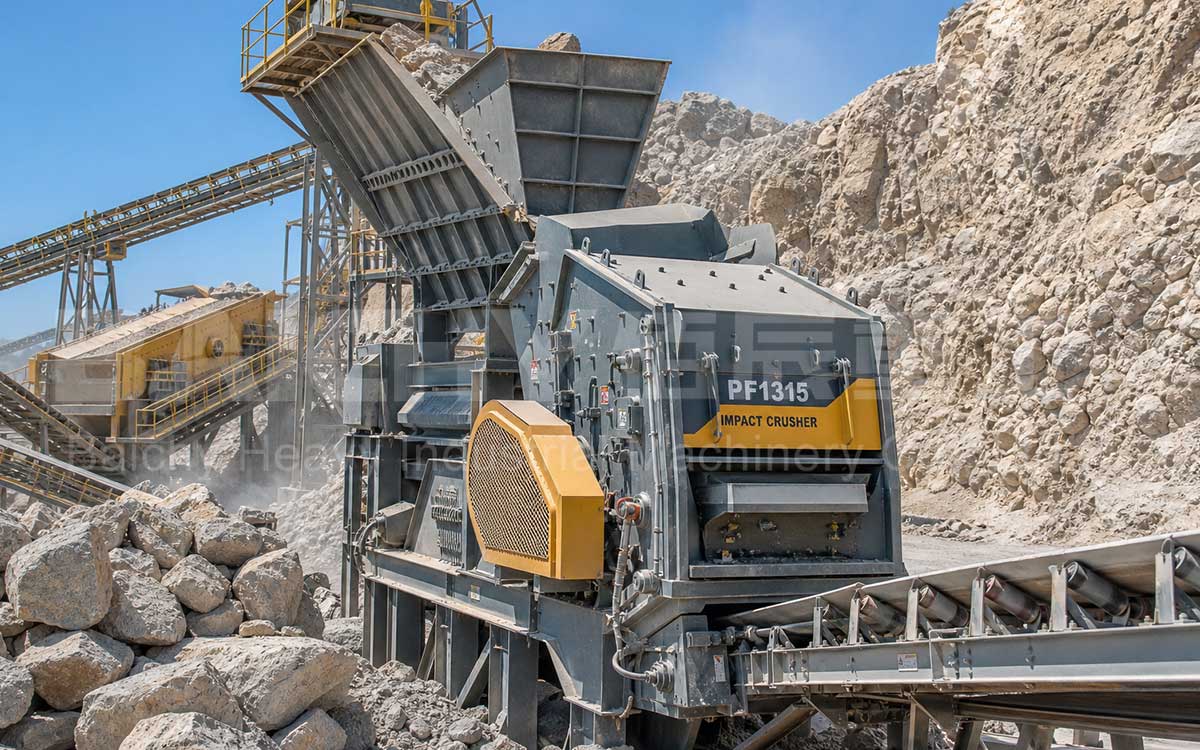
• PF Series Impact Crusher / CS Series Cone Crusher: Primary equipment for secondary crushing; impact crushers are suitable for medium-soft materials and aggregate shaping, while cone crushers are ideal for hard, highly abrasive rock;
• YK Series Circular Vibrating Screen + Belt Conveyor: Handles particle size grading and material transport, completing the closed-loop circuit;
• C90 Series Jaw Crusher: A new-generation model with a high reduction ratio, suitable for stationary production lines requiring finer output sizes.
For mobile operations (such as mine site transfers or on-site construction waste processing), the jaw crusher can be integrated into YDPZ Series tracked or wheeled mobile crushing stations, enabling immediate operation upon arrival and eliminating the need for foundation construction.
VII. FAQ (Frequently Asked Questions)
1. What is the difference between a jaw crusher and a cone crusher? How should I choose?
They serve different functions: Jaw crushers handle primary (coarse) crushing (feed size up to 750mm, output 20–200mm), offering a high reduction ratio and suitability for materials of any hardness; cone crushers handle secondary and fine crushing (feed size typically ≤300mm, output 5–50mm), producing better particle shapes but featuring a more complex structure and greater sensitivity to feed size. The standard configuration is a two-stage setup: "Jaw Crusher (Primary) + Cone Crusher (Fine)." However, if the material is medium-soft or has low abrasiveness, an impact crusher can replace the cone crusher to reduce costs.
2. How is the actual capacity of a jaw crusher calculated? Why is on-site capacity often lower than the nominal value?
Nominal capacity is rated based on limestone (density: 1.6 t/m³) and a medium discharge opening setting. Actual on-site capacity is influenced by four factors: material hardness and density (granite: ×0.85; river pebbles: ×0.8), feed size distribution (a high proportion of oversized particles reduces output), discharge opening setting (larger openings yield higher capacity), and feeding continuity (intermittent feeding directly lowers hourly output). When selecting equipment, it is recommended to base calculations on 80–85% of the nominal capacity and to install a vibrating feeder to ensure a continuous material supply.
3. What is the service life of the jaw plates (tooth plates), and how can it be extended?
The service life of high-manganese steel jaw plates depends on material abrasiveness: approximately 4–6 months for moderately abrasive limestone, about 2–3 months for granite, and potentially less than 1.5 months for highly abrasive quartzite. Key measures to extend service life include: maintaining uniform feed size to prevent large rocks from damaging the plates; regularly inspecting the discharge opening to prevent excessive wear; swapping the left and right plates once worn (interchanging them can extend life by about 30%); and avoiding prolonged operation while the machine is empty. Baichy offers a choice of genuine high-manganese steel or alloy steel jaw plates; matching the plate material to the specific characteristics of the feed material can significantly reduce consumable costs per ton.
Baichy Heavy Industry
Baichy Heavy Industry is a high-tech mining equipment company integrating R&D, manufacturing, sales, and after-sales service. Focusing on crushing, grinding, and mineral processing equipment, we provide professional solutions to our customers. We are ISO9001:2015 、certified, and our products include mobile crushing palnts, crawler crushing plant, construction waste crushing plants, jaw crushers, sand making machines, cone crushers, fine crushers, grinding mills, ball mills, etc., all with reliable performance to meet diverse project needs.
Baichy Heavy Industry – Your Trusted Partner
To ensure optimal performance of your equipment, Baichy Heavy Industry offers:
- Professional on-site installation guidance
- Comprehensive operator training
- 24/7 technical support & maintenance services
Our complete after-sales service system guarantees long-term, stable operation of your machinery with minimal downtime.
Protect Your Rights – Only Use Official Channels
To avoid scams and ensure authentic support, contact us exclusively through:
• Official Website: www.baichychina.com
• WhatsApp: +8615093222637
• Email: [email protected]
Your satisfaction is our priority – expect prompt, professional service every time.
(Note: Beware of unauthorized third parties claiming to represent Baichy. Always verify through official contacts.)