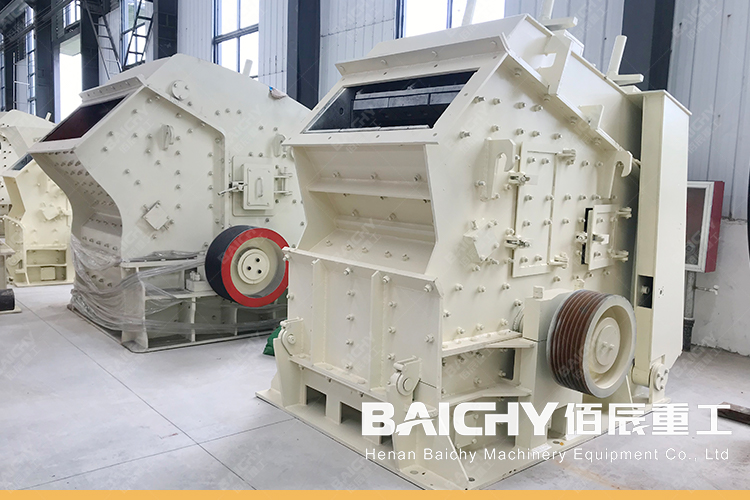
In the increasingly competitive sand and gravel aggregate market, the particle shape, gradation, and production efficiency of products directly affect the core profitability of a project. As a seasoned professional in the mining crushing industry, you are well aware that while traditional compression crushing equipment is robust and durable, it often falls short in producing high-quality manufactured sand and cubic aggregates. At this point, the impact crusher, with its unique working principle and superior output effect, has become an indispensable "finishing" tool in modern crushing production lines.
Today, we will delve into the working principle of the impact crusher, revealing how it can become your winning formula for enhancing product added value and gaining market share.
Act One: The Source of Power – A Perfect Interpretation of Centrifugal Force and Acceleration
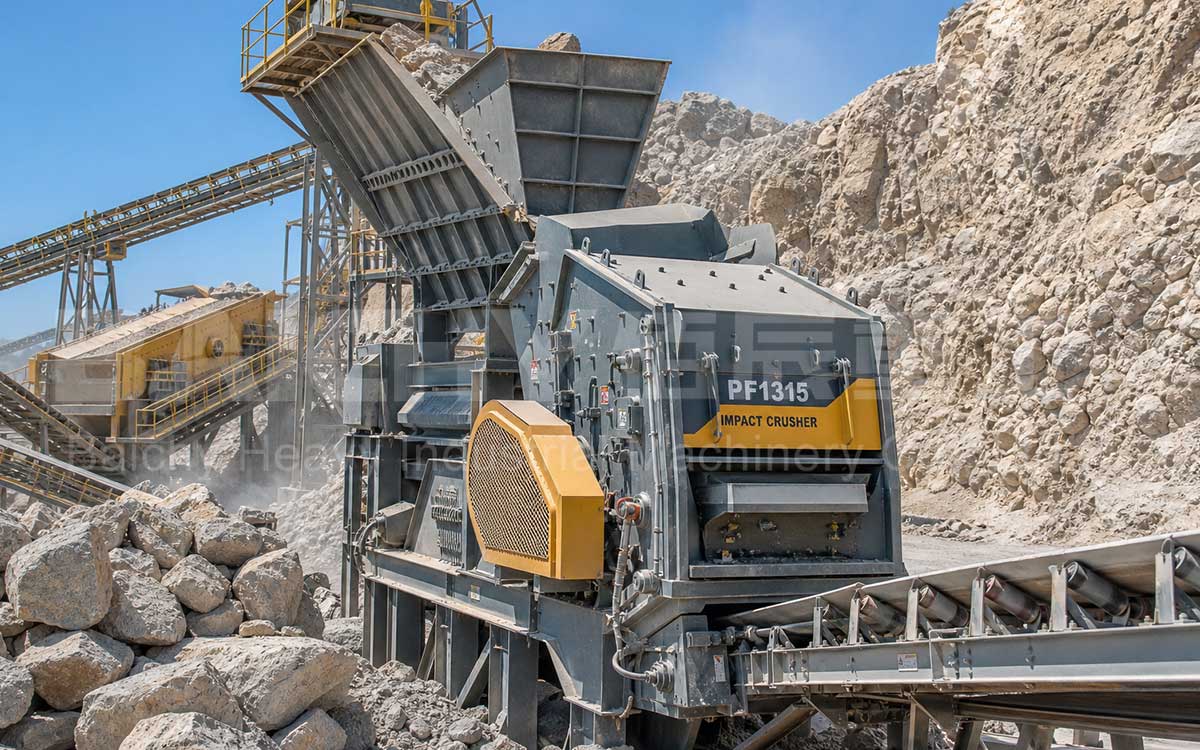
The core idea of the impact crusher is very simple yet extremely efficient: utilizing the kinetic energy of high-speed rotation, the material is accelerated and thrown against a fixed impact plate, achieving crushing through intense impact. This completely simulates the phenomenon of rocks colliding and breaking in nature at high speed, but placed in a controlled and efficient industrial environment.
This process begins at the "heart" of the crusher – the high-speed rotating rotor. The rotor is typically driven by a high-powered motor via a belt, achieving extremely high speeds. The material to be crushed is fed into the feed inlet at the top of the crusher, falling into the center of the rotor. The rotor is equipped with robust hammers (or impact blocks), which "grab" the material and impart tremendous centrifugal force as the rotor rotates at high speed.
Under the influence of centrifugal force, the material is ejected from the rotor at high speed, with linear velocities reaching 60-80 meters per second or even higher. These accelerated materials become "projectiles" with enormous kinetic energy. The stage for crushing is now set, and the exciting collision is about to begin.
Act Two: The Dance of Crushing – A Duet of "Stone Against Stone" and "Stone Against Iron"
Where do these accelerated material "projectiles" fly? This leads to one of the most ingenious designs of the impact crusher: the crushing chamber. Depending on the structure of the crushing chamber, impact crushing is mainly pided into two modes to adapt to different raw material and product requirements:
1. Stone-on-Stone Principle:
◦ Scenarios: Primarily used for shaping and sand production of highly corrosive materials (such as basalt and granite), or applications sensitive to wear and tear on durable parts.
◦ Process: The material accelerated by the rotor does not directly impact the metal impact plate, but rather impacts the material lining formed around the crushing chamber. This lining is a protective layer naturally formed by the previously fed, smaller-sized material. Therefore, crushing mainly occurs between the accelerated material and the material lining.
◦ Advantages: Significantly reduces metal wear and lowers operating costs. Produces better-shaped sand and gravel, mostly cubic, with extremely low needle-like and flaky content.
2. Stone-on-Iron Principle:
◦ Scenarios: Primarily used for crushing materials of medium hardness and low abrasiveness (such as limestone) to achieve a higher crushing ratio and output.
◦ Process: Accelerated material directly impacts a fixed metal impact plate (or anvil) within the crushing chamber. This direct, high-energy impact generates tremendous crushing force.
◦ Advantages: Higher crushing efficiency and a larger crushing ratio (the ratio of feed particle size to output particle size).
Modern advanced impact crushers (such as VSI sand making machines) often combine two principles, using adjustable guide plate designs to flexibly switch between "stone-on-stone" and "stone-on-iron" modes, thereby achieving the optimal balance between output and particle shape, wear and efficiency.
Act Three: The Art of Precision Control – Particle Size Adjustment and Circulation Classification
Another key advantage of impact crushers lies in their convenient and precise ability to adjust the finished product particle size. Unlike traditional jaw crushers or cone crushers that control particle size by adjusting the discharge port size, impact crushers primarily achieve this through the following methods:
• Rotor Speed: Increasing the rotor speed results in greater kinetic energy for the material, stronger impact force, and finer product particle size; conversely, decreasing the speed results in coarser product particle size.
• Guide Plate/Impact Plate Position: By adjusting the angle and distance from the rotor of the peripheral guide plates or impact plates, the impact angle of the material and the flow path within the crushing chamber can be altered, thus affecting the crushing effect and product particle size.
Furthermore, crushers typically have an internal screening device. Material that does not reach the target particle size is intercepted by the screen and returned to the rotor for further accelerated crushing, forming a closed-loop cycle to ensure that all outputs meet the preset particle size requirements. This "more crushing, less grinding" concept greatly improves energy utilization and the final product qualification rate.
Why Choose an Impact Crusher? — A Clear Return on Investment
From a marketing and customer value perspective, a deep understanding of its working principle reveals its commercial advantages:
1. Superior Particle Shape: The produced sand and gravel aggregate particles are cubic with sharp edges and a reasonable gradation, greatly improving the compressive strength and stability of concrete, resulting in high product added value.
2. High Efficiency and Energy Saving: Kinetic energy is directly used for crushing, resulting in high energy utilization. Compared to compression crushing, it is more energy-efficient in certain applications.
3. Flexible Adjustment: Product specifications can be quickly changed by simply adjusting the speed and mechanism to adapt to changing market demands.
4. Multi-functional: It can be used for sand making as well as medium and fine crushing operations, achieving stone shaping and crushing, simplifying the process flow.
Building Market Competitiveness with Core Technology: The impact crusher is far more than a simple "impact" machine; it is a precision system meticulously designed based on dynamic principles. From efficient energy conversion to the intelligent choice between "stone-on-stone" and "stone-on-iron" crushing, and the precise adjustment of closed-loop control, every step showcases the essence of modern crushing technology.
For those seeking high-quality sand and gravel aggregates and maximizing return on investment, choosing a technologically advanced impact crusher means equipping your production line with a powerful "heart." It is not just crushing equipment, but a strategic weapon for enhancing product competitiveness and seizing the high-end market.
Now, it's time to reassess your crushing process. Are you ready to inject new momentum into your business with impact crushing technology?