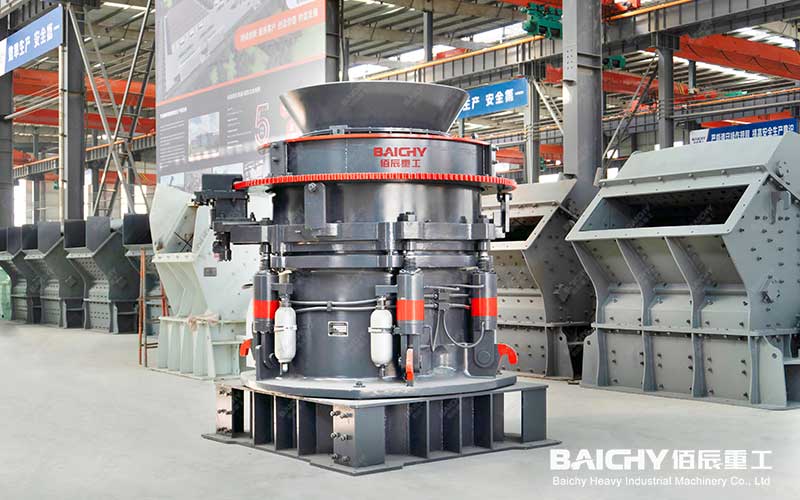
Hydraulic cone crushers are core medium and fine crushing equipment in modern sand and gravel aggregate production. Understanding their different types is crucial for selection. Based on your suggestions, I have written a comprehensive and clearly structured blog post for you.
What Types of Hydraulic Cone Crusher are There? This article will guide you through the selection process.
In sand and gravel aggregate production and mining crushing, cone crushers play a vital role due to their high efficiency and stability. Hydraulic cone crushers, as an upgraded version of traditional spring cone crushers, have become the mainstream choice in the market due to their high degree of automation, convenient discharge adjustment, and strong overload protection.
However, are you confused by the wide variety of hydraulic cone crushers on the market, such as single-cylinder, multi-cylinder, and fully hydraulic types? What are the differences between them? And how do you choose the most suitable type for your project? This article will answer these questions one by one.
I. Core Advantages of Hydraulic Cone Crusher
Before delving into the specific type, let's quickly review why hydraulic cone crushers are so popular:
1. Automated Intelligent Control: The discharge opening size can be easily adjusted via the hydraulic system and PLC touchscreen, achieving precise control over product particle size.
2. Iron Overload Protection and Cavity Clearing Function: When uncrushable materials (such as iron blocks) enter the crushing chamber, the hydraulic system automatically lowers the moving cone to discharge the foreign object, then quickly resets, preventing equipment damage. Hydraulic cavity clearing is also possible during shutdown, reducing manual labor and downtime.
3. Stable Operation and Excellent Particle Size: The hydraulic system provides better buffering, resulting in smoother operation and better product particle shape, with higher cubic content and reduced needle-like and flaky particles.
4. High Production Efficiency: The advanced crushing chamber design and higher rotational speed result in greater throughput and higher crushing efficiency.
II. Three Main Types of Hydraulic Cone Crusher
Hydraulic cone crushers are mainly classified according to the number and arrangement of hydraulic cylinders. The most common are the following three types:
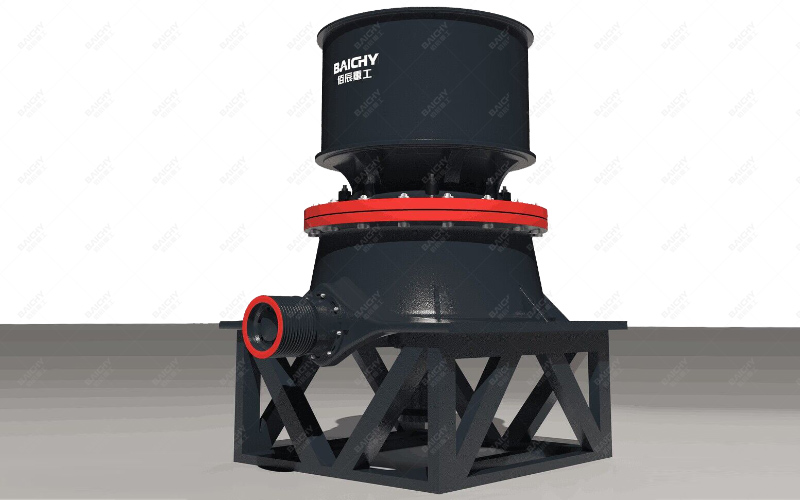
1. Single-Cylinder Hydraulic Cone Crusher
This is the simplest type in structure. As the name suggests, it has only one hydraulic cylinder at the bottom of the main shaft. This hydraulic cylinder integrates multiple functions: it supports the moving cone and main shaft, adjusts the discharge opening size, and provides overload protection.
• Working Principle: The hydraulic cylinder's lifting motion drives the main shaft and moving cone to move up and down as a whole, thereby changing the gap in the crushing chamber.
• Core Features:
◦ Simple structure, low cost: Fewer parts and fewer maintenance points, resulting in lower overall purchase and maintenance costs.
◦ Mature technology, high reliability: The simple structure means a relatively low failure rate.
◦ Good layered crushing effect: Suitable for medium and fine crushing operations, producing good particle shape.
• Applicable Scenarios: Ideal for processing materials of medium to high hardness, making it a cost-effective choice for small to medium-sized sand and gravel aggregate production lines.
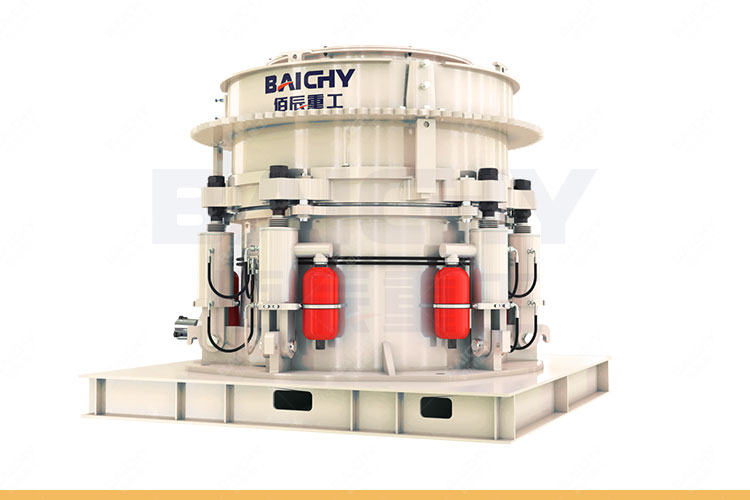
2. Multi-Cylinder Hydraulic Cone Crusher
A multi-cylinder hydraulic cone crusher has multiple hydraulic cylinders (usually several) evenly distributed around the machine body. These cylinders primarily provide strong locking force, ensuring stable operation of the crusher under heavy loads. Adjusting the discharge opening and overload protection are typically handled by a separate hydraulic system.
• Working Principle: Multiple hydraulic cylinders provide strong locking force, the main shaft remains stationary, and the discharge opening is changed by adjusting the crushing wall.
• Core Features:
◦ High Crushing Force and High Output: The multi-cylinder structure provides greater crushing force, resulting in strong processing capacity for high-hardness materials and high output.
◦ Excellent Product Particle Shape: Particularly suitable for fields with extremely high requirements for aggregate particle shape (such as highway and high-speed rail construction).
◦ Relatively Complex Structure: The hydraulic system is more precise, requiring higher maintenance standards and resulting in relatively higher costs.
• Applicable Scenarios: Primarily used for secondary (medium) and tertiary (fine) crushing, especially suitable for projects processing high-hardness materials (such as granite and basalt) with stringent requirements on product particle shape.
3. Fully Hydraulic Cone Crusher
This is currently the most technologically advanced and highest-performing type. It is entirely hydraulically driven, eliminating the mechanical structure of the main shaft and bowl-shaped bearings found in traditional cone crushers. The oscillation and rotation speed of the moving cone are directly driven by a hydraulic motor.
• Working Principle: The moving cone is directly driven by a hydraulic motor to perform a gyratory motion; the speed and stroke can be independently and steplessly adjusted.
• Core Features:
◦ Extremely Flexible Adjustment: The crushing chamber shape, speed, and stroke can be easily adjusted in real time via the control system, and different production modes (such as capacity priority or particle shape priority) can be switched with a single button.
◦ Strongest Overload Protection and Cavity Clearing Capacity: The moving cone can rotate bidirectionally, resulting in the fastest and most thorough cavity clearing and obstacle removal.
◦ Top-Tier Technology, High Price: Represents the highest level of cone crusher technology, with the highest initial investment cost. • Applicable Scenarios: Suitable for large and super-large mines and special aggregate production lines, especially suitable for modern intelligent mines that require frequent changes in product specifications and processing of various materials.
III. A Table for Quick Comparison of Three Types
| Features | Single-cylinder hydraulic cone crusher | Multi-cylinder hydraulic cone crusher | Fully hydraulic cone crusher |
| Number of Hydraulic Cylinders | 1 (integrated function) | Multiple (mainly for locking) | Hydraulic motor driven, no traditional spindle |
| Structural Complexity | Simple | Complex | Most Complex |
| Initial Cost | Low | High | Highest |
| Maintenance Difficulty | Easy | Relatively Complex | Requires professional technicians |
| Product Particle Shape | Good | Excellent | Very Good, Adjustable |
| Processing Capacity | Medium | Large | Largest, Most Flexible |
| Core Advantages | High cost-performance ratio, reliable | High-hardness materials, good particle shape | Intelligent, flexible, highly efficient and versatile |
IV. How to Select the Right Type Based on Actual Needs?
Choosing the right hydraulic cone crusher requires comprehensive consideration of the following factors:
1. Material Characteristics: The hardness, moisture content, mud content, and feed particle size of the material are primary factors. For high-hardness materials, multi-cylinder or fully hydraulic crushers are preferred.
2. Capacity Requirements: Determine the required production capacity based on the scale of the production line.
3. Product Requirements: What are the requirements for the particle shape and gradation of the final product? For extremely high requirements, consider multi-cylinder or fully hydraulic crushers.
4. Investment Budget: Clarify your budget. Single-cylinder crushers offer the best cost-effectiveness, while fully hydraulic crushers represent a long-term investment.
5. Automation Level: Is a high degree of automation and remote monitoring required? Fully hydraulic crushers have a clear advantage in this regard.
In short:
• For those seeking cost-effectiveness and handling medium-hardness materials: A single-cylinder hydraulic cone crusher is the ideal choice.
• For those primarily handling high-hardness materials with high requirements for particle shape: A multi-cylinder hydraulic cone crusher will not disappoint.
• For those with a sufficient budget and seeking top efficiency and ultimate flexibility: A fully hydraulic cone crusher is an investment for the future.
Hopefully, this detailed introduction will help you gain a deeper understanding of the different types of hydraulic cone crushers, providing a clear reference for your equipment selection. The right choice is the beginning of efficient production!