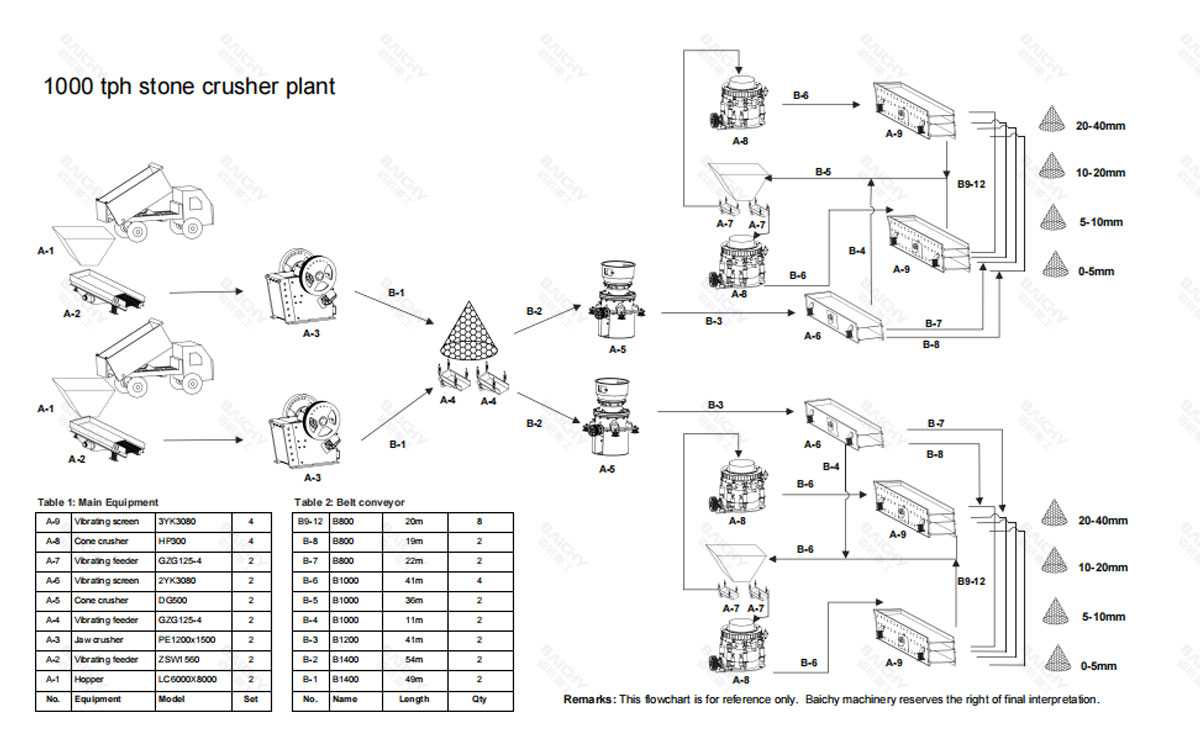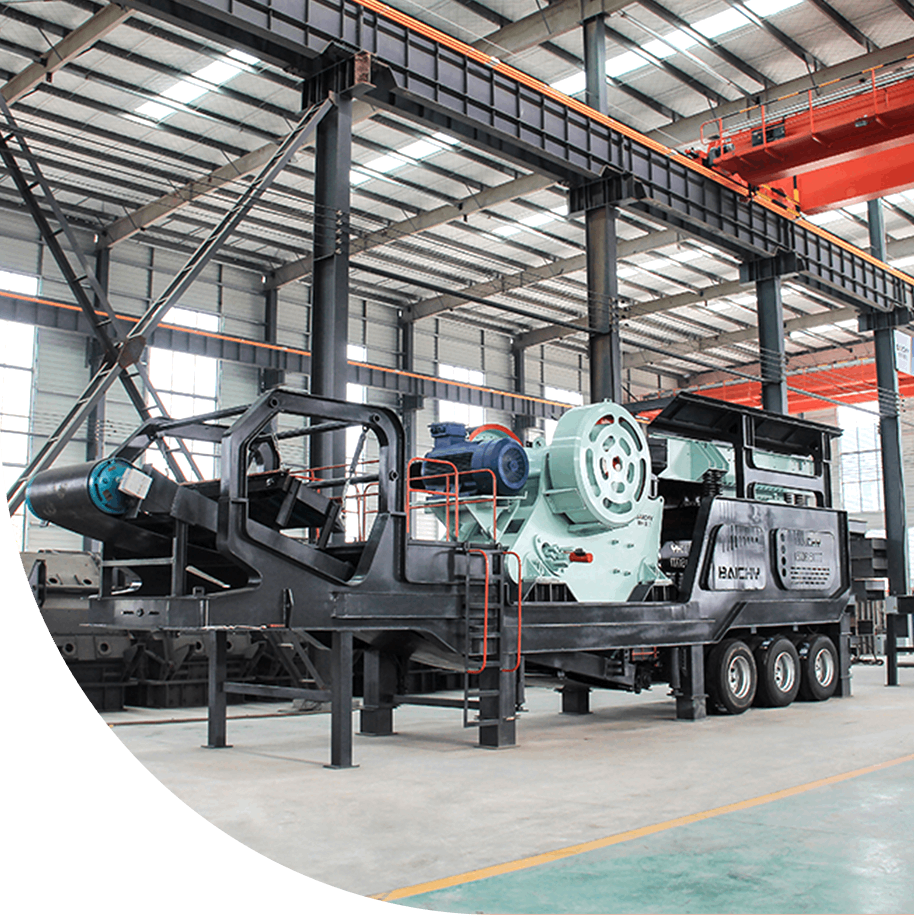

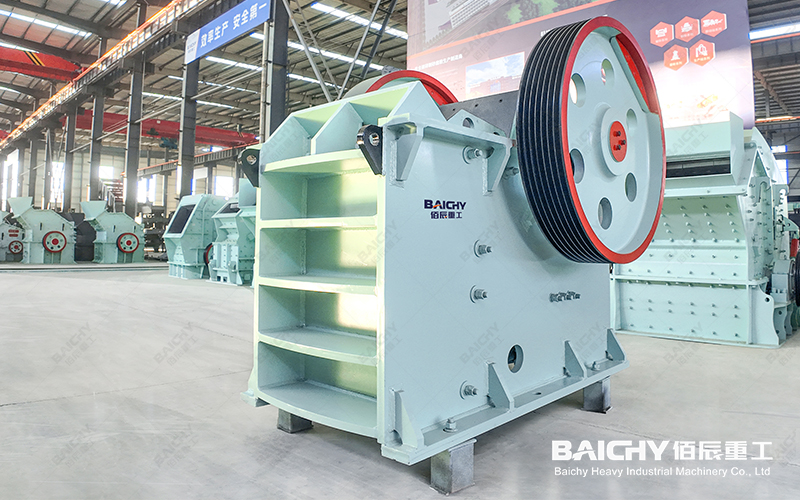
Jaw Crusher For crushing hard rock
Hard rock crusher selection comes down to three inputs: the hard rock compressive strength in MPa, the largest lump in mm arriving at each crushing stage, and the target output in t/h. A jaw crusher for hard rock holds the primary stage, a cone crusher for hard rock holds secondary and tertiary duty, and an impact crusher for hard rock is reserved for the least abrasive feed in the circuit.
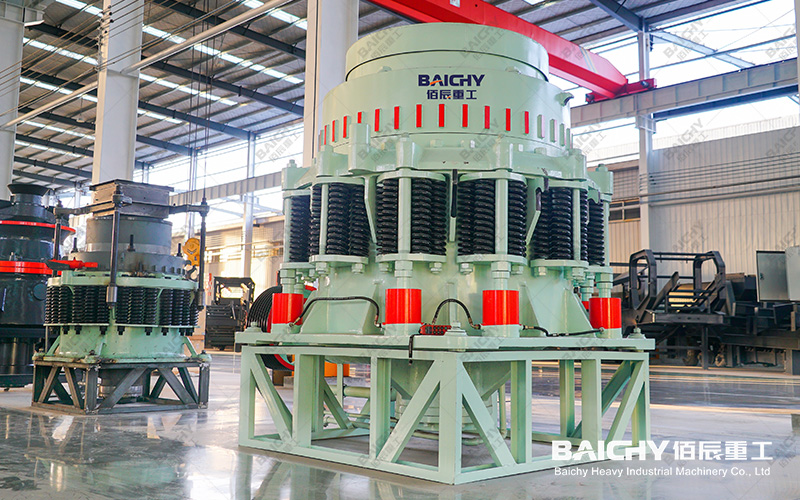
Symons Cone Crusher for crushing hard rock
What Data Do You Need Before Choosing a Crusher?
Collect seven values before a model is quoted: each removes a crusher family from the shortlist.
• Rock type: granite, basalt, diabase, quartzite or river pebble
• Uniaxial compressive strength in MPa from core samples of your own deposit
• Mohs hardness, which sets liner and plate wear
• Largest lump in mm at the infeed and target output in t/h per finished fraction
• Product top size in mm, the flaky limit your buyer accepts, and the site power supply in V and Hz
Baichy prints the same caveat under every capacity table: "The output will vary according to different materials, feed particle size and other factors." Read a catalogue tonnage as a limestone-class figure until your rock is tested.
How Hard Is Hard Rock?
Hard rock begins at a Mohs hardness of 6-7 with a compressive strength of 150-300 MPa, the band where the multi-cylinder cone crusher is specified.
Jaw crushers cover a wider range: the C series jaw crusher is published for granite, basalt and iron ore at ≤320MPa, and the PE heavy-duty jaw series is built for the same three materials. Impact crushers are published for medium and fine crushing of material not higher than 320Mpa.
Strength alone does not settle the family: on a PE 750×1060 plus HP300 line, Baichy publishes that wear-resistant parts last 3 times longer than on an impact crusher.
Which Crusher Does Each Stage Need?
The stage fixes the crusher family; feed size and tonnage fix the model.
| Stage | Duty | Model | Max feed (mm) | Capacity (t/h) | Motor (kW) |
|---|---|---|---|---|---|
| Primary | Granite and basalt infeed | PE750×1060 jaw crusher | 630 | 110–380 | 110 |
| Primary | Large-lump quarry, 300 t/h class | PE900×1200 jaw crusher | 750 | 220–450 | 132 |
| Primary | 700 mm feed at high tonnage | C110 jaw crusher | 700 | 200–400 | 132 |
| Secondary | High-tonnage lamination duty | HP400 cone crusher, Extra Coarse | 240 | 300–630 | 315 |
| Secondary | 300 t/h class | HP300 cone crusher, Extra Coarse | 190 | 220–445 | 220 |
| Secondary | Spring-supported alternative | CS160 cone crusher, Coarse | 205 | 172–349 | 132 |
| Tertiary | Product shape control | HP300 cone crusher, Fine | 85 | 145–280 | 220 |
| Secondary | Abrasion-tolerant alternative | PFW1315 impact crusher | 350 | 130–220 | 200 |
Baichy's published hard-rock flow is PE900×1200 jaw crusher (primary) to HP400 cone crusher (secondary) to HP300 cone crusher (tertiary); the range behind the table runs six size classes from HP100 to HP800 with five chambers each.
How Do You Size the Model to Your Feed?
Match the largest lump to the feed opening, then convert the target tonnage at a stated setting.
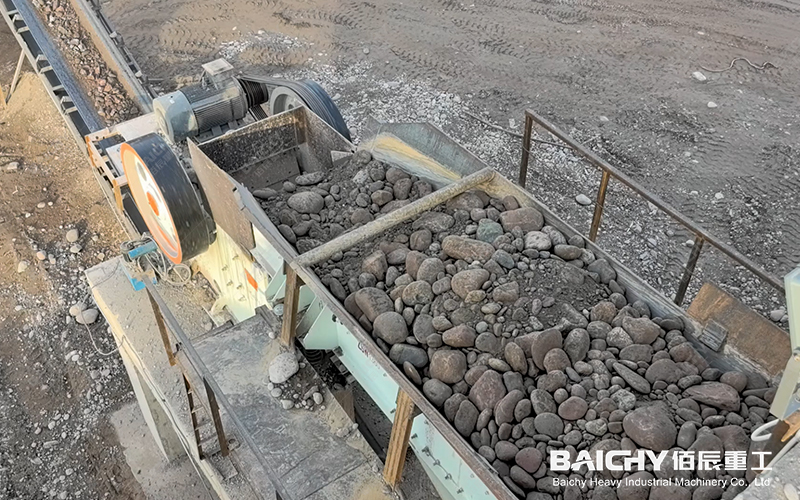
Across the published PE jaw crusher table, maximum feed size runs from 80.0% to 87.5% of the feed opening width: a 630 mm lump points to the PE750x1060 jaw crusher, whose 750 mm opening accepts it at 84%.
The discharge setting fixes product top size and capacity. The PE750x1060 jaw crusher adjusts its outlet across a 60-150 mm range and is rated 110-380 t/h on a 110 kW motor; the HP300 cone in the Fine chamber closes to a 14 mm minimum discharge. A lump above the maximum feed must be stopped at the feeder or broken by a breaker, because oversize rock stalls the chamber instead of entering it.
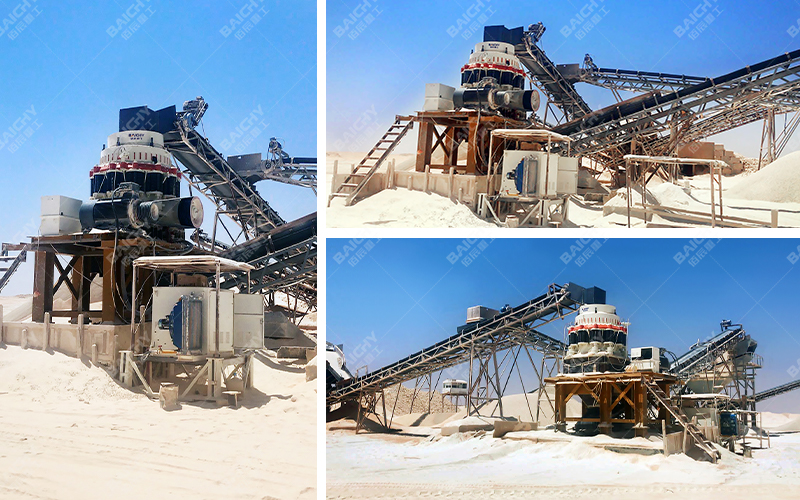
Hard rock fracturing site - cone crusher
Why Does Hard Rock Duty Move to a Cone Crusher?
A cone crusher for hard rock transfers crushing force through a manganese liner instead of a rotating rotor, and that is where the wear cost sits.
The PE900x1200 jaw crusher carries a high-strength manganese steel jaw plate published at an 8-12 month life in granite, on a page quoting power consumption at or below 1.8 kWh/ton. Downstream, cone-crushed aggregate is published with a needle-like content below 10%, and the multi-cylinder hydraulic principle cuts energy consumption by 15-20% against impact crushing. On granite or basalt, Baichy pairs the PF series impact crusher with a high chromium alloy hammer.
FAQ: Choosing a Crusher for Hard Rock
1. Which crusher handles hard rock?
A jaw crusher handles the primary stage and a multi-cylinder cone crusher handles secondary and tertiary stages. Baichy publishes the C series jaw crusher for granite, basalt and iron ore at ≤320MPa, and the multi-cylinder cone for a Mohs hardness of 6-7 at 150-300 MPa.
2. What hard rock compressive strength can a crusher take?
Impact crushers are published for medium and fine crushing of material not higher than 320Mpa, and the C series jaw crusher for hard rock at ≤320MPa. The multi-cylinder cone crusher is specified across the 150-300 MPa band. Above 320 MPa, test core samples first.
3. What is the maximum feed size for a hard rock jaw crusher?
It depends on the feed opening. Across the published PE jaw table, maximum feed size runs from 80.0% to 87.5% of the opening width: the PE900x1200 takes a 750 mm lump into a 900x1200 mm opening, and the PE750x1060 takes 630 mm into 750x1060 mm.
4. How many crushing stages does a hard rock plant need?
Three stages suit most hard rock. Baichy publishes a PE900×1200 jaw crusher as primary, an HP400 cone crusher as secondary and an HP300 cone as tertiary; a two-stage jaw plus cone layout covers smaller tonnages.
5. What does a hard rock crusher cost?
Price follows configuration, not the model name, because cavity type, plate grade, motor and control level change within one size class. Send the rock type, largest lump in mm, target output in t/h and site power supply for a quotation.
Send Your Rock Specification for a Crusher Recommendation
Send four values and the crusher family can be fixed before a quotation is issued: rock type, compressive strength in MPa, the largest lump in mm, and the target output in t/h. The reply covers the primary jaw crusher, the cone crusher stage behind it and the matching motor rating.
Baichy Heavy Industry
Baichy Heavy Industry is a high-tech mining equipment company integrating R&D, manufacturing, sales, and after-sales service. Focusing on crushing, grinding, and mineral processing equipment, we provide professional solutions to our customers. We are ISO9001:2015 、certified, and our products include mobile crushing palnts, crawler crushing plant, construction waste crushing plants, jaw crushers, sand making machines, cone crushers, fine crushers, grinding mills, ball mills, etc., all with reliable performance to meet diverse project needs.
Baichy Heavy Industry – Your Trusted Partner
To ensure optimal performance of your equipment, Baichy Heavy Industry offers:
- Professional on-site installation guidance
- Comprehensive operator training
- 24/7 technical support & maintenance services
Our complete after-sales service system guarantees long-term, stable operation of your machinery with minimal downtime.
Protect Your Rights – Only Use Official Channels
To avoid scams and ensure authentic support, contact us exclusively through:
• Official Website: www.baichychina.com
• WhatsApp: +8615093222637
• Email: [email protected]
Your satisfaction is our priority – expect prompt, professional service every time.
(Note: Beware of unauthorized third parties claiming to represent Baichy. Always verify through official contacts.)