Baichy Heavy Industrial Machinery Co., Ltd

Phone/Wechat/Whatsapp:+008615093222637

Email:[email protected]
24 hours online
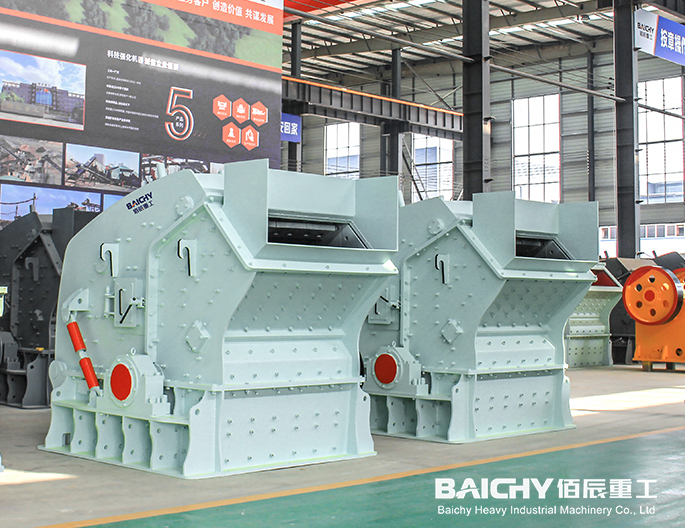
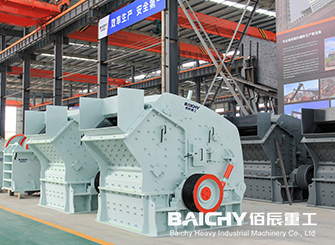
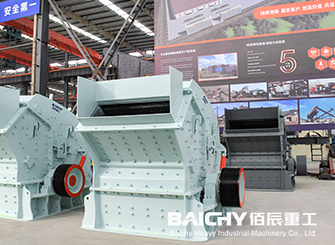
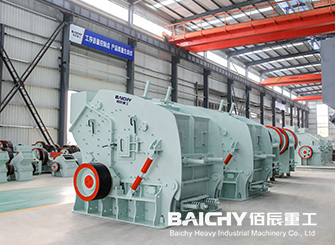
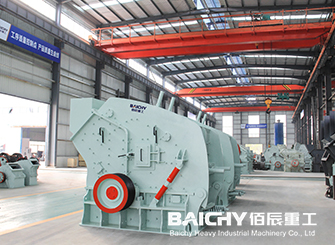
The PF1210 Impact Crusher is a classic medium-to-fine crushing model from our company that has been thoroughly validated by the market. Distinguished by its exceptional product particle shape and consistently high output, it has become the preferred core crushing equipment for medium-scale aggregate processing and construction waste recycling projects. Its value lies not only in its ability to efficiently execute crushing tasks but also—by producing aggregates with superior particle shape—in its capacity to directly enhance the market competitiveness and added value of your final products.
This equipment employs a mature impact crushing principle (utilizing both "stone-on-stone" and "stone-on-iron" techniques). During the crushing process, it naturally generates a high volume of cubical particles—producing high-quality aggregates with minimal needle-like or flaky content. This characteristic makes it particularly well-suited for applications with stringent requirements regarding product particle shape, such as the production of commercial concrete, asphalt mixtures, high-speed railway ballast, and high-grade highway construction materials.
The PF1210 is specifically optimized for crushing medium-to-low hardness materials with a compressive strength of ≤350 MPa. Under suitable operating conditions, it enables continuous production characterized by high efficiency and high economic returns, all while maintaining lower unit wear costs and energy consumption.
• Limestone, Dolomite, Marl (Offers the best crushing performance and economic benefits)
• Bricks, Concrete Blocks, and similar construction waste (Serves as core equipment for construction waste recycling)
• Coal, Coal Gangue, Loose Shale
• Medium-hardness River Pebbles, Weathered Granite
• Slag, Furnace Slag
• Fresh Granite, Basalt, Quartzite, Diabase, and other hard igneous rocks.
Note: Crushing such extremely hard materials will result in abnormally rapid wear of consumable parts—such as blow bars and impact plates—leading to a sharp increase in unit production costs. For such applications, we strongly recommend utilizing a Cone Crusherfor medium-to-fine crushing operations.
| Model | PF-1210 |
|---|---|
| Feeder Opening Size(mm) | 450X1150 |
| Max. Feeding Size(mm) | 300 |
| Rotor sizeD*L(mm) | Φ1250X1050 |
| Motor Power(kw) | 70-130 |
| Capacity(t/h) | 90-110 |
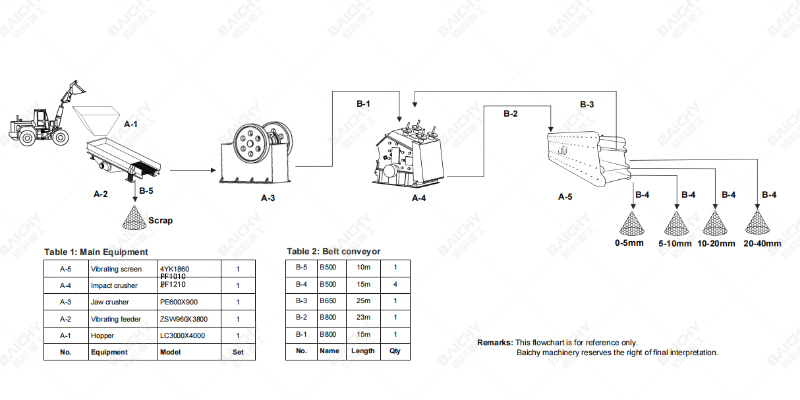
| NO. | Product Name | Model | Quantity |
|---|---|---|---|
| 1 | Hopper | LC3000*4000 | 1 |
| 2 | Vibrating feeder | ZSW960x3800 | 1 |
| 3 | Jaw Crusher | PE600x900 | 1 |
| 4 | Impact Crusher | PF1010、PF1210 | 1 |
| 5 | Vibrating Screen | 4YK1860 | 1 |
| 6 | Belt conveyor | B800 | 2 |
| 7 | Belt conveyor | B650 | 1 |
| 8 | Belt conveyor | B500 | 5 |
The theoretical standalone processing capacity of the PF1210 impact crusher ranges from 70 -130 tph. However, within an actual crushing and screening production line, the ultimate economic benefit is determined not by the parameters of a single machine, but rather by the stable output capability of the entire production system.
The core principle here is that a production line functions as a precisely coordinated "closed-loop system," where the final capacity adheres to the "Barrel Principle"—meaning it is determined by the system's weakest link. Let us consider, for example, a configuration in which the PF1210 serves as the primary machine for secondary or tertiary crushing:
Upstream equipment—such as vibrating feeders and jaw crushers—must provide a continuous, stable supply of raw materials with the appropriate particle size. If the supply is insufficient or uneven, the PF1210 will operate in a "starved" or "unbalanced-feed" state, preventing it from realizing its full performance potential.
Screening efficiency directly dictates the system's effective output. If the screening equipment is improperly selected, the screen mesh configuration is ill-suited, or the material is excessively wet (leading to clogging), a significant volume of already-qualified finished product will fail to be separated in a timely manner. This material is then forced back into the crusher, resulting in "over-crushing" and an inefficient recirculation loop; this severely constricts the processing capacity available for new incoming material, thereby significantly reducing the actual overall output.
The client's specific requirements regarding the final product's particle size constitute the fundamental factor determining the output volume. The finer the required product, the higher the crushing ratio must be; consequently, the material will undergo more cycles within the system, and the throughput per unit of time (i.e., the output) will naturally decrease accordingly.
Therefore, a standard production line scientifically matched and designed around the PF1210 typically achieves an optimized, stable system-wide capacity within the range of 80 to 120 tons per hour. To achieve precise, reliable, and economically viable output, the key lies in comprehensive, systematic process design conducted during the initial planning stages.
Leave your requirements, and our engineers will get back to you within 24 hours.


 +86-15093222637